



Level: Beginner
The three numbers on a fertiliser label are the percentages by weight of nitrogen, phosphorus (as P2O5) and potassium (as K2O) [4]. Indoor light is weaker, so needs are lower than outdoors [3]. Extension advice is to feed only during active growth and never exceed the label strength [1][2].
Key points
- Read the label first: the three numbers give nitrogen, phosphorus and potassium by weight [4]. A balanced feed suits foliage plants; a phosphorus-richer feed is suggested for flowering ones [3].
- Feed when the plant is making new growth. US universities advise stopping or cutting back when winter slows growth [1][2][3].
- Go weaker rather than stronger: a general-purpose fertiliser can be mixed at half or quarter strength [1].
- White crust, brown tips and stalled growth can mean salt build-up, not hunger [3][6].
What do the three NPK numbers on a fertiliser mean?
They give nitrogen (N), phosphorus (P) and potassium (K) as a percentage of the product weight, with phosphorus expressed as P2O5 and potassium as K2O [4]. Clemson University’s example: 100 lb of an 18-4-10 fertiliser holds 18 lb nitrogen, 4 lb phosphate and 10 lb potash [4]. Three equal numbers, such as 10-10-10, make a balanced fertiliser [4].
Which one to buy? Clemson suggests a balanced feed such as 20-20-20 for foliage plants and a feed higher in phosphorus, such as 15-30-15, for flowering plants [3]. The University of New Hampshire also recommends a balanced ratio [2]. Clemson’s label guide adds a caution: plants need more nitrogen and potassium than phosphorus, and soilless mixes benefit from all three nutrients but not necessarily in equal amounts [4]. So the idea that balanced is always best is not settled. A product sold for houseplants or foliage plants is a sensible start for a beginner.
Fast or slow? Most liquid and powder feeds are available to the plant straight away, while slow-release pellets break down over weeks or months [2]. Slow-release is harder to undo, so liquid feeds give you finer control.
When should you feed, and how often?
Feed when the plant is producing new leaves or roots. The University of New Hampshire says plants only use added nutrients when they are making new growth [2], and Iowa State advises feeding only in active growth [1].
Frequency varies by source. Iowa State says anywhere from every two weeks to every three to four months, depending on the product [1]. New Hampshire says most houseplants benefit from feeding every one to three months, depending on formulation [2]. Clemson suggests label strength every two to three months, or about one-tenth strength at every watering, or feeding on every seventh watering [3]. These are different routines, not contradictions. Pick one and watch the plant.
Should Hong Kong plants stop in winter? The US sources assume short days and a winter rest [1][3], and New Hampshire suggests putting fertiliser away from October to March [2]. The Hong Kong Observatory’s 1991–2020 normals give a mean temperature of about 16.5°C in January and 18.2°C in December [7]. Our own inference: some plants in Hong Kong homes keep growing slowly through winter. Use new growth as the signal rather than the calendar. No new leaves, stop. New leaves, reduce.
How strong should you mix it?
Weaker is the safer default. Iowa State says general-purpose fertilisers, which are not made for houseplants, can be mixed at half or quarter of the label strength, because indoor plants grow more slowly than the outdoor plants the label assumes. Products made for houseplants follow the label [1]. New Hampshire adds that you should never use a stronger mix than the label recommends [2].
Dilute liquid feeds reduce the risk of fertiliser burn [3]. Check that the pot drains freely before feeding. That is a common-sense habit rather than a point the sources compare directly.
How can you tell hunger from other problems?
Deficiency symptoms are easy to mistake for other things. The University of Maryland says they are very hard to tell apart from insect, disease, soil and irrigation problems (the page covers woody landscape plants) [6]. UC IPM says deficiency-like symptoms often come from anything that makes roots unhealthy, including salts, pH problems and waterlogging [5]. So do not add fertiliser on yellow leaves alone. Check the table first.
On a phone, swipe sideways to see every column.
| Clue | Possible cause | Next step |
|---|---|---|
| Slow growth, small pale new leaves, regular watering and good light | Possibly low nutrients; New Hampshire says stunted growth with yellow or purple tints may call for balanced feed [2] | Feed lightly in the growing season at the right strength and watch new leaves |
| White crust on pot rim or drainage hole, brown tips, lower leaves dropping, wilting | Possibly salt build-up [3] | Stop feeding, flush the pot, see fertiliser burn |
| Soil stays wet, leaves yellow and droop | Possibly low oxygen at the roots rather than hunger [5] | Unpot and check roots, see root rot |
| Yellowing in a clear pattern on old or new leaves, no crust | Possibly a specific nutrient problem | See the deficiency guide |
How do you start feeding for the first time?
- Confirm the plant is growing (new leaves or roots) and the roots are healthy and drain well.
- Choose a liquid feed made for houseplants or foliage plants, or a general-purpose one.
- Use label strength for a houseplant feed. Use half or quarter strength for a general-purpose feed [1].
- Apply on a normal watering day, not to bone-dry soil or a wilting plant.
- Write down the date and watch for two to four weeks before deciding how often to repeat.
The two to four week check is our suggestion for comparing results, not a timing given by the sources.
What should you avoid?
- Feeding a wilting, root-damaged or just-repotted plant. New Hampshire says plants only use nutrients when producing new growth [2].
- Going stronger than the label, or doubling up to make up for a missed feed. Too much or too frequent feeding can harm plants [2].
- Keeping the summer routine in winter, when light is lower and growth slower [3].
- Adding fertiliser to yellow leaves without checking roots and watering first [5].
How do you prevent salt build-up, and when should you ask for help?
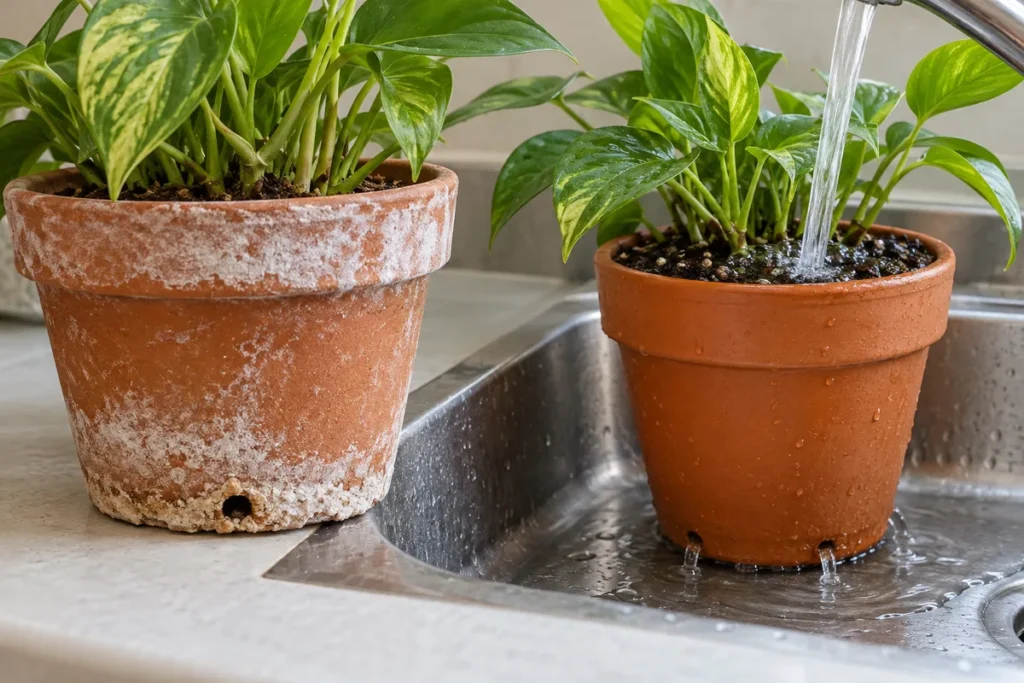
Fertiliser contains soluble salts. Too much makes it harder for plants to take up water and can burn root tips and leaf edges [2]. New Hampshire suggests flushing pots about every four months by running plenty of fresh water through until it drains freely [2]. Clemson notes that a white film on the soil or a crust on the rim may signal over-fertilising or over-watering [3].
If you have stopped feeding, flushed the pot and improved drainage but there is still no new growth after a month or two, or you see pests or soft stems, stop adding fertiliser. Review watering and the potting mix, or ask a horticulturist with a photo and the plant name.
Frequently asked questions
Do all houseplants need fertiliser?
The sources only say to feed during active growth; they do not say every plant must be fed [1][2]. New Hampshire notes that stunted growth or yellow and purple tints may mean a plant needs balanced feed, but fertiliser alone may not revive it [2]. Check light, watering and fresh mix too.
Is organic or synthetic fertiliser better for houseplants?
The university pages we used do not compare the two for indoor plants, so there is no firm answer. Go by the nutrient ratio and directions on the label [4].
Should I feed in a Hong Kong winter?
US sources mostly say to stop in the winter rest [1][3]. Hong Kong’s January mean temperature is about 16.5°C [7], and some plants may still grow. Use new leaves as the signal. This is our inference, not a stated source recommendation.
How do I dilute fertiliser?
Follow the label for houseplant feeds, and use half or quarter strength for general-purpose ones [1]. Clemson also describes about one-tenth strength at every watering [3].
Are brown leaf tips a sign of hunger?
Not necessarily. Clemson says salt build-up can cause slow growth, brown leaf tips, lower leaf drop and wilting [3]. Check the pot rim for white crust, then see brown leaf tips.
Sources
- Iowa State University Extension: “How often should I fertilize houseplants?” — Feed only when growing; general-purpose fertiliser at half or quarter strength; follow the label
- University of New Hampshire Extension: “Fertilizing Houseplants” — Winter slowdown, balanced formulas, soluble salt build-up and leaching pots
- Clemson University Home & Garden Information Center: “Indoor Plants” — Lower fertiliser needs indoors; frequency and dilution; foliage versus flowering formulas; salt build-up signs
- Clemson University Home & Garden Information Center: “Reading A Fertilizer Label” — The three numbers are percentages by weight of N, P (as P2O5) and K (as K2O); ratios; soilless mixes
- University of California IPM (UC IPM): “Common Nutrient Deficiency Symptoms” — Deficiency-like symptoms often come from unhealthy roots, salts, pH or waterlogging (landscape plants)
- University of Maryland Extension: “Nutrient Deficiency of Trees and Shrubs” — Deficiency symptoms are hard to tell from pests, disease and irrigation problems (woody landscape plants)
- Hong Kong Observatory: “Monthly Meteorological Normals for Hong Kong (1991-2020)” — 1991-2020 monthly mean temperature
Further reading
- Back to Plant Doctor
- Nutrient deficiency guide: N, P, K, Ca, Mg, Fe
- Fertiliser burn: what to do after over-feeding
- Yellow leaves: causes and how to tell them apart
- How to water
- Potting mix science
Sources checked: 31 October 2026. This is general guidance, not an on-site diagnosis. Always follow the product label.
