



Level: Intermediate
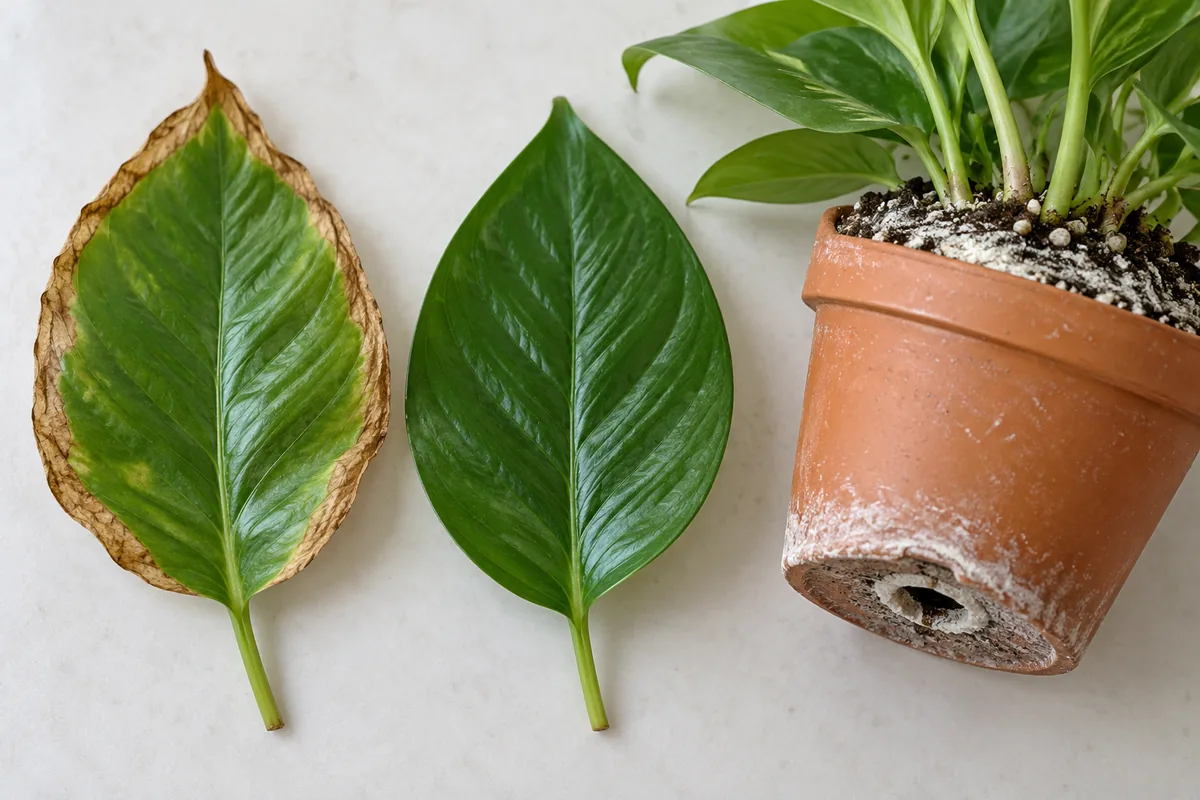
Fertiliser burn happens when fertiliser salts build up in the pot, making it harder for roots to take up water and sometimes damaging them, which often shows as brown leaf tips and edges, wilting and a white crust on the mix [1][5]. Stop feeding, scrape off the crust, flush slowly with plenty of clean water, then let the mix dry to a suitable point before watering again.
Key points
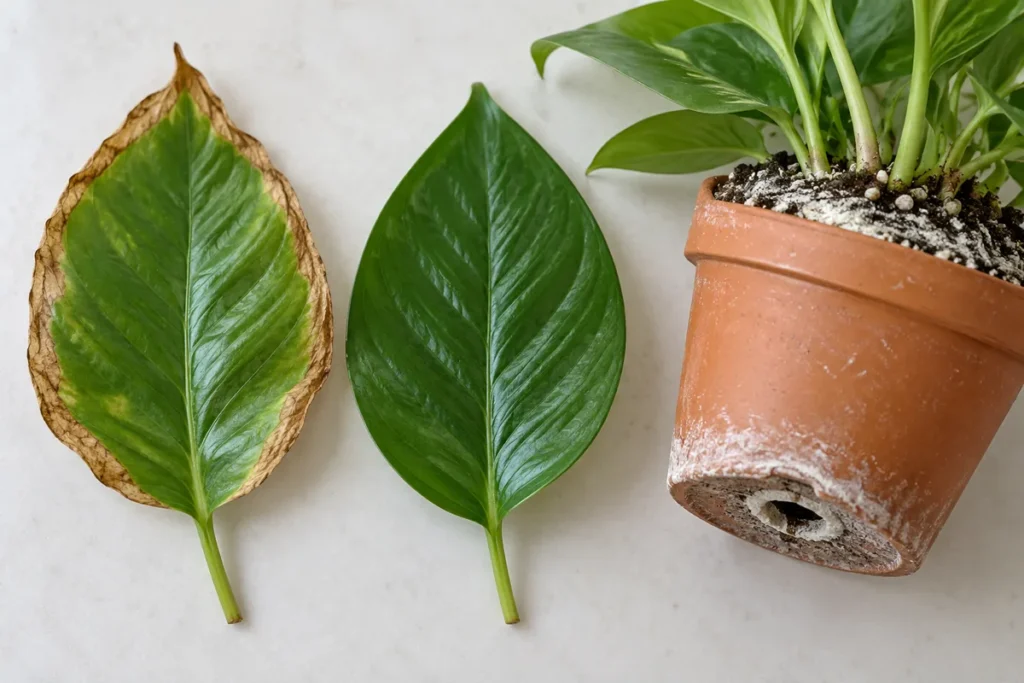
- Burn from fertiliser usually appears evenly across the plant, and a white or brown crust may show on the mix or pot rim [3][1].
- One heavy dose or repeated feeding can both build up salts [4], so stop feeding first.
- Flush with plenty of clean water; US sources suggest anything from twice to three times the pot volume [1][6], then let the mix dry before watering.
- Scorched leaves will not turn green again; watch for healthy new growth.
How can I tell fertiliser burn from drought or root rot?
The biggest clues are timing after feeding and an even pattern. WSU HortSense says fertiliser burn symptoms are typically spread evenly over the plant, container plants are especially susceptible, and a brownish or whitish crust may appear on the medium or pot rim [3]. Nebraska Extension lists reduced growth, brown leaf tips, dead root tips and wilting as possible signs, but notes they can have other causes [1].
Nebraska Extension explains that as soil salt rises, plants find it harder to take up water even when the mix is moist, and at very high levels water can be pulled out of root tips, which then die [1]. Colorado State PlantTalk likewise says excess soluble salts burn foliage, damage roots and cause water uptake problems [5].
On a phone, swipe sideways to see every column.
| Clue | Possible cause | Next step |
|---|---|---|
| Recent feeding or stronger mix, even scorching at leaf edges, white crust on mix or rim | Fertiliser burn or salt build-up [3][1] | Stop feeding, remove crust, flush |
| Mix dry through, pot light, scorched edges and drooping, no crust | Underwatering or dry air | See brown leaf tips; water thoroughly |
| Mix stays cold and wet, sour smell, yellow soft lower leaves | Waterlogging or root rot; Nebraska says high salts often go with root rot [1] | Unpot and inspect; see root rot |
| White crust but healthy leaves and normal growth | Possibly water minerals, harmless salts or mould | See white marks on potting mix |
| Scorched edges but no feeding at all recently | Water quality, dry air or something else; Colorado notes salts can also come from the mix or irrigation water [5] | See Hong Kong tap water |
What is the first thing to do once I suspect it?
Stop feeding. University of New Hampshire Extension says feeding too often or too heavily can harm plants, and that you should follow the label and never mix stronger than it recommends [2]. University of Maryland Extension adds that salts can build from a single excess dose or repeated feeding [4], so think back over the last few months instead of only the last dose.
- Stop all feeding for now.
- Look at the surface and rim. Nebraska Extension advises removing any crust before leaching, and says there is no need to take off more than about a quarter inch of mix [1].
- Check the saucer. Colorado State says salts cannot drain away when water stays in the saucer, because it is reabsorbed [5], so empty it right after flushing.
- If the fertiliser is slow-release granules, read the next section before relying on flushing.
- Watch for new growth. Scorched tissue does not turn green again, so wait for healthy new leaves before trimming brown edges (our suggestion; no source tests it).
How do I leach the pot properly?
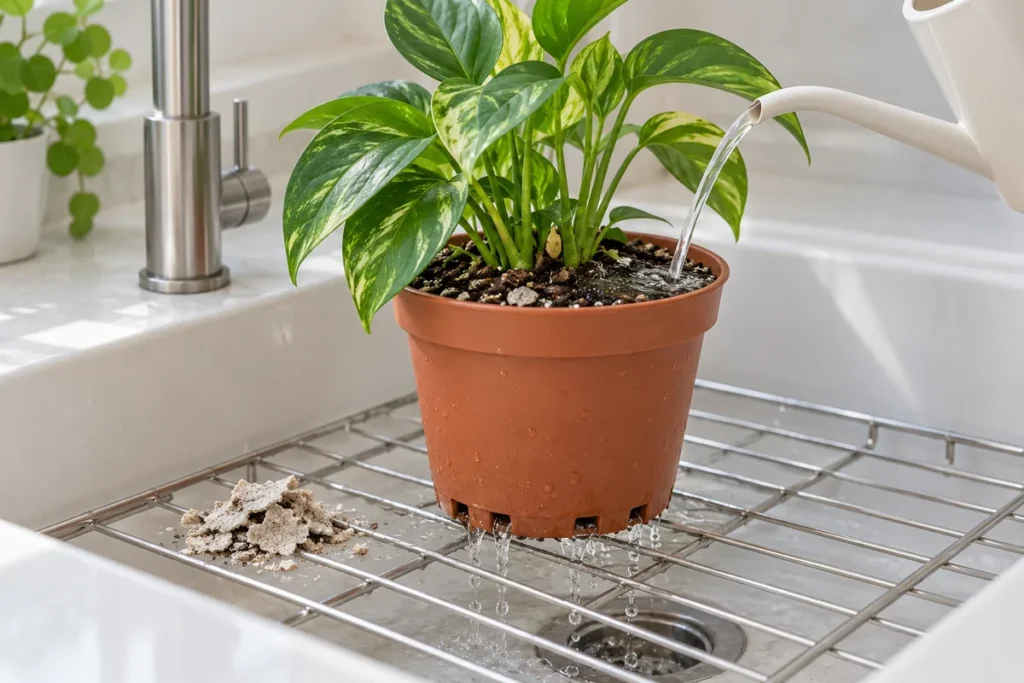
Leaching means running plenty of clean water slowly through the mix so salts drain out of the base. University of New Hampshire Extension suggests standing the pot in a sink or bath and flushing with copious fresh water until it drains freely, then letting it drain fully [2]. Nebraska Extension gives an amount of about twice the pot volume, for example 10 cups for a pot holding about 5, poured slowly so soil is not washed away [1]. Clemson-based advice on the Maryland Extension page says to leach at least three times with the pot volume of fresh water [6].
The amounts differ. Our reading (inference) is that both lean towards more rather than less, and Nebraska says using more than recommended will not hurt the plant but using less is not advised [1]. With a small pot, three volumes is easy to do.
- Stand the pot in a sink with the drainage holes clear.
- Scrape off surface crust first [1].
- Pour clean water slowly until it drains from the base and you have used the planned amount [1][6].
- Let it drain fully and empty the saucer [5].
- Wait until the mix has dried to a suitable point before watering again. Nebraska notes you will not need to water for quite a while afterwards [1].
WSU says leaching is only effective for quick-release or liquid fertilisers [3]. If slow-release granules are still in the pot they keep releasing, so flushing alone may not be enough; two sources suggest fresh mix as another option [1][6].
Flushing water is usually tap water in Hong Kong. See Hong Kong tap water for plants, and test a small pot first if you are concerned.
When should I replace the mix instead of just flushing?
Sources offer both routes. Nebraska Extension says repotting with new soil is one way to remove excess salt, with periodic leaching as another [1]. The Clemson-based Maryland page also lists leaching or repotting with fresh media [6].
- Flush only: milder build-up, firm roots, or a large or old plant where repotting is risky.
- Replace the mix: heavy salt build-up, slow-release granules that are hard to remove, or symptoms that keep worsening after flushing (inference).
- Old clay pots: Penn State says clay pulls water and salts out of the mix [7], so an old pot can carry salts on its walls and should be cleaned before reuse [7].
Roots may already be damaged, so handle them gently; see how to repot. Do not feed straight after repotting; see shock after repotting.
What should I avoid while a plant recovers?
- Do not add more fertiliser as a rescue. If symptoms look like a deficiency, confirm first; see the deficiency guide.
- Do not water more often because leaves are scorched. A mix that stays wet can turn burn into rot. Nebraska notes root rot is one of the most common problems with high salts [1].
- Do not feed during hot, dry spells. WSU says never feed plants stressed by heat or drought [3], and Maryland says damage is generally worse in hot dry weather [4].
- Do not mix stronger than the label. [2]
- Do not trust folk fixes. We found no university or botanic garden support for neutralising salts with other household chemicals.
How do I prevent it, and what matters in Hong Kong?
Prevention is small doses, label strength and feeding only in the growing season. University of New Hampshire Extension advises feeding only when plants are actively growing, since they only use nutrients when producing new leaves and roots [2]. Nebraska says feeding a dormant plant can cause a harmful build-up of salts [1].
Hong Kong Observatory 1991-2020 normals show a mean of about 16.5 degrees C in January and about 28.9 degrees C in July [8]. In summer heat, plants lose water quickly and salts concentrate in the leaves; Maryland says damage is worse in hot, dry weather and can show up in summer even though soil salts were high through winter and spring [4]. So watch accumulation across the season, not only each dose. We found no source with direct data on growth rates in air-conditioned Hong Kong rooms.
- Dilute to label strength, never stronger [2].
- Feed only when there are new leaves or buds [1][2].
- Flush on a schedule: New Hampshire says about every four months [2] and Nebraska says every 4 to 6 months [1]. Both are US advice with no Hong Kong equivalent, so the shorter end is the safer choice (inference).
- Empty saucers promptly [5].
- Fertiliser basics are in choosing a fertiliser.
When should I give up or ask for help?
If a month or two after flushing and refreshing the mix the plant still drops leaves with no new roots or shoots, or the stem base turns soft and dark, it is likely no longer just fertiliser burn and root rot may be involved; unpot and look at the roots, see root rot. For valuable or large plants, ask an experienced horticulturist to look in person, since an article cannot see the roots.
These sources are mostly US universities covering both landscape and indoor plants. We found no Hong Kong study on houseplant fertiliser burn, so adjust to how your own plant responds.
Frequently asked questions
Will scorched leaves turn green again?
Dead, scorched tissue usually does not recover, so wait for healthy new leaves before deciding whether to trim brown edges. The key is to stop salts building up further [1][4].
How often should I leach a pot?
University of New Hampshire Extension suggests about every four months [2], and Nebraska Extension every 4 to 6 months [1]. These are preventive schedules, not the number of times to flush during an actual burn.
What about slow-release fertiliser pellets?
WSU says leaching only works for quick-release or liquid fertilisers [3]. If pellets remain in the pot, flushing may not be enough, and fresh mix is worth considering [1][6].
Is a white crust on the mix always fertiliser salts?
No. Colorado State says salts can come from the mix, fertiliser or irrigation water [5], and white growth can also be mould or mineral deposit. See white marks on potting mix.
How long after feeding do symptoms appear?
There is no fixed time. Maryland Extension says symptoms may not appear until summer even though soil salts were high through winter and spring [4].
Sources
- Nebraska Extension (Lancaster County): “Success With Houseplants – Fertilization” — How salts form, symptoms, crust, leaching amount and frequency, removing surface crust
- University of New Hampshire Extension: “Fertilizing Houseplants” — Label strength, feeding only in active growth, leaching method and frequency
- Washington State University HortSense: “Common Cultural: Fertilizer burn” — Evenly distributed symptoms, container plants at risk, leaching works only for quick-release or liquid products, no feeding under heat or drought (landscape fact sheet with a container section)
- University of Maryland Extension: “Leaf tip browning from excessive fertilizer” — A single excess dose or repeated feeding can build up salts; salts can injure roots; damage is worse in hot, dry weather
- Colorado State University PlantTalk: “1338 – Whitish Crust on Potting Mixes” — White crust is soluble salt build-up; water standing in saucers stops salts draining away
- University of Maryland Extension (based on Clemson HGIC): “Diagnose Indoor Plant Problems” — Yellowing or wilting linked to high soluble salts; leach with at least three pot volumes of fresh water, or repot
- Penn State Extension: “Repotting Houseplants” — Clay pots pull water and salts from the mix; old pots with salt build-up need cleaning
- Hong Kong Observatory: “Monthly Meteorological Normals for Hong Kong (1991-2020)” — 1991-2020 monthly mean temperature
Further reading
- Back to Plant Doctor
- Choosing a fertiliser: NPK, timing and amount
- Brown crispy leaf tips and edges
- Hong Kong tap water for plants: chlorine, hardness and salts
- White Marks on Potting Mix: Look Before You Treat
- pH and EC: when to measure and how to read them
Sources checked: 31 October 2026. This is general guidance, not an on-site diagnosis. Always follow the product label.
