



Level: Advanced
PPFD is the photosynthetic light hitting a leaf at one moment (µmol·m⁻²·s⁻¹), and DLI is the day’s total (mol·m⁻²·d⁻¹): PPFD × hours of light × 3600 ÷ 1,000,000 [1]. Human eyes adjust to brightness, so they cannot judge whether a plant has enough [1].
Key points
- DLI = PPFD × hours × 3600 ÷ 1,000,000. A 200 PPFD lamp running 16 hours gives about 11.5 mol·m⁻²·d⁻¹ [1].
- For daylight, foot-candles ÷ 5.01 gives PPFD, so 150 foot-candles is about 30 PPFD (our conversion) [1][2].
- Universities disagree on where low, medium and high light begin, so combine a measurement with how the plant looks [2][3][4].
- The Observatory’s 1991 to 2020 King’s Park average is 13.23 MJ/m² per day, roughly 27 mol·m⁻²·d⁻¹ outdoors (our conversion) [5][6].
Why use PPFD and DLI instead of eyesight or lux?
Virginia Cooperative Extension says our eyes adjust to brightness, which makes it nearly impossible to judge how much light a plant gets [1]. It advises against candela, lumen, foot-candle, lux, watt and joule for plant light, because they track human vision or energy output [1].
Two plant-based units fit better. PPFD is the photon flow at a moment (µmol·m⁻²·s⁻¹) and DLI is the daily total (mol·m⁻²·d⁻¹), both over the 400 to 700 nm band [1]. Source setting: the guide was written for greenhouses and nurseries, though it says home plant owners can use it too [1].
Still, the Penn State author notes that foot-candles are the common unit at home, and that even after metering you should read the plant [4]. Numbers support observation; they do not replace it.
How do you calculate PPFD and DLI?
DLI (mol·m⁻²·d⁻¹) = PPFD (µmol·m⁻²·s⁻¹) × hours of light × 3600 ÷ 1,000,000. The 3,600 turns hours into seconds [1].
- Virginia’s example: LEDs giving 200 PPFD for 16 hours a day. That is 200 × 16 × 3600 ÷ 1,000,000, about 11.5 (our arithmetic) [1].
- Assume a window spot averages 50 PPFD for 12 hours: 50 × 12 × 3600 ÷ 1,000,000 ≈ 2.16 mol·m⁻²·d⁻¹ (hypothetical example).
- The same 50 PPFD for only 6 hours halves it to about 1.08 (hypothetical example).
Advanced. Virginia lists reference DLIs for crops, such as impatiens 8 to 12, begonia 12 to 19 and lettuce 12 to 17, but these are production crops, not houseplants [1]. We found no university target DLI for common foliage houseplants, so do not treat these as a pass mark for your pot.
How bright is low, medium and high light indoors?
Sources disagree. Penn State says extension offices, horticulturists and even engineers differ on what counts as low, medium or high [4]. The table converts each source’s foot-candles to PPFD using the daylight factor of 5.01, which applies to sunlight only because lamps have different factors [1].
On a phone, swipe sideways to see every column.
| Source | Low | Medium | High |
|---|---|---|---|
| University of Illinois [2] | about 75 (about 15) | about 150 (about 30) | about 300 (about 60); direct 1500 (about 299) |
| University of Maryland [3] | 25 to 100 (about 5 to 20) | 100 to 500 (about 20 to 100) | 500 to 1000 (about 100 to 200); direct over 1000 |
The same label can differ several times over: Illinois’s high light at 300 foot-candles would be only medium by Maryland’s scheme [2][3]. Pick one source, use its bands consistently, and adjust with plant response.
On position, Illinois puts a north window front at medium light, while a south window needs 15 to 20 feet distance to be low light [2]. Maryland adds that light drops quickly with distance and that curtains, screens, weather, season, shading and window cleanliness all matter [3].
What do the plant’s own signs say about light?
Maryland lists signs of too little light: stretched growth, leaning toward the window, fading leaf colour, less flowering and poor growth [3]. Too much light also harms; leaves turn pale, brown and die [3]. The Penn State author saw a Chinese evergreen bleach out and pulled it back from the window [4].
On a phone, swipe sideways to see every column.
| Clue | Possible cause | Next step |
|---|---|---|
| Long stems, wide leaf spacing, leaning to the window | Light may be too low [3] | Measure PPFD; see leggy plants |
| Paler leaves, new leaves shrinking | Low light or other causes | See smaller new leaves and measure light |
| Pale or brown patches after moving nearer glass | Light may be too strong [3] | Step back or add a sheer curtain; see leaf sunburn |
| Growth stalls, no other signs | Low light, dormancy or something else | See no new growth |
How should you measure window light?
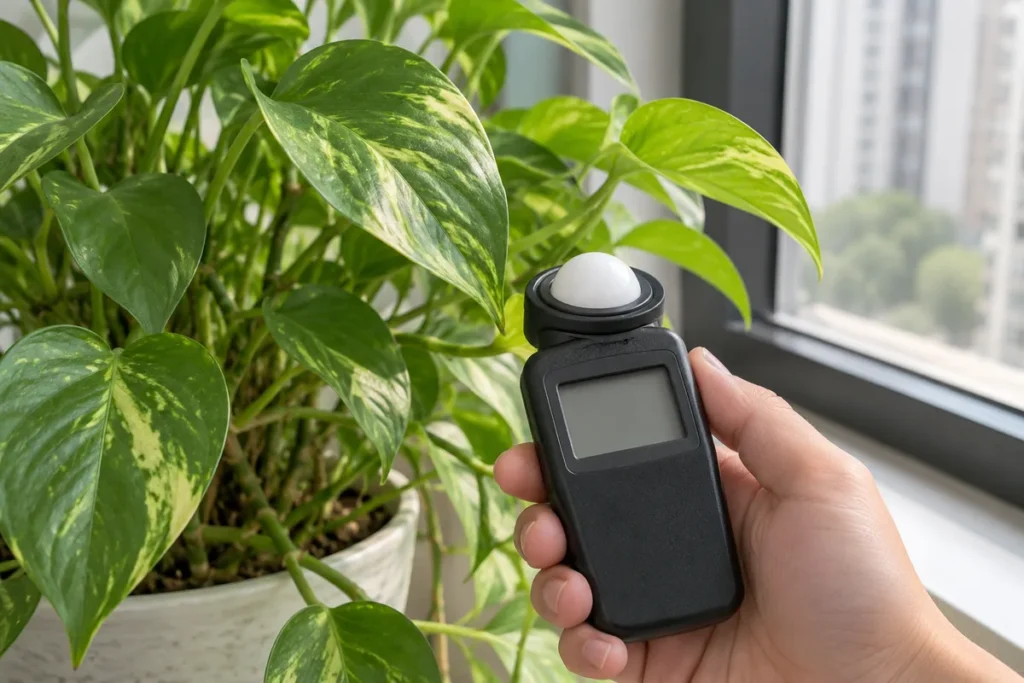
Virginia says a quantum (PAR) sensor reads PPFD directly, and phone apps that use the phone’s light sensor can be the cheapest option. It suggests a roughly twenty-dollar app may be useful to a homeowner, so check its accuracy yourself [1]. The Penn State author bought a meter that shows both foot-candles and lux [4].
- Hold the sensor at leaf height, facing the light, without shading it with your body (our suggestion).
- At the same spot, record every one to two hours from morning to evening, sunny or not (our suggestion).
- If the meter shows foot-candles, divide by 5.01 to estimate PPFD, for daylight only [1].
- Average the hourly PPFD, multiply by the hours of light, then apply the DLI formula (our method) [1].
- Repeat on several days, since cloudy and clear days differ widely. Virginia notes that measuring your own location always gives the best information [1].
A single midday reading probably overstates the day’s DLI, because mornings and evenings are much dimmer (our inference).
How much light does Hong Kong get outdoors, and how far is indoors from it?
The Observatory’s 1991 to 2020 normals give King’s Park mean daily global solar radiation of about 13.23 MJ/m² for the year, about 10.24 in February and about 17.22 in July [6]. Cloud amount is 72 to 77% from February to June, so spring is often overcast [6].
The University of New Hampshire page converts 1 MJ/m² to about 2.05 mol of photosynthetic photons [5]. So 13.23 × 2.05 ≈ 27.1 mol·m⁻²·d⁻¹ for the year, 10.24 × 2.05 ≈ 21.0 in February and 17.22 × 2.05 ≈ 35.3 in July (our conversion). That is open-air, horizontal-surface light, not what your window receives.
For comparison, Virginia reports outdoor DLI falling from 40 to 45 in July to 15 to 20 in December, and warns that indoor DLI could be far lower [1]. Hong Kong’s seasonal swing is smaller, but indoor values still have to be measured.
Suppose a “high light” spot (Illinois, 300 foot-candles, about 60 PPFD) gets 10 hours: 60 × 10 × 3600 ÷ 1,000,000 ≈ 2.2 mol·m⁻²·d⁻¹ (conversion plus assumption). Against about 27 outdoors that is an order of magnitude lower. Tall buildings and tinted glass can lower it further; see assessing indoor light in Hong Kong.
What can you do when light is too low?
- Move the plant closer. Light falls quickly with distance, so small moves matter [3].
- Use light-coloured walls or reflective surfaces to raise ambient light [3].
- Move gradually. Plants moved from bright to dim conditions may drop or yellow leaves [3].
- If still short, add a grow light. Illinois says low-light plants can have 14 to 16 hours of light but no more than 16 [2], and Maryland also caps total light at 16 hours a day [3].
- Use the DLI formula to set the hours. At 100 PPFD for 12 hours: 100 × 12 × 3600 ÷ 1,000,000 ≈ 4.3 mol·m⁻²·d⁻¹ (our arithmetic, consistent with Virginia’s Table 4) [1].
For lamp choice, see the grow light guide for windowless offices. Some plants respond to day length: Maryland says poinsettia, kalanchoe and Christmas cactus flower only when days are 11 hours or less [3].
What should you avoid?
- Do not judge by eye or phone camera brightness [1].
- Do not compare foot-candles, lux and PPFD directly; units and light sources differ [1].
- Do not treat crop DLI targets as houseplant targets; we found no university source for those [1].
- Do not move a plant from deep shade into harsh direct sun, since Maryland says too much direct light turns leaves brown [3].
- Do not leave lights on around the clock; both Illinois and Maryland cap it at 16 hours [2][3].
- Do not rely on one reading. The Penn State author pairs the meter with watching the plant [4].
How do you prevent problems, and when should you change plant or ask for help?
Prevention: measure before placing a new plant, record date, weather and position, and re-measure each season or after moving. The Penn State author recorded as little as 25 foot-candles at a snake plant’s spot in mid-morning [4].
For dim spots, start with plants Illinois lists as minimum low light, such as snake plant, peace lily and parlour palm, but that is a minimum, not a promise [2]. Your own measurement decides.
When to ask for help: if light is adequate yet symptoms continue, look at other causes such as pH and EC, or ask a nursery or plant doctor. When to give up: if a spot stays below the plant’s minimum and you cannot add light, a more shade-tolerant plant is usually more realistic than persisting (our inference).
Frequently asked questions
Can I use a light-meter app on my phone?
Virginia says phone apps are usually the most cost-effective option and may be useful for homeowners [1]. Phone sensors vary and we saw no independent test, so compare it with a dedicated meter once or twice.
How do I convert lux to foot-candles?
The Penn State author’s meter shows both foot-candles and lux [4]. The safest route is to switch the meter’s unit rather than assume a factor.
Is a higher PPFD always better?
No. Virginia says too much light wastes energy and can harm sensitive plants [1], and Maryland says excess light is as harmful as too little [3].
Is the foot-candle factor the same for LED grow lights?
No. Virginia lists 5.01 for sunlight, 7.62 for high-pressure sodium and 6.60 for metal halide [1]. That page does not list an LED factor, so measure LED PPFD with a quantum sensor.
Why can’t I use the Observatory figure as my window light?
The King’s Park number is open-air solar radiation [6]. Glass, curtains, nearby buildings and distance cut indoor light a lot, and Virginia warns that residential indoor DLI can be far lower [1].
Sources
- Virginia Cooperative Extension (Virginia Tech): “Calculating and Using Daily Light Integral (DLI): An Introductory Guide” — PPFD and DLI definitions and formula, foot-candle conversion factor, measuring tools, example crop DLI values (greenhouse and nursery setting)
- University of Illinois Extension: “Houseplants: Lighting” — Low, medium and high indoor light in foot-candles, window positions, light duration advice
- University of Maryland Extension: “Lighting for Indoor Plants” — A different foot-candle scheme, symptoms of too little and too much light, upper limit for daily light hours
- Penn State Extension: “Low Light Houseplants” — Sources disagree on low, medium and high light; using a light meter at home; checking against plant response
- University of New Hampshire (PnET model page): “Converting Units of Solar Radiation” — Factor for converting daily solar radiation in MJ per square metre to photon units (a university ecosystem-model page, not an extension publication)
- Hong Kong Observatory: “Monthly Meteorological Normals for Hong Kong (1991-2020)” — Monthly mean daily global solar radiation at King’s Park and cloud amount (Table 6)
Further reading
- Back to Plant Doctor
- Leggy plants: why they stretch
- Leaf sunburn after moving to brighter light
- New leaves getting smaller
- Assessing indoor light in Hong Kong
- Grow lights for windowless offices
Sources checked: 31 October 2026. This is general guidance, not an on-site diagnosis. Always follow the product label.
