



Level: Beginner
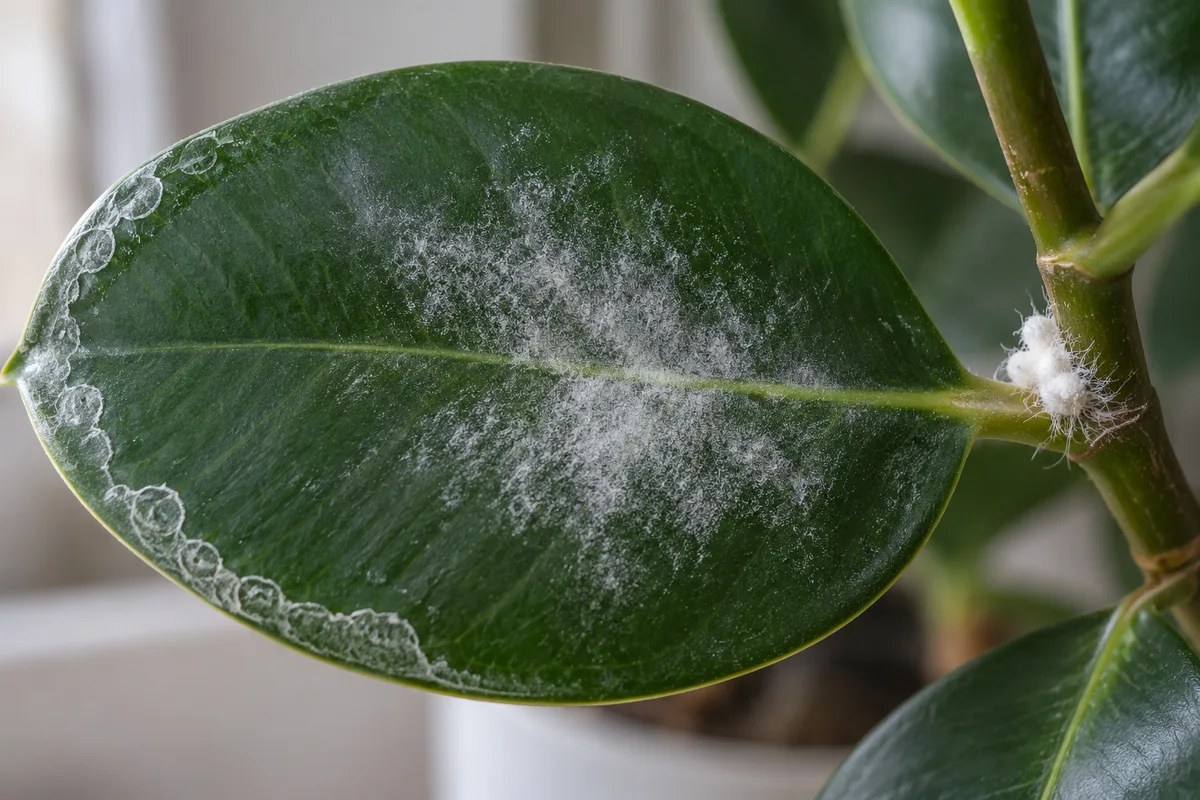
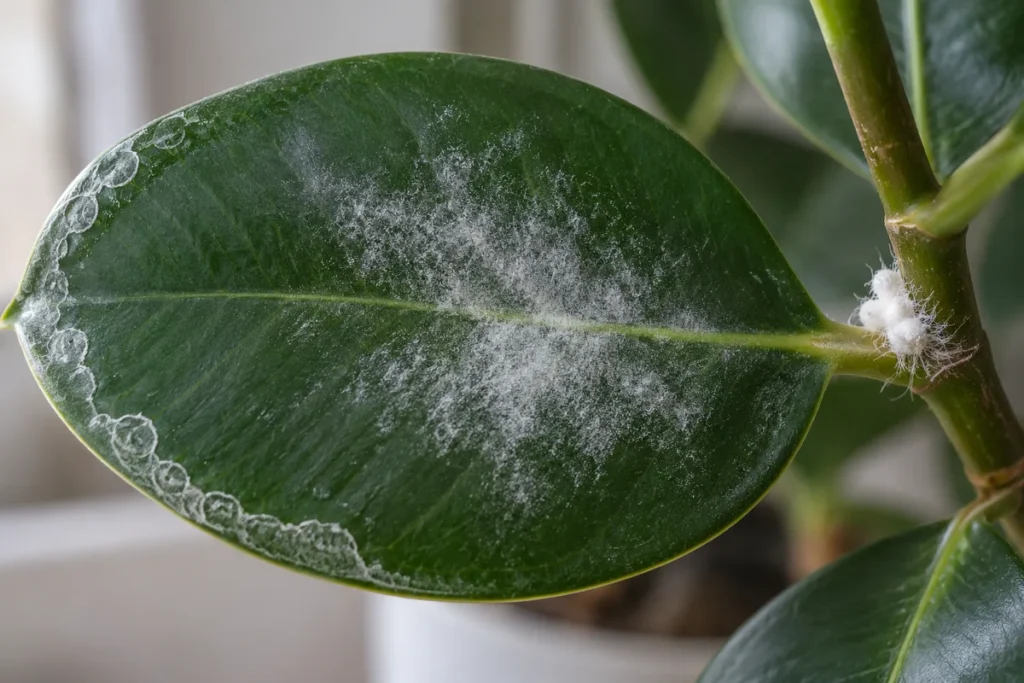
White spots on leaves are most often dried water or salt marks, powdery mildew, or mealybugs and scale insects [1][4][6]. Check whether the spots are crusty, powdery or cottony, and whether they spread over a week, and you can usually narrow it down.
Key points
- Crusty marks where water dried, with no spread, suggest mineral or salt residue; loose powder that spreads suggests powdery mildew [1][5].
- White cotton in stem joints suggests mealybugs; raised round bumps suggest scale [6][7].
- Hong Kong tap water is on the soft side, averaging 36 mg/L total hardness, so mineral marks are less likely from the tap alone, but other water and fertiliser residues remain possible [2].
- Rinsing does not cure powdery mildew; better airflow, lower humidity and removing badly affected leaves are the usual first steps [4][5].
How do I tell the three kinds of white spot apart?
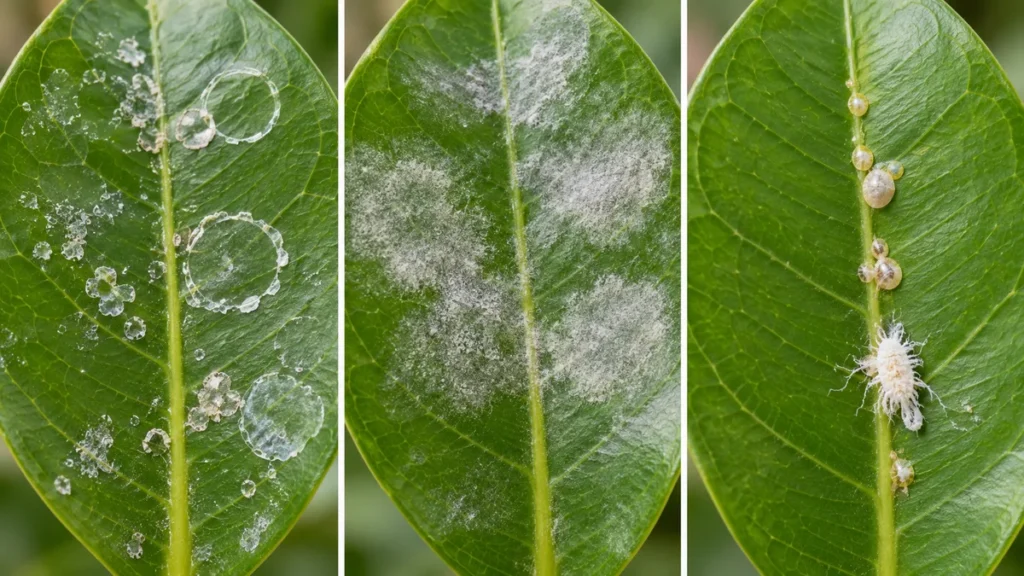
Look at texture and position, not only colour. Oregon State University Extension notes that transpiring plants can leave white salt residues on leaves [1]. UC IPM describes powdery mildew as a white powdery growth on leaf surfaces [5]. Mealybugs and scale are living insects that cluster or stick to stems and leaves [6][7].
- Use a hand lens or zoomed-in phone photo. Is it loose powder or a hard crust? Can you see tiny legs or wax threads?
- Check position: is it on edges or spots where droplets dried, across the whole leaf surface, or in stem joints?
- Photograph it, then photograph the same spot a week later to see whether it has grown or multiplied.
- Gently wipe one edge leaf with a damp cloth and see what comes off. This wipe test is my own supporting check, not a standard diagnostic listed by the universities.
If you see cotton or bumps, read the pages on mealybugs or scale insects. If the white is on the potting mix rather than the leaves, see white marks on potting mix.
Quick guide: spots, powder or cotton?
This table gives clues, not a diagnosis. One plant can have more than one problem, such as a water mark plus mealybugs.
On a phone, swipe sideways to see every column.
| Clue | Likely cause | Next step |
|---|---|---|
| Crusty marks with a ring edge, where water droplets dried | Mineral or salt residue; Oregon State says transpiration can leave white salts [1] | Wipe with a damp cloth; note your water and fertiliser; see the Hong Kong water section below |
| Loose powder, easy to disturb, spreading over a week | Powdery mildew; UC IPM describes a white powdery growth on leaf surfaces [5] | Remove badly affected leaves, space plants out and improve airflow [4] |
| White cottony tufts in stem joints or leaf axils | Mealybugs; wax filaments give them a white cottony look [8] | Remove individually; see mealybugs |
| Round or oval raised dots that scrape off with a nail | Scale insects; adults look like circular or oval discolorations or bumps [7] | See scale insects |
| Appeared after spraying a product or leaf shine | Pesticide residue is one of the other possible causes Oregon State lists [1] | Check the label, test-wipe one leaf, and follow the label next time |
Could Hong Kong tap water cause mineral spots?
Hong Kong tap water is low in hardness, so mineral marks are not the obvious first guess. The Water Supplies Department reports total hardness (as calcium carbonate) of below 5 to 62 mg/L, averaging 36 mg/L, for April 2024 to March 2025 [2]. Oregon State classes 0 to 60 mg/L as soft and 61 to 120 as moderately hard [1].
Read that carefully. The department’s figures describe supplied water, which may differ by the time it reaches your tap, and they do not include home filters or softeners. The university pages I read do not say whether soft water can still leave leaf marks. If spots keep appearing where droplets dry, and you use well water, filtered water or water with fertiliser, residues remain a reasonable suspect. That is my inference.
To test it, avoid wetting leaves at your next watering and wipe any splashes before they dry. For more on water quality, see Hong Kong tap water and plants.
How can I confirm powdery mildew?
Loose white powder that spreads, sometimes with distorted new growth, points to powdery mildew. UC IPM says new growth may be dwarfed and distorted [5]. Iowa State University Extension says it is common on indoor plants such as African violets, begonias and poinsettias, typically in winter or early spring [4].
Humidity in Hong Kong is high all year. Observatory 1991-2020 normals put mean relative humidity at about 70% in December and 82-83% from March to May [3]. Iowa State says high humidity and poor air circulation favour powdery mildew [4], so do not wait for winter; judge by the humidity and airflow where the plant sits. Combining the two sources is my own inference; neither says it for Hong Kong.
UC IPM also says powdery mildew can germinate and infect without water on the leaf, and that long periods of surface water inhibit the spores of most species [5]. Spraying or rinsing leaves is therefore not a reliable cure.
What should I do first?
- Isolate the plant so leaves do not touch others.
- Mineral or salt marks: wipe with a damp cloth, then try to keep water off the leaves.
- Powdery mildew: if only a few leaves are affected, pinch them off and discard them [4]; space plants out and run a small fan to improve airflow and lower humidity [4].
- Mealybugs or scale: remove individually with a damp cloth, thumbnail or a cotton swab and alcohol; see the specific guides for details.
- Photograph the same spot a week later and compare.
Before using a fungicide or insecticide, confirm the problem. The university pages I read give no home-use concentrations I can pass on, so follow the product label and only use a product that lists both your plant and the pest or disease. For product choices, see pest-control products.
What should I avoid doing?
- Do not treat mildew as a water mark. Wiping without fixing humidity and airflow lets it return [4].
- Do not rely on spraying to wash mildew off. UC IPM says long wetting inhibits the spores, but that does not make spraying a fix, and added wetness may favour other diseases (my inference) [5].
- Do not mix home recipes before you know the cause. Baking soda, milk or egg mixes were not backed by the university pages I opened, so the evidence is weak and I do not recommend them.
- Do not ignore cotton tufts. Mealybugs live in colonies in sheltered spots between stems and leaves [6]; they get harder to control later.
- Do not keep an affected plant beside others.
If you have pets or children at home, read the label safety directions before treating, and ask a vet or doctor if unsure.
How can I prevent white spots coming back?
- Leave space between plants and let a gentle breeze move through [4].
- Water the potting mix rather than the foliage, and wipe splashes before they dry.
- Glance under leaves and at stem joints each time you water; one minute is enough.
- Check new plants on arrival and keep them apart for a week or two (the length is my own suggestion).
- Look for new white marks after long humid spells such as the spring wet season; spring is one of Hong Kong’s most humid periods [3].
For a full routine, see integrated pest management for houseplants.
When should I get help or give up on a plant?
Ask for help if the white area keeps growing for two to three weeks, new leaves distort, or you cannot tell what it is. Take close photos of the upper and lower leaf and the stem joints and send them to a horticulturist or plant clinic.
- Several plants show the same problem, which may point to the environment; check them all together.
- New growth stays small or distorted even after you improve airflow and remove affected leaves.
- Insects are clearly present and you have followed the label for three to four weeks without improvement.
If most leaves are coated or full of insects and the plant is dropping leaves, discarding it may protect your other plants. Before deciding, cut off the worst parts and see how new growth looks.
Frequently asked questions
If the white wipes off, is it always powdery mildew?
No. The university pages I read do not treat wiping as a diagnostic test. Loose powder that spreads and distorts new growth suggests mildew [5], while cotton or raised bumps may be insects [6][7]. Use a hand lens and compare photos a week apart.
Can powdery mildew spread to my other plants?
UC IPM says wind carries powdery mildew spores to new hosts [5], so isolate the plant and remove badly affected leaves [4]. Each species of powdery mildew tends to infect a limited range of plants, so not every neighbour is equally at risk.
Is powdery mildew especially common in Hong Kong because it is humid?
The sources say high humidity and poor air circulation favour it [4], and Hong Kong’s mean relative humidity runs about 70-83% [3]. None compares Hong Kong with other places, so say conditions are favourable, not that it is inevitable.
Will filtered water prevent white spots?
Hong Kong tap water is already low in hardness [2], and filters may change it again. Whether spots relate to water depends on where and how often they appear; changing water alone will not settle it.
Is white crust on the potting mix the same problem?
Not necessarily. Leaf spots and soil-surface crust can have different causes. For the soil surface, read white marks on potting mix.
Sources
- Oregon State University Extension: “White spots from watering with hard water?” — Hard water as a possible cause of white spots, water hardness classes, and other causes (fungus, scale, pesticide residue, salts left by transpiration)
- Water Supplies Department, Hong Kong: “Drinking Water Quality for the Period of Apr 2024 – Mar 2025” — Minimum, maximum and average total hardness (as calcium carbonate) of Hong Kong drinking water
- Hong Kong Observatory: “Monthly Meteorological Normals for Hong Kong (1991-2020)” — 1991-2020 monthly mean relative humidity
- Iowa State University Extension: “What are the white blotches on my African violet leaves?” — Powdery mildew on houseplants, typical season, humidity and airflow, pinching off leaves and lowering humidity
- University of California IPM (UC IPM): “Powdery Mildew on Ornamentals” — Appearance of powdery mildew; spores can germinate without surface water, while long wetting inhibits them (landscape plant source)
- University of California IPM (UC IPM): “Mealybugs” — Mealybugs are wax-covered insects that live in colonies in sheltered spots
- University of California IPM (UC IPM): “Scales” — Scales lack an obvious head or legs and look like circular or oval discolorations or bumps
- Iowa State University Extension: “Diagnosing Houseplant Problems Caused by Insect Pests” — Mealybug wax filaments give the white cottony look
Further reading
- Back to Plant Doctor
- White marks on potting mix: look before you act
- Powdery mildew
- Mealybugs
- Scale insects
Sources checked: 31 October 2026. This is general guidance, not an on-site diagnosis. Always follow the product label.
