



Level: Beginner
Light trimming of dead, yellow or stretched growth can be done in late winter [1]. Save hard cutbacks for the start of the growing season [2]. Cut just above a node or dormant bud with clean, sharp shears, and leave the wound untreated in most cases [2].
Key points
- Separate light trimming from hard pruning: tidy up early [1], cut back hard only when growth is starting [2].
- Cut directly above a node or dormant bud, using scissor-type bypass shears rather than anvil cutters [2].
- The sources give no single rule for how much to remove, so cut less the first time and watch the response.
- Sanitise your blade between plants so disease does not travel on the tool [1].
When is the best time to prune?
Light and hard pruning have different windows. Clemson Extension suggests trimming dead, yellow and leggy growth in late winter, which can encourage fuller growth through the season [1]. The Missouri Botanical Garden says major cutbacks of main stems are best at the start of the growing season, because dormant buds may respond poorly at other times [2].
Both sources describe US conditions and give no Hong Kong months. Hong Kong Observatory normals for 1991–2020 show mean temperatures of 16.5°C in January, 17.1°C in February, 19.5°C in March and 23.0°C in April [5]. Our own reading: Hong Kong has no hard winter, but warming from March to April makes that the sensible window for hard cuts, with January and February kept for light tidying.
Trimming balcony plants before a typhoon is wind protection, not shaping. See typhoon preparation.
What needs cutting? A quick decision table
On a phone, swipe sideways to see every column.
| Clue | Likely cause | Next step |
|---|---|---|
| Dry brown leaf tips | Possibly dry air or another environmental issue; trimming only tidies | Snip the dry part with sharp scissors [3]; find the cause in brown leaf tips |
| Dead stems, yellow leaves, spent flowers | Ageing or stress; leaving them looks untidy | Remove with sanitised snips [1]; tidiness helps reduce pest and disease problems [3] |
| Long stretched stems, wide gaps between leaves | Often low light (leggy growth) | Light trimming can encourage fuller growth [1]; also fix the light, see leggy plants |
| Plant reaches the ceiling or is too big | Outgrown its space | Cut back hard at the start of the growing season [2] |
| Soft, dark stem base | Possibly stem rot; cutting the surface may not be enough | Read stem rot first; do not treat it as routine shaping |
What is the difference between pinching, trimming and cutting back?
The University of Maryland Extension defines pinching as removing an inch or less of new growth just above a node to encourage side shoots, and pruning as removing a whole branch or section [3]. The Missouri Botanical Garden divides indoor pruning into pinching and cutting back, with cutting back usually aimed at hardened, woody stems [2].
- Pinching: remove only the tip, suited to soft-stemmed plants you want bushier [3].
- Light trimming: remove dead, yellow or leggy growth [1].
- Hard cutback: shorten main stems to restore a manageable size, at the start of the growing season [2].
For flowering plants, check where the flower buds sit before cutting. That is our own caution; the sources do not cover it plant by plant.
How do I make the cut?
- Use sharp, clean shears. The Missouri Botanical Garden recommends scissor-type bypass blades, because anvil cutters crush stems and let decay organisms in [2].
- Sanitise between plants. Clemson advises sanitising snips between each plant [1]; Illinois Extension advises dipping tools in denatured alcohol between cuts when taking cuttings (a propagation setting, applied here by analogy) [4].
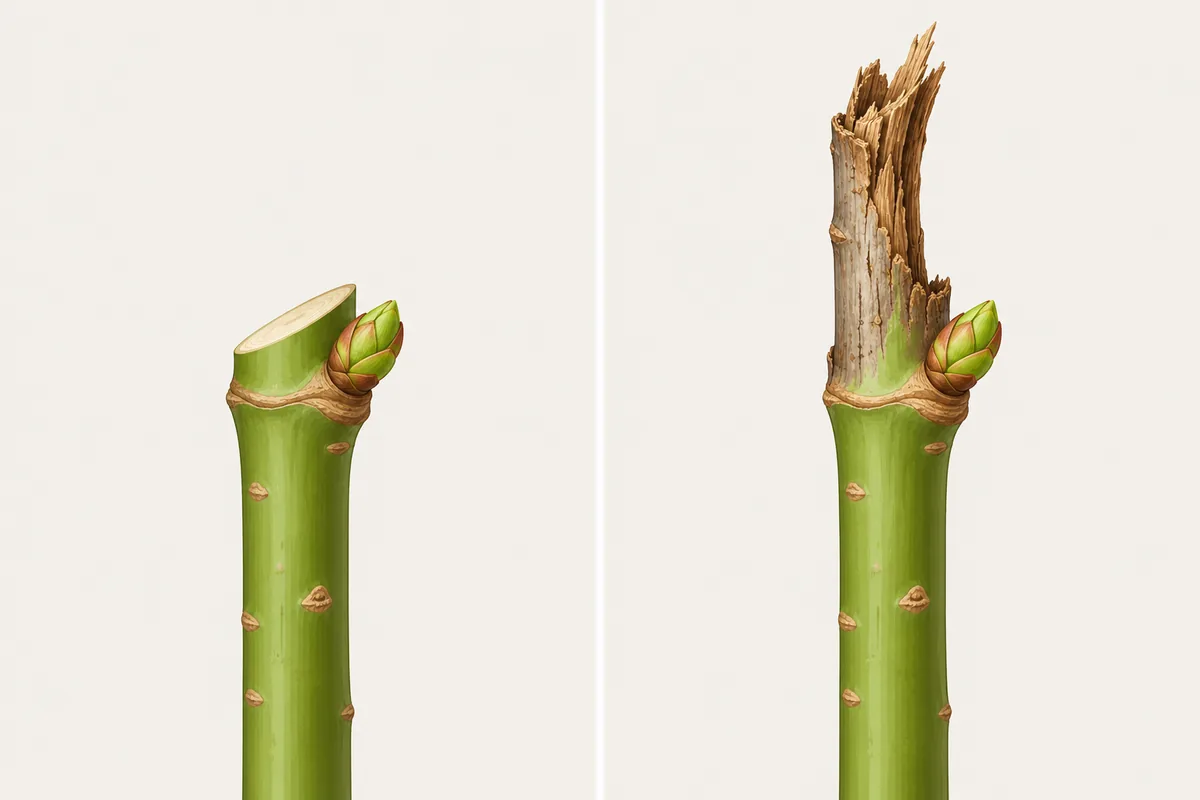
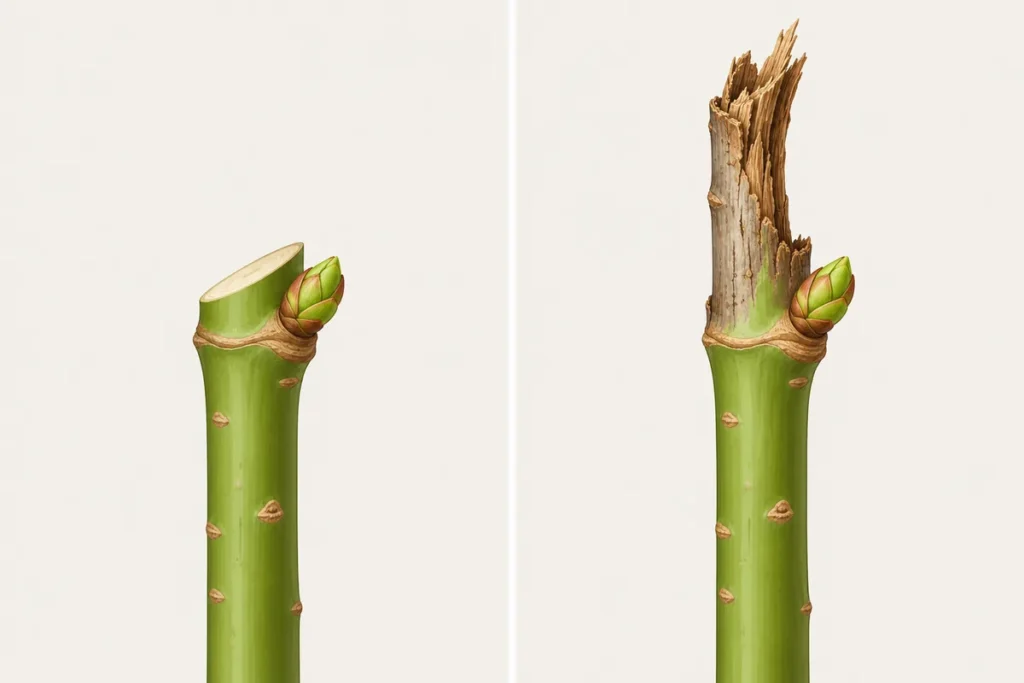
- Cut directly above a dormant bud or node. This heals quickly and avoids an unsightly stub [2].
- Cut straight across, or slant from above the bud down to the opposite side of the stem. Never slant down towards the bud, which may damage it [2].
- Leave wounds untreated, except on plants with milky sap, where an ice cube held on the cut for about a minute reduces fluid loss [2].
We found no university or botanic-garden support for sealing paste on indoor plant cuts. If sap touches skin or eyes and you feel unwell, rinse and speak to a doctor.
How much can I remove at once?
The Missouri Botanical Garden warns that timid cutbacks are quickly replaced by new growth; to rescue a plant that has hit the ceiling, it suggests cutting back several feet [2]. It names rubber plant, dracaena, bougainvillea, dieffenbachia, oleander and hibiscus as plants that may need this, but says palms generally do not suit drastic pruning [2].
The sources we read give no percentage limit. The popular “never more than a third” rule is not backed by any university or botanic-garden page we found, so treat it as folk caution. For a first cut, remove a little and watch how the plant responds.
What should I avoid?
- Anvil-type cutters that crush the stem, which invites disease [2].
- Slanting the cut downward towards the bud, which may injure it [2].
- Hard pruning outside the growing season, when buds may respond poorly [2].
- Hard pruning palms, which the source says generally do not suit it [2].
- Moving from one plant to the next without sanitising the blade [1].
- Cutting wildly when you spot pests or disease. Identify the cause first; see integrated pest management.
For new or quarantined plants, tool hygiene matters even more. See quarantine and tool hygiene.
What happens after the cut, and when should I call in help?
Tip cuttings from what you remove can be rooted, which the Missouri Botanical Garden suggests [2]; see propagation. Removing spent flowers, dying leaves and dead branches regularly keeps plants tidy and helps reduce pest and disease problems [3].
If there is no regrowth for a long time, check light, watering and season first; see no new growth. The sources give no timeline for sprouting, so do not judge success by a day count.
For large trees on a high-rise balcony, branches you can only reach on a ladder, or stems that are rotting extensively, ask a gardener or arborist. That is a safety judgement of ours, not a statement from the sources.
Frequently asked questions
Why has nothing sprouted since I cut?
The Missouri Botanical Garden says pruning stimulates dormant buds nearest the cut, but a hard cut outside the growing season may leave buds slow to respond [2]. It gives no sprouting timeline, so check light and season first.
Can I prune in winter?
Light tidying, yes. Clemson Extension suggests removing dead, yellow and leggy growth in late winter [1]. Keep hard cutbacks for the start of the growing season [2]; in Hong Kong, temperatures rise from March [5].
Does removing yellow leaves treat the problem?
It only tidies. Clemson says removing yellow or dead growth helps limit pests and keeps the plant cleaner [1], and Maryland Extension says tidiness reduces pest and disease problems [3]. The cause still needs finding; see yellow leaves.
Can I replant what I cut off?
You can try. The Missouri Botanical Garden suggests rooting tip cuttings from removed parts [2]. Success varies by plant; see propagation.
Sources
- Clemson Cooperative Extension (HGIC): “End-of-Winter Houseplant Care: How to Prepare Indoor Plants for Spring” — Light late-winter pruning of dead, yellow and leggy growth; sanitised snips between plants (US south-east setting)
- Missouri Botanical Garden: “How do I prune an overgrown indoor plant?” — Timing of hard pruning, type of shears, where and at what angle to cut, wound care, which plants suit hard pruning
- University of Maryland Extension: “Grooming Indoor Plants” — Definitions of pinching and pruning, trimming dry leaf tips and spent flowers, tidiness reducing pests and disease
- University of Illinois Extension: “Propagation (Houseplants)” — Dipping cutting tools in denatured alcohol (written for cuttings; applied here to pruning by analogy)
- Hong Kong Observatory: “Monthly Meteorological Normals for Hong Kong (1991-2020)” — Hong Kong monthly mean temperatures (1991-2020), used to place the growing season
Further reading
- Back to Plant Doctor
- Leggy plants: why they stretch and how to fix them
- Propagation: cuttings, division and air layering
- Quarantine and tool hygiene
- No new growth: dormancy or a problem?
Sources checked: 31 October 2026. This is general guidance, not an on-site diagnosis. Always follow the product label.
