



Level: Intermediate
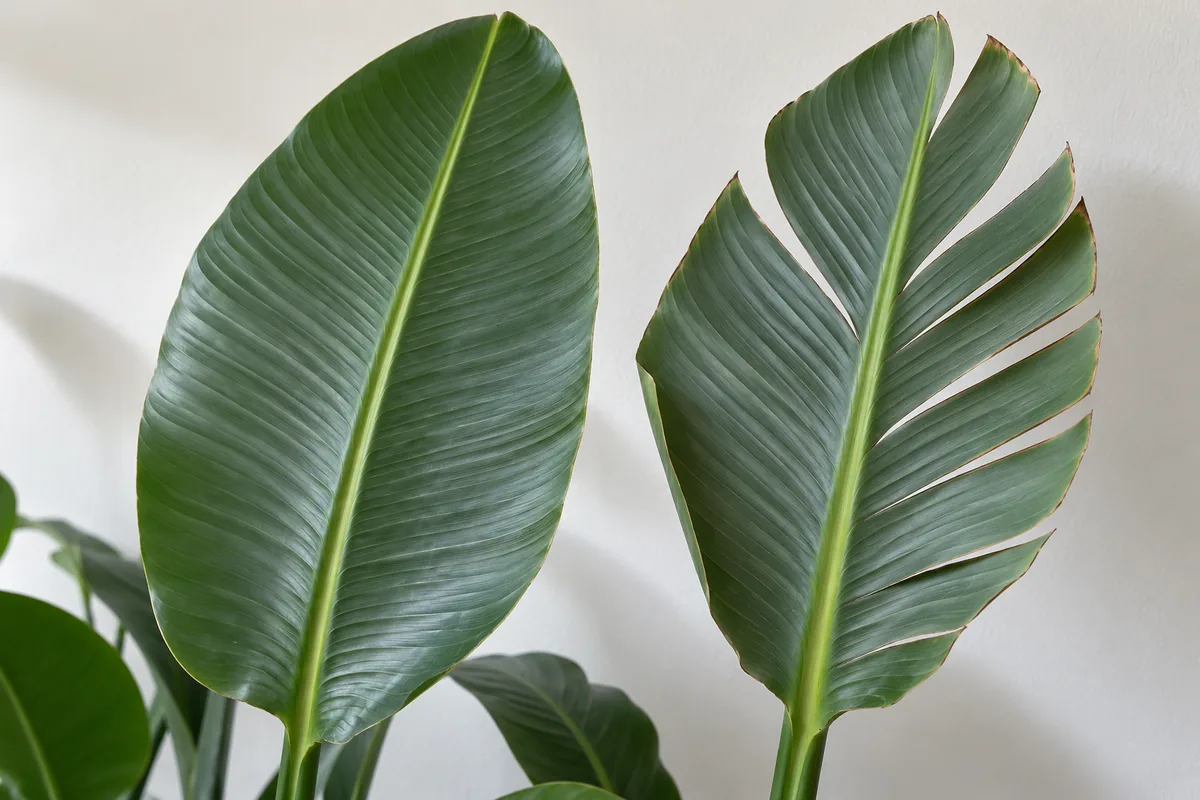
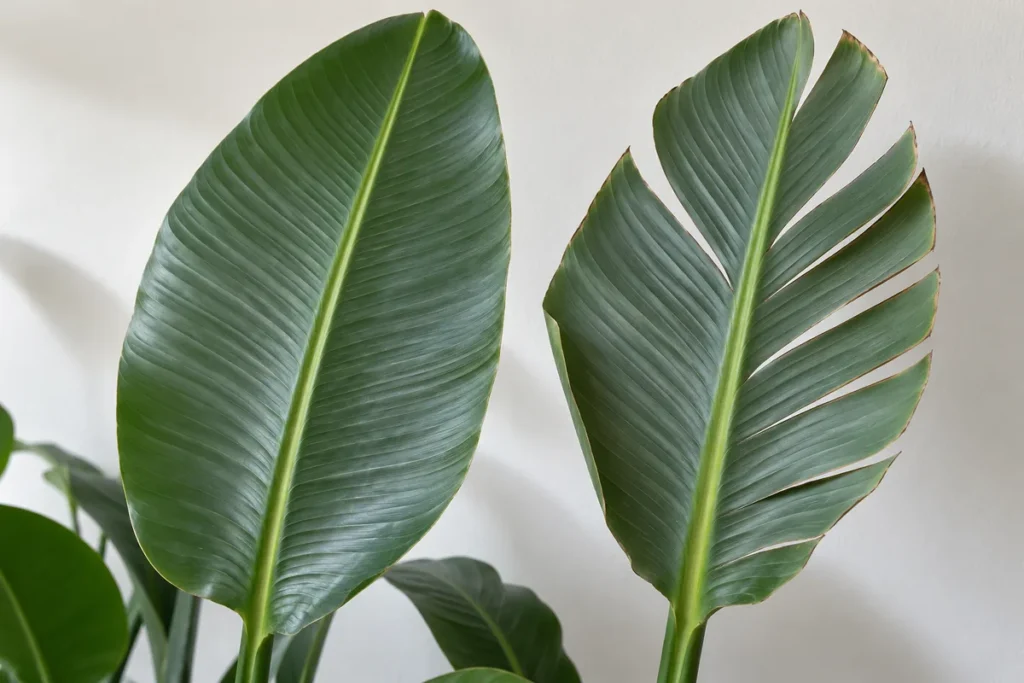
Bird of paradise leaves that split along the parallel veins are usually torn by wind, not by disease [4][5]. Yellowing, crispy edges and rot deserve more worry. A plant that never flowers is more often too young or short of light [1][2].
Key points
- Split leaves tear along the veins, and university sources mostly blame wind [4][5]. Whether indoor air-con or fan draughts do the same is our own inference.
- For no flowers, check age and light first. The RHS says plants are often five to ten years old before they bloom [1]. Wisconsin Extension names low light as a common cause [2].
- Indoors, let the mix dry between waterings [2]. Poor drainage raises the risk of root rot [3].
- Strelitzia reginae is listed by the ASPCA as toxic to dogs, cats and horses [6]. Call a vet if a pet chews it.
Are split bird of paradise leaves a disease?
Usually no. The damage is mechanical. NC State Extension says giant bird of paradise (Strelitzia nicolai) leaves can be ripped along the veins by wind [4]. UF/IFAS describes the foliage as banana-like and prone to shredding in wind [5]. The RHS also warns that tall leaves quickly become tatty in a windy spot if you stand the plant outside for summer [1].
These sources describe outdoor or patio settings. We found no university page that studies splitting on plants kept indoors. So the idea that air-conditioner draughts, fans or cross-breezes split leaves is our inference, and the evidence is weak. If the tears sit on the side facing a vent, moving the plant is a cheap test.
Know which species you own. Strelitzia reginae has paddle-shaped leaves on long stalks and orange and blue flowers. Strelitzia nicolai is the larger white bird of paradise with banana-like leaves. The RHS calls reginae the most popular species for growing as a houseplant [1].
Hong Kong note: high-rise balconies are windy and typhoon season is long. Observatory normals for 1991-2020 show 2.43 days a year under Signal No. 8 or higher, including 0.53 days in July, 0.80 in August and 0.67 in September [7]. Bring pots indoors before a typhoon.
How do I tell splits, crispy edges, curling and yellowing apart?
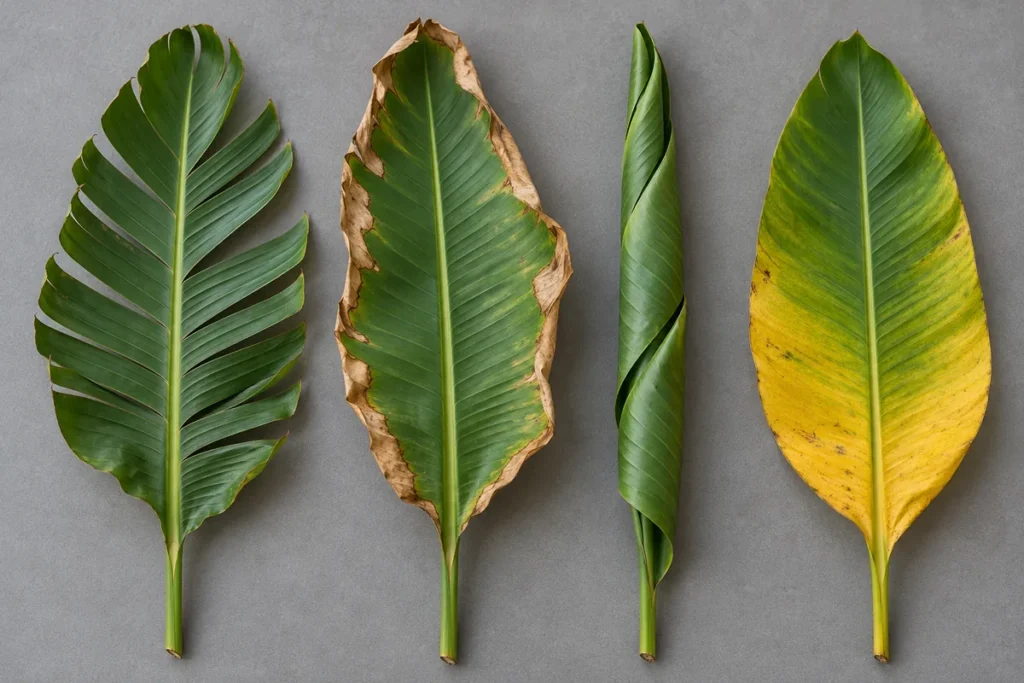
Look at the shape and position first, then check the mix. The RHS lists brown edges, slow growth, deformed leaves and no flowers as signs that growing conditions are wrong, and suggests humid air, regular watering and feeding [1]. Be careful with the humidity advice. Misting raises room humidity only briefly, and we found no source that measures it. Hong Kong air is humid for much of the year anyway (see below), so do not assume crispy edges mean dry air.
On a phone, swipe sideways to see every column.
| Clue | Possible cause | Next step |
|---|---|---|
| Leaf torn into strips along parallel veins, clean edges | Wind or draughts is the most common explanation [4][5][1] | Move away from airflow or shelter the balcony. Cut badly tattered leaves at the base [1][4] |
| Dry tan edges or tips, rest still green | The RHS lists it as a sign of poor conditions [1]. Water quality or salts may also play a part (our inference) | Check the mix, drainage, humidity and feeding in that order [1] |
| Leaf rolled inward, mix very dry | We found no source on curling. Underwatering is a plausible guess, with weak evidence | Check the roots and mix before adding water |
| Lower leaves yellow, mix stays wet | NC State says overwatering or poor drainage can cause root rot [3] | Unpot and look at the roots. See root rot |
| Yellow or brown spots | NC State lists leaf spot as a possible problem [3] | Remove affected leaves. See leaf spot |
| Sticky leaves, cottony bits or tiny dots | Wisconsin Extension names mealybugs, scale and spider mites as possible pests [2] | Isolate and check leaf undersides and stalk bases. See mealybugs |
Why is my bird of paradise not flowering?
Age and light are the usual suspects. The RHS says plants usually need to be a substantial size and five to ten years old before they flower [1]. For the giant species, NC State mentions five to six years [4]. A young plant with no flowers may be doing nothing wrong.
On light, Wisconsin Extension says insufficient light is one of the most common reasons mature plants bloom poorly, because they want near full sun in summer and as much light as possible in winter [2]. The RHS suggests a large sunny window or conservatory, with a little shade during flowering because strong sun can bleach the colours [1]. In Hong Kong, a flat shaded by neighbouring blocks or with only north light is a likely cause (our inference). See measuring light.
A pot that is too big can also delay flowers. Both the RHS and Wisconsin Extension say slightly pot-bound plants tend to flower better [1][2]. Repot only when roots fill the container, and the RHS suggests doing so every couple of years in spring [1].
On feeding, Wisconsin Extension calls them heavy feeders and suggests a water-soluble feed about every two weeks in summer and monthly in winter [2]. Sources vary on frequency, so follow the product label and see fertiliser basics.
What should I do step by step?
- Remove the draught. Move the plant away from air-con outlets, fans and constantly open windows, then watch new leaves (inference, not confirmed by a source).
- Check the mix with a finger. Indoors, let it dry out between waterings [2]. Make sure the pot drains and the saucer is not left full [3].
- Improve light. Move it to the brightest large window and turn the pot a quarter each time you water, as the RHS suggests [1]. Acclimatise gradually to stronger light, because Wisconsin Extension warns of sunburn if moved outdoors suddenly [2].
- Trim with sharp, clean secateurs. The RHS says to remove browning or tatty leaves at the base [1], and NC State says to remove ripped leaves [4]. A partly split green leaf can stay; that is our view, as no source says whether it still works well.
- Wipe the leaves with a soft cloth and skip leaf-shine products, which Wisconsin Extension says can damage the matte finish [2]. It also lets you inspect for pests.
- Wait four to six weeks before judging. Avoid changing feeding, pot and position all at once, or you will not know what helped.
What should I avoid doing?
- Watering heavily or misting daily as soon as leaves split. NC State links overwatering and poor drainage to root rot [3]. The RHS does advise misting [1], but no source here measures the benefit indoors, so the evidence is weak.
- Repotting on one symptom. Roots may be fine and repotting is stressful. Unpot and look first. See repotting guide.
- Adding lots of fertiliser to force blooms. Feed to the label [2]. It does not replace light or maturity.
- Using leaf-shine. It may harm the natural finish [2].
- Mixing up two plants with one name. The ASPCA warns that Strelitzia reginae should not be confused with Caesalpinia gilliesii, also called bird of paradise and more toxic [6].
Pets and children: the ASPCA lists Strelitzia reginae as toxic to dogs, cats and horses, with GI irritants as the principle. Signs are mild nausea, vomiting and drowsiness, mainly from fruit and seeds [6]. NC State also says it is toxic to cats, dogs and horses [3]. Call a vet or the ASPCA Animal Poison Control if a pet eats it, and ask a doctor if a person does.
How do I prevent problems in a Hong Kong flat?
Adjust for local weather rather than copying overseas advice. Observatory normals for 1991-2020 show a January mean daily minimum of 14.6°C and 26.9°C in July [7]. NC State suggests night temperatures of 55 to 65°F, about 13 to 18°C [3]. Most Hong Kong winters therefore do not call for special heating, but a window pane can be colder than the room during a cold snap (inference).
Water by the mix, not the calendar. Summer is hot and humid so a pot may dry slowly, while an air-conditioned room can dry it fast. Check with a finger each time. Wisconsin Extension also says indoor plants should dry out between waterings [2].
- Balcony: choose a sheltered corner, as the RHS advises for outdoor summers [1].
- Typhoons: bring plants inside early [7].
- Wipe leaves monthly and check leaf undersides and stalk bases for mealybugs, scale or spider mites [2]. Then follow integrated pest management.
- Repot only when roots fill the pot, and go up just one size [1].
When should I get help or give up?
If most leaves yellow, the stem base turns soft or smells, this is no longer a simple split-leaf case. Unpot and inspect the roots [3]. If rot is widespread, dividing off healthy sections is one option, since the RHS describes division as a propagation method [1]. No source gives a success rate.
For heavy pest infestations, or if you want to use a pesticide, follow the product label. In Hong Kong pesticides are regulated under the Pesticides Ordinance (Cap. 133); check the Agriculture, Fisheries and Conservation Department. We do not suggest home-made sprays. If a pet has chewed the plant and shows vomiting, drooling or dullness, contact a vet straight away [6].
Frequently asked questions
Should I cut off split bird of paradise leaves?
The RHS says to remove browning or tatty leaves at the base [1], and NC State says to remove torn leaves [4]. A green leaf with a split edge can stay if you accept the look. Use clean, sharp secateurs.
How long does a bird of paradise take to flower?
The RHS says plants usually need to be a substantial size and five to ten years old [1]. NC State mentions five to six years for the giant species [4]. A small young plant may simply need more time.
Is air-conditioning bad for bird of paradise?
We found no source that tests it. Wisconsin Extension stresses good light indoors [2], and NC State suggests 13 to 18°C at night [3]. A direct cold draught on the leaves might contribute to splitting, but the evidence is weak. Move the plant out of the airflow and watch.
Is bird of paradise poisonous to cats and dogs?
The ASPCA lists Strelitzia reginae as toxic to dogs, cats and horses, with mild nausea, vomiting and drowsiness reported, mainly from fruit and seeds [6]. Call your vet if a pet has eaten any, and do not induce vomiting yourself.
Can it stay on a balcony all year?
Only in a sheltered spot. The RHS warns that tall leaves shred in wind [1], and Hong Kong averages 0.80 days of Signal No. 8 or higher in August [7]. Bring it in before a typhoon.
Sources
- Royal Horticultural Society (RHS): “How to grow strelitzia / RHS Growing Guide” — Light, flowering age, slightly pot-bound plants, brown edges and no flowers, wind-shredded leaves
- University of Wisconsin Horticulture Extension: “Bird of Paradise, Strelitzia reginae” — Low light as a common cause of no bloom, pot-bound blooming, indoor watering and feeding, common pests
- NC State Extension Plants Toolbox: “Strelitzia reginae (Bird of Paradise)” — Night temperature, root rot risk, leaf spot, pests, toxic to cats, dogs and horses
- NC State Extension Plants Toolbox: “Strelitzia nicolai (Giant Bird of Paradise)” — Giant bird of paradise leaves ripped along veins by wind, years to flowering, removing torn leaves
- UF/IFAS Extension Gardening Solutions: “Bird of Paradise” — White bird of paradise foliage resembles banana leaves and shreds in wind; old leaves drop naturally
- ASPCA: “Toxic and Non-toxic Plants: Bird of Paradise Flower” — Strelitzia reginae is listed as toxic to dogs, cats and horses; a more toxic plant shares the name
- Hong Kong Observatory: “Monthly Meteorological Normals for Hong Kong (1991-2020)” — Hong Kong monthly mean minimum temperature and tropical cyclone signal days
Further reading
- Back to Plant Doctor
- Drooping, wilting plant: too dry or too wet?
- Root rot: how to tell and when to give up
- Brown crispy leaf tips and edges
- No flowers: light, age or feeding?
- Preparing plants for a typhoon
Sources checked: 31 October 2026. This is general guidance, not an on-site diagnosis. Always follow the product label.
