



Level: Beginner
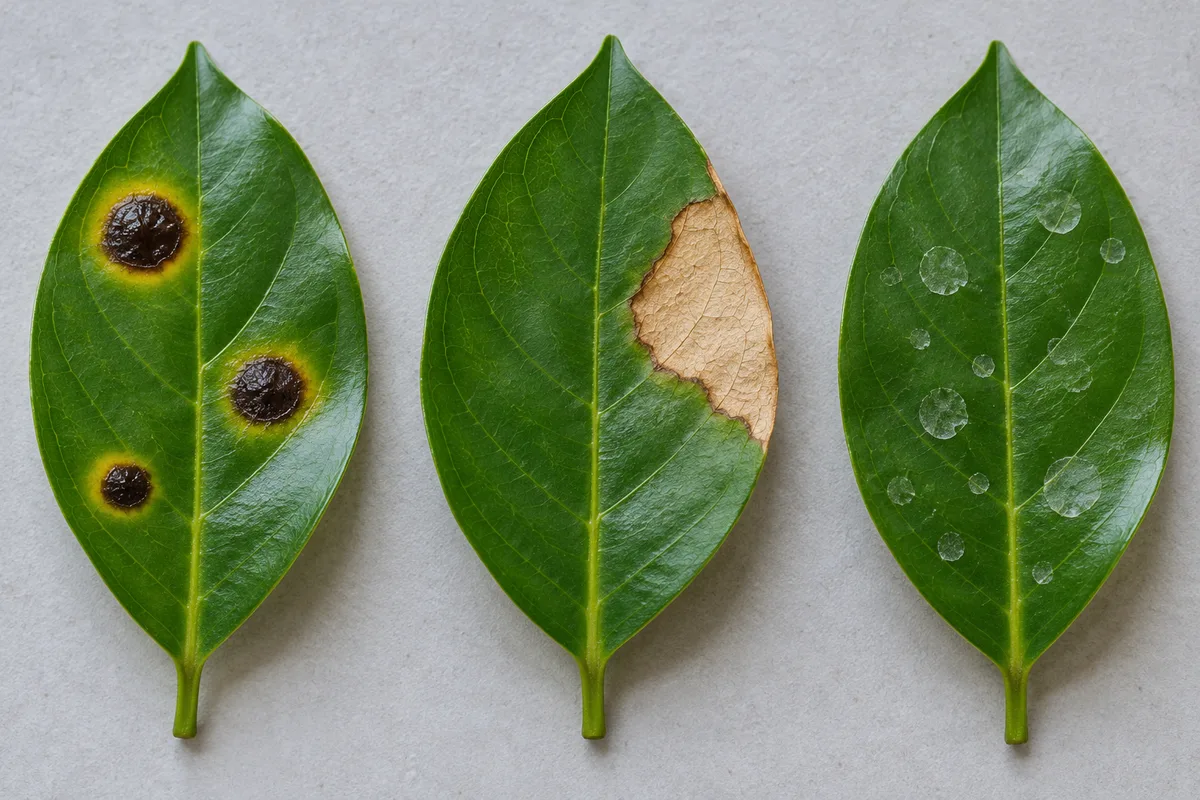
Brown or black spots on leaves may be fungal or bacterial leaf spot, but sun scorch, water marks, chemicals and pests can look similar, so appearance alone may not settle it [4]. Useful clues: wet-looking spots with a yellow halo point towards disease [1][5], while dry, papery patches on the sunny side point towards scorch [3].
Key points
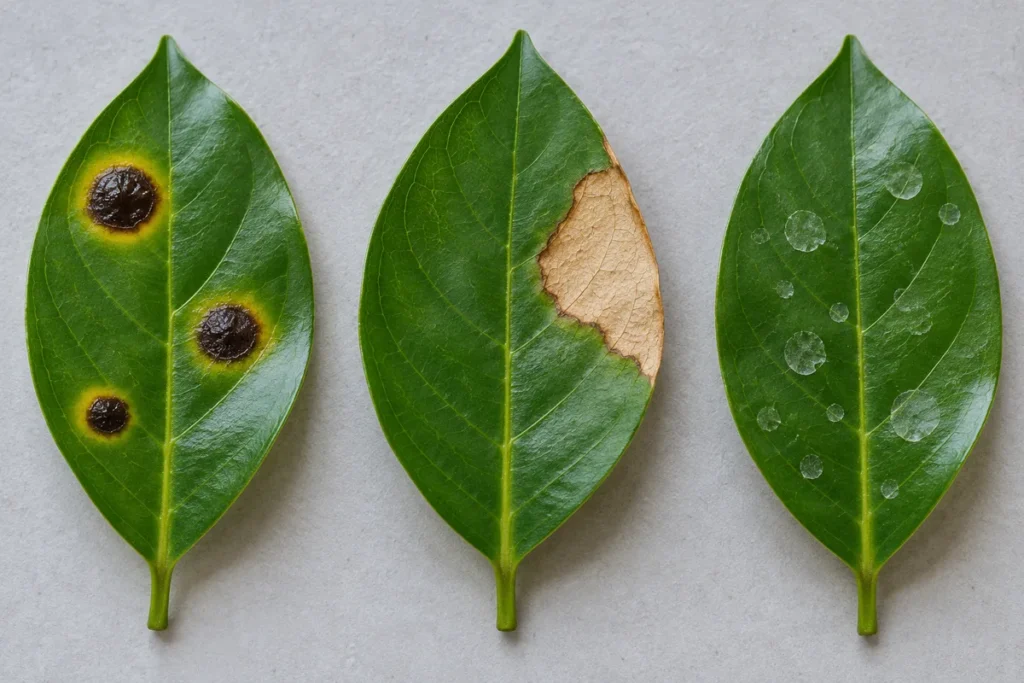
- Check texture and position first: wet-looking spots with a yellow halo suggest leaf spot, dry papery patches on the light side suggest scorch [1][3][5].
- Fungal or bacterial infection is uncommon indoors unless the plant recently came from outdoors or a greenhouse [2], so rule out scorch, water marks and pests first.
- Cut off affected leaves, keep foliage dry and improve airflow. The RHS does not recommend fungicides on houseplants [3].
- If spots keep appearing on new leaves, isolate the plant and consider discarding it [2].
How do you read the spots?
Ask three questions before you spray anything. Is the spot wet-looking or dry? Is there a yellow ring? Where on the leaf is it? Clemson describes bacterial leaf spots as water-soaked, sometimes with a yellow halo [1], and NC State describes them as water-soaked, brown to black lesions often outlined in yellow [5]. NC State’s guidance mainly concerns greenhouse ornamentals, so treat it as a guide, not a rule for your living room.
Fungal spots are described by Clemson as small brown spots with yellowish margins [1], and the RHS says dark spots with yellow margins may be fungal [3]. Note the limit: UC IPM says bacteria, insects, mites and environmental factors can all cause similar spots, so looks alone may not identify the cause [4]. The table below gives clues, not a diagnosis.
On a phone, swipe sideways to see every column.
| Clue | Possible cause | Next step |
|---|---|---|
| Wet-looking, brown to black, yellow ring, spreads when leaves stay damp | Bacterial or fungal leaf spot is more likely | Remove affected leaves, keep foliage dry, isolate [1][5] |
| Dry, thin, tan patch on the side facing the window, recently moved | Sun scorch is more likely | Move away from harsh direct sun; see leaf sunburn [3] |
| Scattered pale or white marks that wipe off | Water marks, hard-water deposits or cleaning products | Water at the pot edge, keep sprays off leaves [3] |
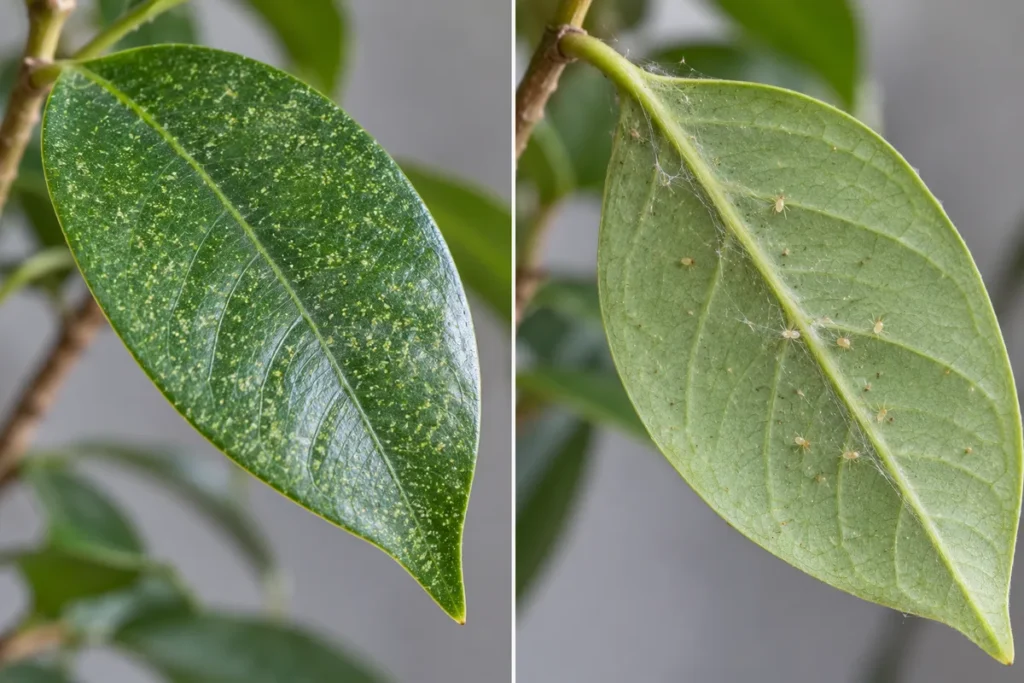
| Fine pale stippling, webbing or specks on the underside | Possible pests such as spider mites | Check the underside with a lens, then follow the pest guide [4] |
| Spots merge and the stem base or roots are soft | May be more than a leaf problem | Read stem rot and root rot; consider isolating [2] |
When you photograph the leaf, include the top, the underside and the whole plant. Images are for comparison only, not a diagnosis.
Why do indoor plants suddenly get spots?
UC IPM notes that fungal or bacterial infections are uncommon indoors unless plants have recently come from outdoors or a greenhouse [2]. A newly bought plant, or one that spent time on a balcony, deserves more suspicion. An old plant that has lived indoors for years and suddenly spots may have a non-disease cause.
Water on leaves is another clue. UC IPM says many of these fungi need hours of continuous leaf wetness to infect [2], and Clemson warns that splashing water spreads fungi and that crowding and cold favour bacterial spots [1]. The RHS adds that cleaning products or aerosols can leave pale spots and hard tap water sprayed on leaves can leave calcium deposits [3].
Clemson also notes that cold water or splashing can cause white or straw-coloured patches [1]. These are usually not disease, but they share a cause with leaf spot: water on the foliage. Watering at the pot edge reduces several risks at once.
Does Hong Kong’s humidity make leaf spots more likely?
Possibly, but do not over-read it. Hong Kong Observatory 1991–2020 averages show mean relative humidity of about 82–83% from March to June, with roughly 19 rain days in June and 18 in July [6]. Our own inference, since no source speaks about Hong Kong interiors, is that during the spring damp spell and the rainy season leaves dry more slowly, which fits UC IPM’s point about leaf wetness [2].
That does not mean every plant should be watered less. Leaf dryness and soil moisture are separate. Water as the plant needs, but pour near the pot edge, avoid wetting leaves at night, and keep air moving with a fan or an open window.
Hong Kong tip: in damp spells, condensation can sit on window-side leaves. Wiping the frame and nearby leaves dry in the morning matches the sources’ advice better than spraying.
How do you treat leaf spot step by step?
- Isolate it. Move the plant away from others. Indoor infection is mostly seen in plants that recently came in from outdoors or a greenhouse [2].
- Remove affected leaves. Clemson advises removing and destroying infected material [1]. Use clean shears and wipe them with 70% alcohol afterwards, as UC IPM describes [2].
- Keep leaves dry. Stop misting, water near the soil, and water in the morning so foliage dries during the day [4].
- Improve airflow. Avoid crowding and low temperatures [1]; the RHS also suggests better ventilation and spacing [3].
- Check weekly. Note the number of spots and photograph from the same angle. If new leaves keep spotting, see the last section.
Spots do not heal. The RHS suggests cutting off leaves that are entirely brown or shrivelled and keeping mostly green ones until new growth appears [3]. That advice is written for scorch, but applying it to spotted leaves is our own inference.
Do you need a fungicide?
Sources differ. The RHS does not recommend fungicides on houseplants [3], and UC IPM says fungicide treatment is generally not warranted for leaf spots on landscape plants [4]. Clemson, by contrast, lists several active ingredients, including copper soaps and sulphur, and says to remove diseased material first and follow the label, ideally spraying outdoors in shade [1].
UC IPM also notes that pesticide sprays do not work against bacterial diseases that spread through the whole plant [2]. In practice, hygiene and dryness come first. If you do consider a product, choose one legally registered locally and labelled for ornamentals, follow the label exactly and never mix your own strength. Do not rely on online recipes.
What should you avoid when leaves are spotting?
- Misting the leaves. Leaf wetness favours infection [2], and Clemson says not to mist leaves affected by anthracnose [1].
- Leaving removed leaves on the soil or near other plants. They should be removed and destroyed [1].
- Cutting from the spotted plant to a healthy one with the same shears. Disinfect with 70% alcohol in between [2].
- Adding fertiliser because the plant looks sick. No source we read supports it for leaf spot; for feeding problems see fertiliser burn.
- Naming the disease from one photo. Too many causes look alike [4].
When should you isolate, give up or ask an expert?
If spotting continues on new leaves after you remove affected ones and fix dryness and airflow, or if spots clearly multiply, consider a bacterial or whole-plant problem. UC IPM says sprays do not work on systemic bacterial disease [2]. In a home, the realistic option is often to discard the plant and its mix, and wash the pot.
For a plant of high value, take clear photos with the plant name and growing conditions and ask a plant diagnostic service or a professional horticulturist. If you also see sticky leaves, check for insects first; if the marks are mainly white and powdery, read white spots on leaves. For isolation steps, see quarantine and hygiene.
Check it step by step with Plant Doctor →
Frequently asked questions
Are black spots always bacterial?
No. NC State describes bacterial spots as often water-soaked, brown to black with a yellow ring [5], but UC IPM says other organisms and environmental factors can look similar [4]. Black is a clue, not proof.
Should I throw the whole plant away because of a few spots?
Not necessarily. UC IPM says most leaf spots on landscape plants can be tolerated [4]. Indoors, remove affected leaves and watch the plant. Consider discarding it only if new leaves keep spotting.
Can wiping leaves with a damp cloth spread disease?
It may. Clemson notes that splashing water spreads fungi [1], so do not reuse a cloth from a spotted leaf on healthy plants, and dry the leaf afterwards so it is not left wet.
Do cinnamon or baking soda help leaf spot?
The university and botanic garden sources we read do not mention them, so the evidence is weak and we would not treat them as proven. Better supported steps are removing leaves, keeping foliage dry and improving airflow [1][2][3].
Does a yellow edge mean the spot is fungal?
Not by itself. The RHS says dark spots with yellow margins may be fungal [3], while Clemson describes bacterial spots with a yellow halo too [1]. A yellow edge cannot separate the two.
Sources
- Clemson University Home & Garden Information Center: “Houseplant Diseases & Disorders” — Appearance of fungal and bacterial leaf spots, avoiding splashed foliage, removing diseased leaves, cold-water spotting
- University of California IPM (UC IPM): “Houseplant Problems” — Fungal or bacterial infection is uncommon indoors, leaf wetness favours infection, keeping leaves dry, tool disinfection
- Royal Horticultural Society (RHS): “How to help a poorly houseplant” — Scorch patches, pale spots from cleaning products, calcium deposits from hard water, dark spots with yellow margins, no fungicides advised
- University of California IPM (UC IPM): “Leaf Spot Diseases” — Bacteria, insects, mites and environmental factors can make similar spots, so appearance alone may not identify the cause (landscape plants)
- NC State Extension: “Leaf Spotting Bacteria on Ornamentals” — Look of bacterial leaf spots and spread by splashing water (greenhouse ornamentals)
- Hong Kong Observatory: “Monthly Meteorological Normals for Hong Kong (1991-2020)” — 1991-2020 monthly mean relative humidity and rain days
Further reading
- Back to Plant Doctor
- Fungal and bacterial leaf spot
- Leaf sunburn after moving to brighter light
- Brown crispy leaf tips and edges
- Plant care in Hong Kong’s damp season
Sources checked: 31 October 2026. This is general guidance, not an on-site diagnosis. Always follow the product label.
