



Level: Beginner
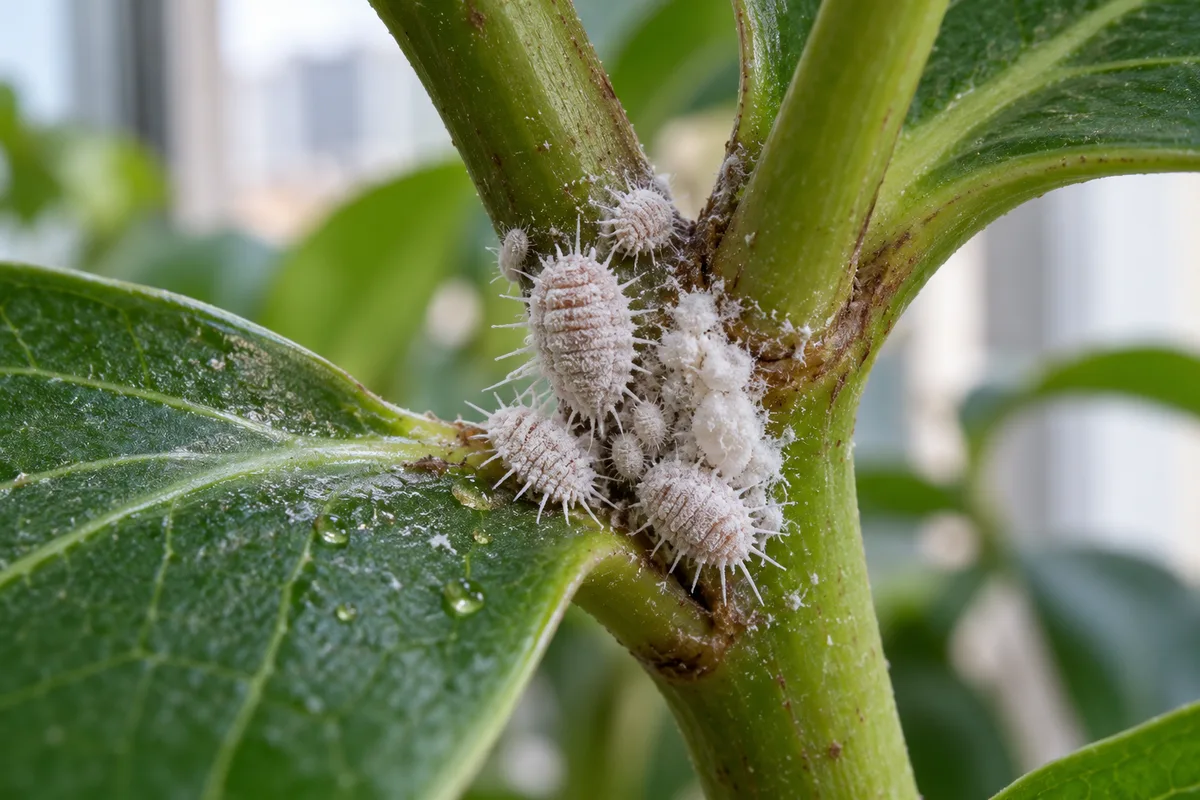
Mealybugs are soft, wax-covered sap-sucking insects that hide in leaf joints, crowns and on stems, and leave sticky honeydew behind [1][4]. For a light case, isolate the plant, dab each insect with alcohol on a cotton swab and recheck every week [2][3].
Key points
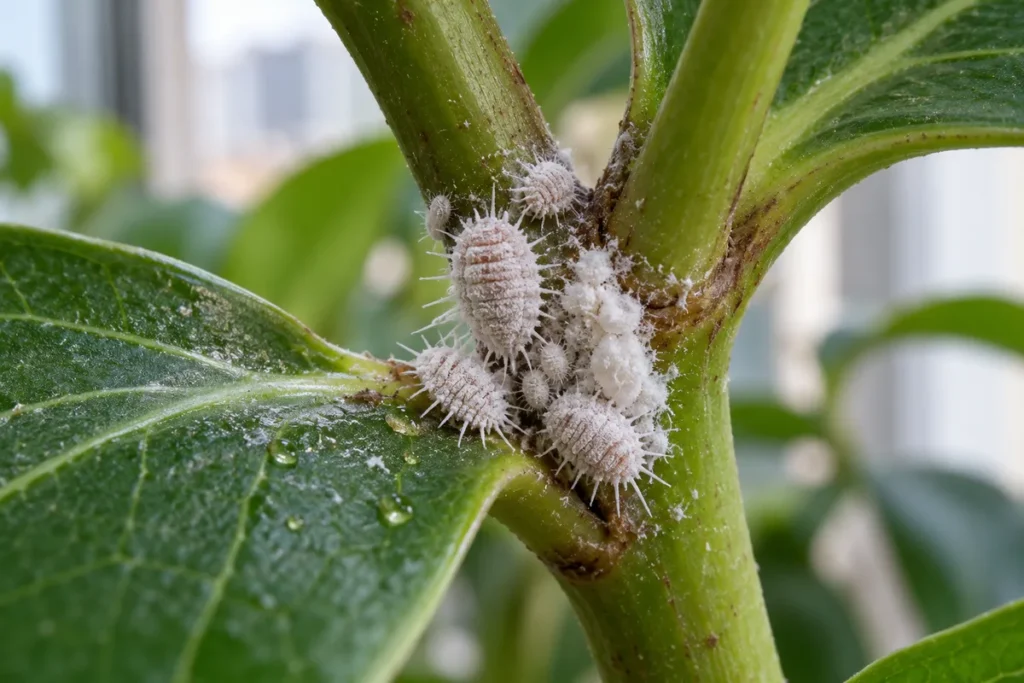
- If you see white fluff in leaf joints, isolate the plant first, then look closely for soft, slow-moving insects [1][3].
- Alcohol swabs suit light cases, but sources disagree on strength, so test a small patch first [1][3][5].
- UC IPM says mealybugs are very hard to control with insecticides, and Iowa State says no single method kills them all, so keep checking weekly [1][2].
- A badly infested, low-value plant may be better discarded than treated [3][4].
How do I confirm mealybugs?
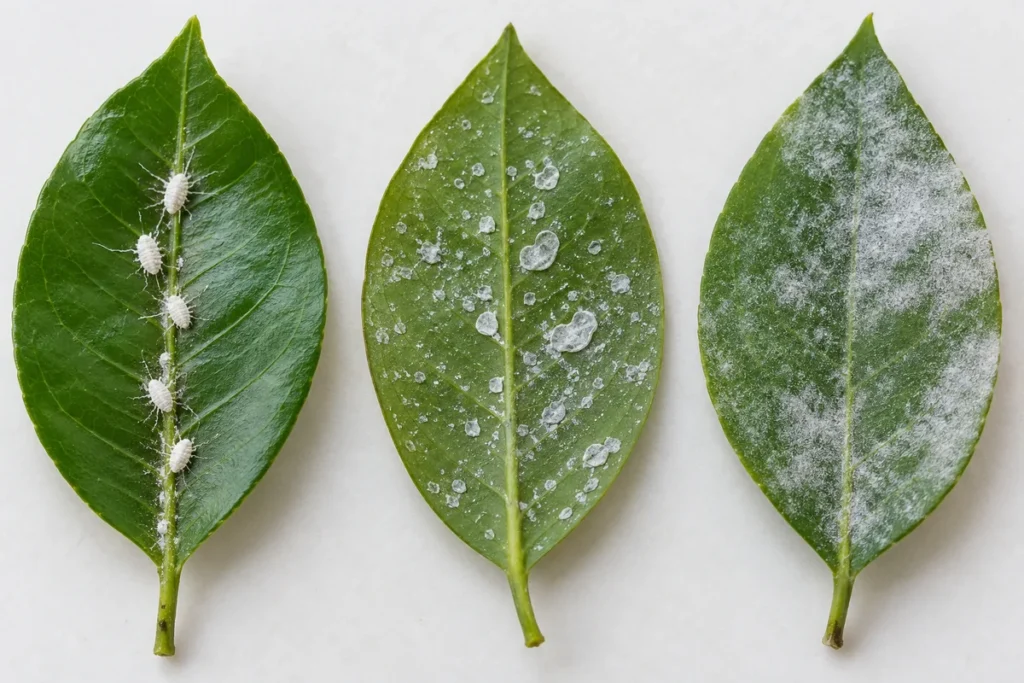
Look for soft, slow, wax-covered insects, not just white marks. UC IPM describes most adults as wingless females with oval, segmented bodies covered in wax [1]. The University of Maryland notes they may crawl slowly on leaf undersides, on stems or even on the outside of the pot [3]. The RHS says the first sign is usually fluffy white wax in sheltered spots such as leaf joints, with insects or orange-pink eggs underneath [4].
They favour protected places: plant crowns, branch forks and stems near the soil [1]. Colorado State adds leaf-and-stem joints and leaf veins [5]. Turn leaves over, part leaf stalks and check the stem base. A torch and a hand lens help a lot.
On a phone, swipe sideways to see every column.
| Clue | Possible cause | Next step |
|---|---|---|
| White fluff in leaf joints; soft insects when parted | More likely mealybugs | Isolate and follow the treatment steps [1][3] |
| Sticky leaves, black sooty film | Honeydew from a sap-sucker; mealybugs are one possibility | See sticky leaves: tracing the honeydew [1][4] |
| Hard, flat white marks that do not move | More likely mineral deposit than an insect | See white spots on leaves |
| Slow growth, waxy white insects on roots or at the pot edge | Possibly root mealybugs (Rhizoecus) | Unpot and inspect; the RHS notes these exist, UC IPM calls them harder to control [1][4] |
| Fine webbing and pale speckles | Possibly spider mites instead | See spider mites |
Hong Kong tip: in humid spells, white mould can appear on soil and leaves. Touch it gently with a swab. An insect has a body; mould usually smears away. This is our practical suggestion, not something the sources compare.
What else looks like mealybugs?
Several pests make wax and honeydew. UC IPM lists cottony cushion scale, woolly aphids, soft scales and whiteflies as look-alikes, and advises examining the insect beneath the wax [1]. A flat, hard, immovable dot is more likely a scale; compare with scale insects.
Newly hatched crawlers are yellow to orange-pink, have no wax yet and move around before settling [1]. Tiny orange moving specks can therefore be young mealybugs, even without visible fluff.
What do I do first?
Isolate, then treat one insect at a time. Maryland Extension advises isolating infested plants so the problem does not spread [3]. UC IPM adds that pots, stakes and other items should be checked too [1].
- Move the plant away from others, ideally into a separate room [3].
- Check leaf joints, leaf undersides, the stem base, the pot rim and the pot underside [1][5].
- For light cases, dab each insect with a cotton swab dipped in alcohol. Maryland notes treated insects turn light brown, and warns to keep alcohol off the leaves because it can damage them [3].
- Remove dead leaves and prunings that may carry insects or eggs, and bag them [4].
- Recheck at least weekly. The Iowa State author describes spending about an hour a week checking each plant, and Colorado State advises repeating weekly until the insects are gone [2][5].
UC IPM says a female can lay 100 to 200 or more eggs over 10 to 20 days [1], so one pass is very unlikely to be enough. UC IPM also suggests a strong spray of water for exposed insects on sturdy plants, repeated every few days [1]. Delicate leaves, or insects deep in leaf joints, may limit this; that is our inference.
Alcohol, soap or insecticide: what does the evidence say?
Sources agree on the approach but not on alcohol strength. UC IPM suggests dabbing with 70% isopropyl alcohol or less in water for serious houseplant cases, testing a small area first for leaf burn [1]. Colorado State suggests a spray of 10 percent rubbing alcohol and 90 percent water for heavy infestations and warns some plants are sensitive [5]. Maryland and Iowa State describe alcohol swabs without giving a strength [2][3].
So no strength can be called best. A cautious approach is to start weaker, test one inconspicuous leaf, wait a day or two for scorch, then widen the treatment.
On insecticides, UC IPM says the wax coating and hiding habit make contact products less effective; soaps, horticultural oils and neem oil applied directly to young nymphs can reduce numbers [1]. Maryland suggests an indoor-plant insecticidal soap or a registered houseplant spray for heavy cases, with repeat applications likely [3]. Iowa State suggests combining alcohol with a labelled product because neither kills every insect [2].
Hong Kong law: AFCD states that under the Pesticides Ordinance (Cap. 133), only registered pesticides may be distributed and used in Hong Kong [6]. Check the label for a registration number and listed plants, and follow it exactly. For pet or child safety, ask a vet or doctor. This article gives no home-made mixes.
Colorado State also lists pyrethroid sprays and the soil-applied imidacloprid as likely effective [5]. That is advice from Colorado, not a statement about products registered in Hong Kong, and we do not recommend importing unregistered products.
What should I avoid?
- Do not just wipe off the fluff. It is wax and egg sacs; live insects may be nearby [1][4].
- Do not pour alcohol over the foliage. Maryland warns it can damage leaves [3].
- Do not treat once and stop. Eggs and new crawlers keep appearing [1].
- Do not overfeed with nitrogen. UC IPM says high nitrogen with regular watering stimulates tender growth and mealybug egg production [1].
- Do not keep the plant beside others. Maryland advises isolation [3].
- Do not use home-made or viral mixes. We found no supporting source; see the law note above.
How do I stop them coming back?
Check new plants before they come in. UC IPM advises inspecting new plants thoroughly and discarding or returning them if you cannot remove every insect [1]. Inspect susceptible plants regularly; UC IPM names aglaonema, dracaena, ficus, hoya, orchids, palms, philodendron and schefflera among houseplants often affected [1].
Hong Kong’s climate gives little help. The Observatory’s 1991 to 2020 normals show a mean temperature of about 16.5 degrees C in January and 28.9 degrees C in July [7]. The RHS says glasshouse mealybugs are active all year round on houseplants [4], and UC IPM notes indoor plants lack natural enemies [1]. Our inference is that in a heated or air-conditioned flat, winter will not suppress them as it can outdoors, so stay alert all year.
Biological control, such as the ladybird Cryptolaemus montrouzieri, is a greenhouse approach. The RHS says the ladybird and parasitic wasps need relatively high temperatures and are bought by mail order [4]. It is rarely practical for a home plant.
When should I give up or call an expert?
If the plant is low in value and heavily infested, discarding may be the realistic choice. Maryland advises discarding heavily infested plants [3]; the RHS says disposal can be simpler than eliminating mealybugs [4]; UC IPM says to discard when you cannot remove them all [1].
For a plant you want to keep, cut away the worst parts, treat insect by insect and monitor for several weeks. If the problem keeps returning, appears at the roots or has reached many plants, ask a local horticulturist or plant shop. Bag discarded plants tightly and keep old potting mix away from other pots.
Check it step by step with Plant Doctor →
Frequently asked questions
Can mealybugs spread to other plants?
Yes, it is possible. UC IPM says they are often introduced on new plants, tools or pots, although adults move slowly [1]. Maryland advises isolating infested plants [3]. Keep the plant apart while you treat it.
Why does the fluff come back after I wipe it away?
A female can lay 100 to 200 or more eggs [1], and the insects hide in sheltered spots that are easy to miss [5]. Iowa State therefore recommends continued weekly checks and notes that no single method kills every mealybug [2].
Will alcohol burn the leaves?
It can. Maryland warns alcohol may damage leaves [3], and UC IPM and Colorado State both advise testing a small area first [1][5].
Is it safe to use insecticide around pets or children?
The sources we read give no general answer. Follow the product label and ask a vet or doctor. Hong Kong also allows only registered pesticides to be distributed and used [6].
Can I use ladybirds or wasps indoors?
The RHS describes them as greenhouse tools that need relatively high temperatures and mail order supply [4]. UC IPM adds that some, such as Leptomastix dactylopii, kill only citrus mealybug [1]. Home use is hard to justify.
Sources
- University of California IPM (UC IPM): “Mealybugs” — Appearance, hiding places, egg numbers, honeydew, look-alike pests, water spray and alcohol, limited insecticide effect, inspecting new plants
- Iowa State University Extension: “Houseplant Pests: Mealybugs” — Weekly checks, alcohol swabs, combining with a labelled insecticide, no single method kills all
- University of Maryland Extension: “Mealybugs on Indoor Plants” — Symptoms, isolation, dabbing alcohol while keeping it off leaves, discarding heavy infestations, following labels, rechecking
- Royal Horticultural Society (RHS): “Mealybug” — Year-round activity indoors, root mealybugs, removing dead leaves, discarding heavy cases, biological control needing warmth
- Colorado State University Extension (PlantTalk Colorado): “1466 – Mealy Bugs on Houseplants” — Leaf-joint and vein locations, alcohol dilution, weekly repeats, patch-testing
- Agriculture, Fisheries and Conservation Department, Hong Kong (AFCD): “Pesticide Registration and Control” — Pesticides Ordinance (Cap. 133): only registered pesticides may be distributed and used in Hong Kong
- Hong Kong Observatory: “Monthly Meteorological Normals for Hong Kong (1991-2020)” — Hong Kong monthly mean temperature and relative humidity (1991-2020)
Further reading
- Back to Plant Doctor
- Sticky leaves: tracing the honeydew
- Scale insects: how to tell and what to do
- Quarantine and hygiene for new plants
- Integrated pest management for houseplants
- Large plant pest and disease control
Sources checked: 31 October 2026. This is general guidance, not an on-site diagnosis. Always follow the product label.
