



Level: Intermediate
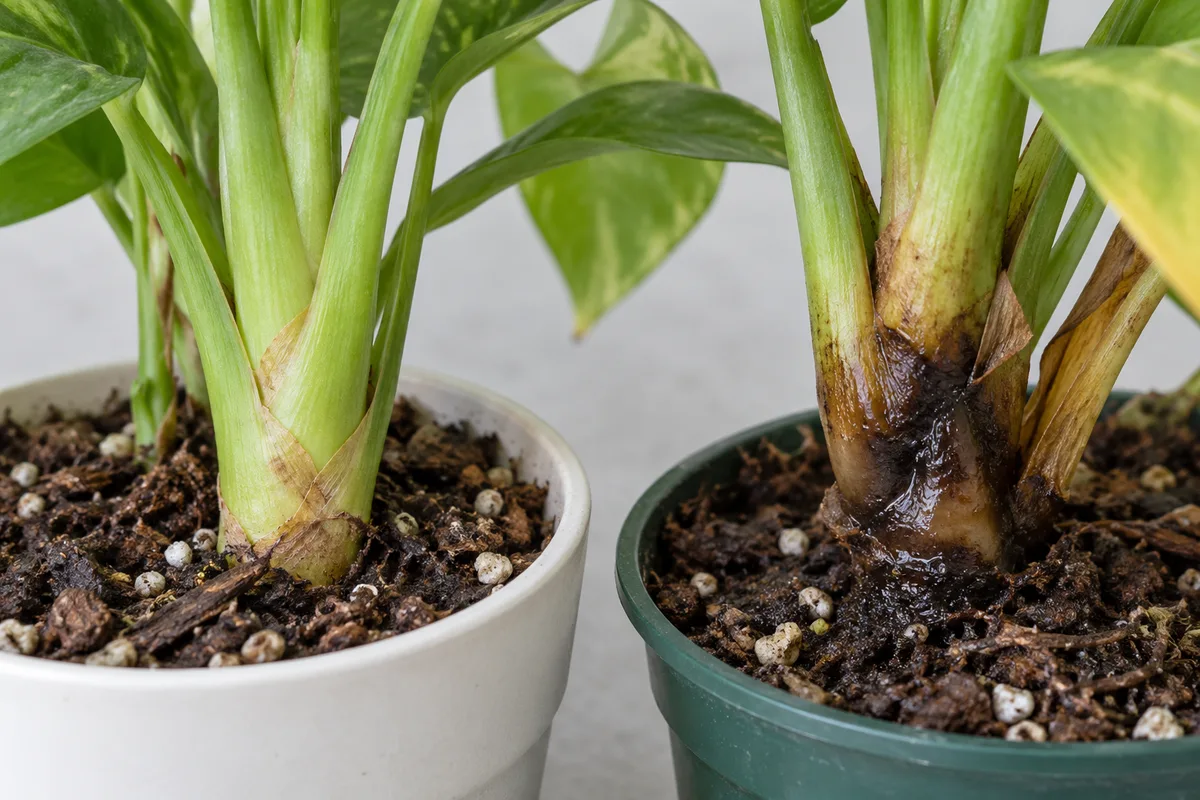
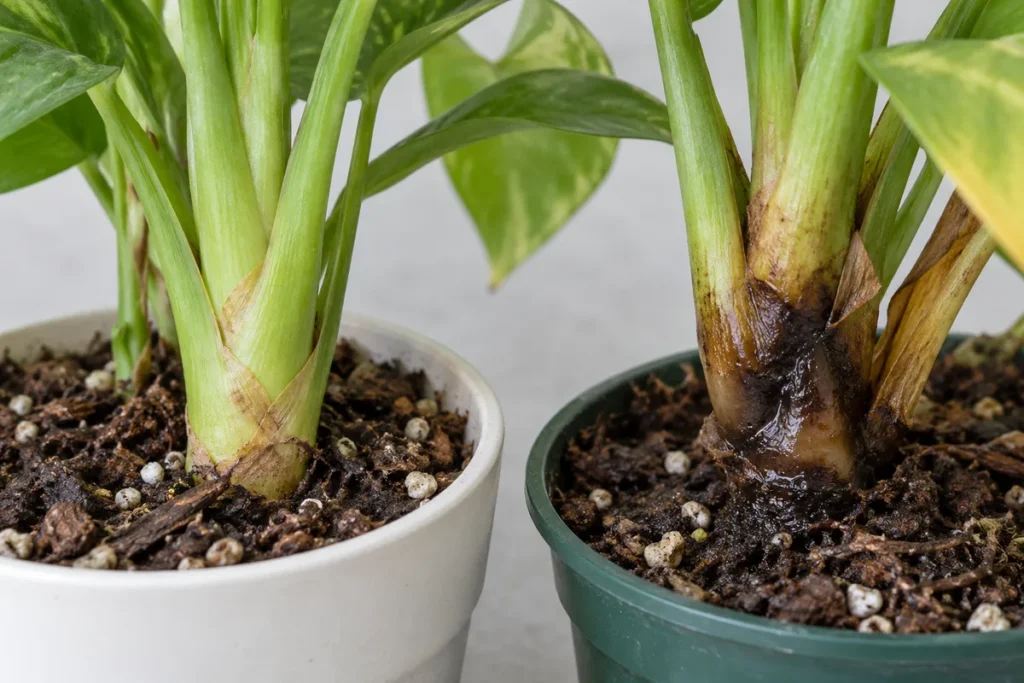
A soft, darkened stem base may be stem or crown rot, and it often occurs together with root rot. UC IPM says infected roots and stems are often dark, soft and decayed [1]. Stop watering, check the stem base and roots, cut away soft tissue, and consider discarding the plant if damage is wide or reaches the main stem [1][6].
Key points
- If the stem base turns soft and dark, stop watering and unpot to check the roots. Stem rot and root rot often occur together and are handled in a similar way [1][6].
- Different organisms may be involved. Rhizoctonia tends to cause a dry brown base rot, Sclerotium can show white threads and seed-like bodies, and bacterial soft rot brings seepage and a strong smell. At home they are hard to separate by eye [2][3][4].
- There is no reliable cure once infected. UC IPM advises removing infected plants, and Wisconsin says there are no treatments for bacterial soft rot [1][4].
- Prevention is mainly about avoiding wet root zones, not planting too deep, and keeping tools and pots clean [1][4].
How can you tell stem rot from root rot?
Look at how soft it is, how dark it is and where it starts. UC IPM says roots and stems affected by root and stem rots are often dark, soft and decayed, and can break off easily [1]. If the damage sits at the stem base near the soil line, think stem or crown rot. If only the roots are soft, it looks more like root rot. The two often occur together, so check both.
Unpotting shows the root side. Chicago Botanic Garden describes healthy roots as firm and pale and rotted roots as soft and darkened [6]. If roots are healthy but the stem is damaged, focus on the stem. If both are bad, follow the root rot routine.
On a phone, swipe sideways to see every column.
| Clue | Possible cause | Next step |
|---|---|---|
| Dry brown base that snaps easily, starting at the soil line | Possibly Rhizoctonia-type base rot | Stop watering, check roots and stem base, cut away damage [2] |
| Soft brown base with white threads or small round bodies nearby | Possibly Sclerotium crown rot (source describes outdoor hostas) | Remove the plant and nearby mix; do not reuse them [3] |
| Sunken, soft tissue with seepage and a strong smell | Possibly bacterial soft rot | Isolate, discard affected parts quickly, keep conditions dry [4] |
| Roots soft and dark, stem base still firm | More like root rot than stem rot | See root rot and check the roots [6] |
| Mix stays wet and the stem base starts to soften | Wet mix plus pathogens are both possible | Stop watering, unpot, use clean mix [1] |
| Only leaves yellow, stem base firm | Not necessarily stem rot; water or nutrients may be involved | See yellow leaves |
Hong Kong note: during humid spells the surface of the mix can stay damp for days. That does not mean the stem base is rotting. Judge by the stem and roots, not the weather.
What can cause stem rot?
Several organisms are possible, and you cannot separate them reliably at home. UC IPM lists Fusarium, Pythium, Phytophthora and Rhizoctonia as common fungi that infect roots and crowns [1]. Other sources describe Sclerotium and bacterial soft rot. Confirming the cause needs professional diagnosis, so treat the clues below as hints, not a verdict.
- Rhizoctonia: Iowa State Extension describes a dry brown rot at the base, after which the stem base breaks off from the rest of the plant, with wilting, yellowing and stunting [2]. That article dates from 1999 and covers cuttings and landscape plants, so apply it to potted houseplants with care.
- Sclerotium: another Iowa State page (about outdoor hostas) describes soft brown decay, sometimes with white fungal threads, and mustard-seed-sized round bodies that turn from cream to brick red and germinate in warm, humid weather [3].
- Bacterial soft rot: the University of Wisconsin horticulture page lists sunken soft tissue, seepage and a strong disagreeable smell, with no treatment once infected [4]. That page is mostly about vegetables, so using it for houseplants is an extension.
- Pythium, Phytophthora, Fusarium: also common root and crown pathogens [1], but none of the sources we read gave a home visual test for them.
Why does it matter? Cases with white threads and round bodies call for removing nearby mix as well as the plant [3], while bacterial soft rot puts more weight on discarding and disinfecting tools [4]. If you cannot tell, use the cautious route: isolate, cut away, and use clean mix and a clean pot.
What should you do once the stem base has gone soft?
Reduce moisture, cut away soft tissue and then decide whether the plant is worth keeping. UC IPM advises avoiding excess moisture in the root zone and removing infected plants [1], and the Wisconsin horticulture page says to remove and discard infected plants or parts immediately [4].
- Stop watering and move the plant away from others. Bacterial soft rot can spread through contaminated tools, water and debris [4].
- Unpot and inspect the stem base and roots. Chicago Botanic Garden says healthy roots are firm and pale, rotten ones soft and dark [6].
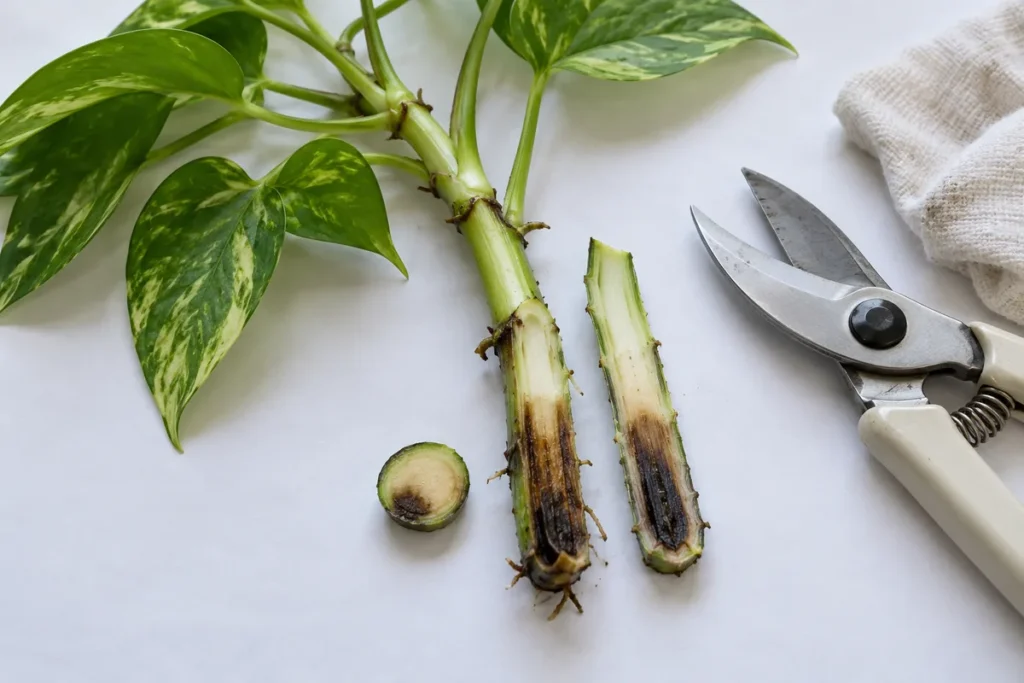
- Cut with clean, sharp shears until the inside tissue looks pale and firm. Disinfect the tool after each cut: Wisconsin mentions at least 30 seconds in 10% bleach or, preferably, 70% alcohol [4].
- Judge what is left. Chicago Botanic Garden says that with more than half the roots damaged you might consider discarding the plant [6]. If the main stem is already soft and black we suggest the same, although the sources do not say this directly.
- Use fresh, free-draining mix and a clean pot with drainage holes. The Wisconsin clinic recommends a pot with drainage holes and fresh commercial potting mix for root rot [5].
- Discard diseased tissue and old mix. For the sclerotia-forming disease, Iowa State advises removing the plant and replacing contaminated soil nearby (outdoor hosta setting) [3]. For a pot, we treat the old mix the same way.
For repotting detail see how to repot. If the plant droops or drops leaves afterwards, see transplant shock. Keep other plants away from the patient; see quarantine and hygiene.
Do fungicides, cinnamon or peroxide work?
The evidence is weak. The Wisconsin clinic does not recommend chemical fungicides for houseplant root rot [5]. That page covers root rot, not stem rot, so it is supporting evidence only. UC IPM advises only avoiding excess moisture and removing infected plants for root, stem and crown rots [1], and Wisconsin says there are no treatments once bacterial soft rot has infected tissue [4].
Cinnamon and hydrogen peroxide are widely shared online, but we found no university or botanic garden support for them, so we do not teach them here. If you still use a pesticide product, use only a locally registered one that lists your use on the label, follow the label exactly and never mix your own strengths. In Hong Kong pesticides are regulated under the Pesticides Ordinance (Cap. 133); check the Agriculture, Fisheries and Conservation Department for details.
What should you avoid with a rotting stem?
- Watering because the plant looks weak: UC IPM advises avoiding excess moisture in the root zone [1].
- Using the same shears on other plants without disinfecting: bacteria can spread on contaminated tools [4].
- Burying or composting rotted tissue: the Wisconsin page stresses immediate removal and disposal [4].
- Reusing old mix or an unwashed pot: sclerotia can survive for a long time [3].
- Planting too deep: UC IPM says not to plant too deep [1]. See replanted too deep.
How do you prevent stem rot in a Hong Kong home?
Focus on drainage, planting depth, watering by need and clean tools. UC IPM advises avoiding excess moisture in the root zone and not planting too deep [1].
Summer needs extra care because it is warm and humid. Hong Kong Observatory 1991-2020 normals show July mean temperature of about 28.9°C and mean relative humidity of about 81% [7], and Iowa State says sclerotia germinate in warm, humid weather [3]. Our inference, not stated by the sources, is that Hong Kong’s summer outdoors resembles the warm, humid conditions those diseases like. Indoors, air conditioning and placement change the temperature and humidity at the pot, so do not read this as meaning every Hong Kong summer causes stem rot.
- Use a pot with drainage holes and a free-draining mix [1][5]. For the basics see how to water.
- Check the mix before watering instead of following a calendar; see overwatered or underwatered.
- When repotting, keep the stem base at its original soil line rather than burying it deeper [1].
- Wash tools and old pots, and use alcohol where suitable [4].
- Keep new or repotted plants apart for a week or two.
When should you get help or let the plant go?
If soft rot covers a wide area, the main stem has gone soft and black, or more than half the roots are damaged, letting go may be the practical choice. Chicago Botanic Garden says you might consider discarding a plant with more than half its roots damaged [6]. UC IPM advises digging out and destroying infected plants [1], and Wisconsin says there are no treatments for bacterial soft rot [4].
If the plant matters to you or several plants are affected, photograph the stem base and roots clearly and ask a plant disease clinic or a trusted expert rather than escalating treatments yourself. Wash your hands afterwards.
Letting go is not failure. If the mix stayed waterlogged, the next plant in that pot may suffer the same way unless the conditions change.
Check it step by step with Plant Doctor →
Frequently asked questions
My stem base is soft but the leaves are still green. Can it be saved?
Green leaves do not prove the stem base is safe. UC IPM says affected roots and stems can be soft and decayed [1]. Unpot and cut back to pale, firm inner tissue. If the main stem is already soft and black, consider letting the plant go.
Can stem rot spread to other plants?
There is a risk. Bacterial soft rot can spread on contaminated tools, water and debris [4], and Sclerotium bodies can survive for a long time [3]. Isolate the plant and disinfect tools [4].
Why is one stem base dry and brown while another is wet and smelly?
The cause may differ. Rhizoctonia can start as a dry brown base rot [2], while bacterial soft rot can bring seepage and a strong smell [4]. At home it is hard to be sure by eye.
My cutting has gone black and soft at the base. Is that the same problem?
Iowa State describes Rhizoctonia-type rot at the base of cuttings [2], though in landscape plants. For houseplant cuttings that rot at the base, see the propagation guide and use clean tools and mix.
The mix smells bad and the stem base is soft. What does that mean?
Bacterial soft rot can bring a strong smell [4], and low-oxygen wet mix can smell too. See smelly potting mix and check both stem base and roots.
Sources
- University of California IPM (UC IPM): “Root, Stem and Crown Rots” — Dark soft roots and stems, common pathogens, avoiding excess moisture, not planting too deep, removing infected plants (landscape plants)
- Iowa State University Extension: “Rhizoctonia Cutting Rot” — Rhizoctonia dry brown basal rot, stem base breaking off, removing dead plants and debris (1999 article, cuttings and landscape plants)
- Iowa State University Extension: “Pests and Diseases of Hosta | Yard and Garden” — Sclerotium crown rot: soft brown decay at the petiole base, white fungal threads, sclerotia germinating in warm humid weather (outdoor hostas)
- University of Wisconsin Extension Horticulture: “Bacterial Soft Rot” — Bacterial soft rot: sunken soft tissue, seepage, strong odour, no treatment once infected, discarding, tool disinfection (mostly vegetables)
- University of Wisconsin Plant Disease Diagnostics Clinic: “Root Rots on Houseplants” — Chemical fungicides not recommended for houseplants (that page covers root rot)
- Chicago Botanic Garden: “Overwatered Houseplants” — Healthy versus rotted roots, considering discarding when over half the roots are damaged
- Hong Kong Observatory: “Monthly Meteorological Normals for Hong Kong (1991-2020)” — 1991-2020 monthly mean temperature and relative humidity
Further reading
- Back to Plant Doctor
- Root rot: how to confirm, treat and know when to stop
- Smelly potting mix: low oxygen, root rot or decay?
- Overwatered or underwatered? A side-by-side check
- How to repot a houseplant
- Quarantine and hygiene for houseplants
- Can you reuse old pots? Checks before you do
Sources checked: 31 October 2026. This is general guidance, not an on-site diagnosis. Always follow the product label.
