



Level: Intermediate
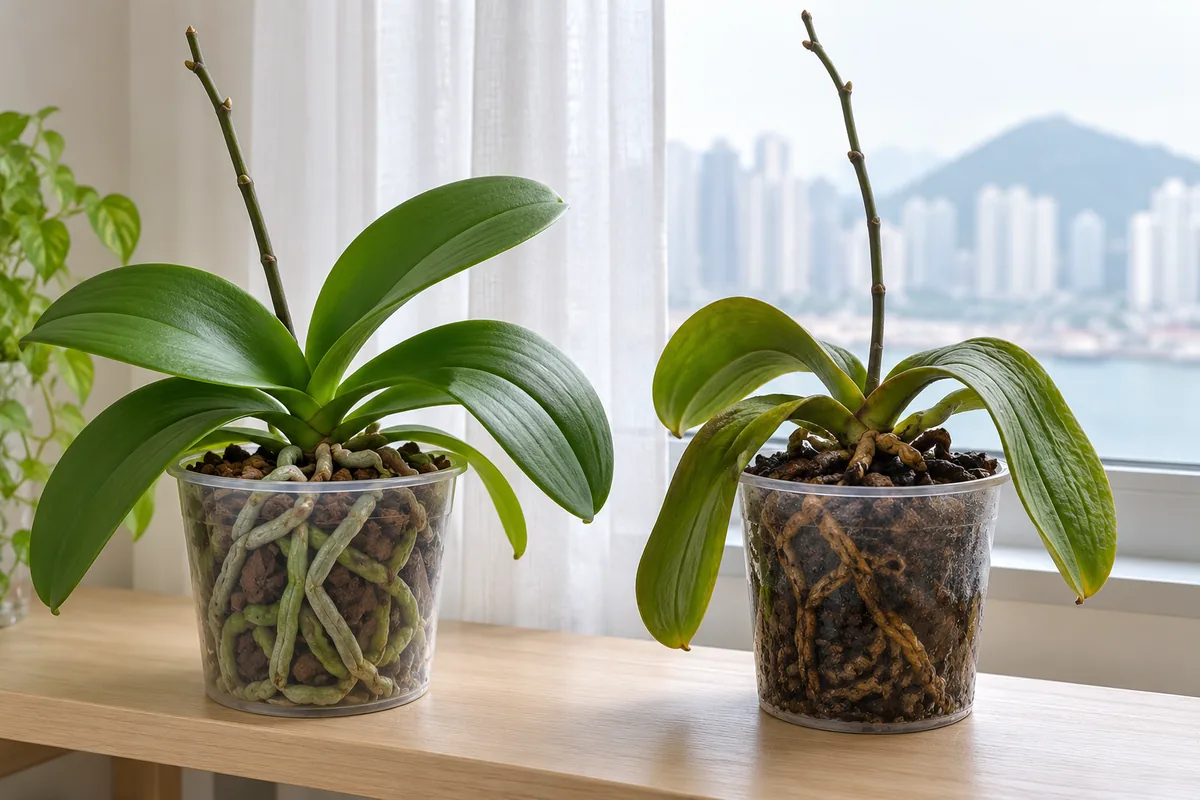
Moth orchids are likelier to rot when their roots stay wet, and likelier to shrivel when they dry out completely [2]. Check the roots first: firm, silvery-green roots look healthy, while brown, hollow or mushy ones need trimming and fresh bark mix [2][1].

Key points
- Wrinkled leaves can come from rotten roots or dry ones, so look at the roots first [2].
- Roots need air and tend to rot if kept soggy [1]; old bark mix breaks down and holds water longer [2].
- After flowering you can cut the spike, but two sources suggest different cut points, and good light matters for reblooming [1][2].
- ASPCA lists moth orchids as non-toxic to cats and dogs, but pets may still upset their stomachs [3].
What do wrinkled leaves and failed flowering tell me?
Wrinkled leaves are a warning, but the leaf alone cannot show the cause. The RHS notes that moth orchid roots may rot if too wet and shrivel if too dry [2]. The table is a first guide only; checking the roots settles it.
On a phone, swipe sideways to see every column.
| Clue | Possible cause | Next step |
|---|---|---|
| Limp leaves, mix still damp, brown soft roots | Root damage, so the plant cannot take up water [1][2] | Unpot, trim damaged roots, use fresh mix |
| Limp leaves, mix very dry, shrivelled silvery roots | Too dry, roots shrinking [2] | Restore regular watering step by step |
| Red tinge on leaves | Strong sun can scorch leaves [1] | Move to bright light behind a sheer curtain |
| Buds drop before opening | Big temperature swings can make buds fall [1] | Keep away from air-conditioner outlets and cold glass |
| No new spike after flowering | Low light can stop reblooming [1] | Improve light, then follow the spike advice below |
| Spike turns pale and dry | The whole stem may have died [2] | Cut it off at the base |
This is a direction, not a diagnosis. If the roots look normal, check light, feeding and pests next.
How do I confirm moth orchid root rot?
Look at the roots. The RHS describes healthy roots as plump, firm and silvery-white, and unhealthy ones as brown, shrivelled, mushy or hollow [2]. A clear pot lets you see some roots without unpotting, and the RHS says it also shows whether the mix is still moist [2].
- Lift the plant out gently and shake off loose bark. Do not tear tangled roots.
- Squeeze a few roots: plump and firm looks healthy, hollow, mushy or shrivelled counts as damaged [2].
- Check whether the bark has broken down. The RHS says old bark mix becomes denser, holds water longer and can lead to rot [2].
- Take a photo so you can compare new root tips two weeks later.
Appearance cannot separate a true infection from simple lack of air, and both are hard to tell apart at home. UConn only notes that rots from poorly drained mix and overwatering are common in orchids [1].

How do I trim and repot after root rot?
Cut off damaged roots, then repot in fresh orchid bark mix. Both UConn and the RHS advise removing dead or rotted roots [1][2].
- Use clean scissors to remove brown, mushy or hollow roots [2].
- The RHS suggests shortening the remaining healthy roots to about 12cm [2].
- Reuse the old pot if the roots fit comfortably. Avoid a much bigger pot, since extra mix stays wet too long [2].
- Use only orchid bark mix. The RHS warns that loam-based or multipurpose compost will kill moth orchids [2].
- Water thoroughly, let it drain fully and do not leave it standing in water [2].
- Do not bury roots growing in the air, because the RHS says they may rot if covered [2].
The two sources disagree on timing. UConn says repotting is best right after flowering [1]; the RHS says any time of year works if the roots are active with green tips [2]. We would let root condition decide, not the calendar.
See also repotting basics and root rot explained.
How should I cut the spike to help it flower again?
Two cuts are recommended, and they differ. UConn says cut at the first node below the lowest flower, or down to leaf level, which takes longer to regrow [1]. The RHS says cut just above the second node below the spent flowers [2]. Neither source gives a comparative success rate.
UConn says new flowers usually appear after 6 to 9 weeks, but low light will stop reblooming [1]. If a large, healthy plant has not flowered for a while, the RHS suggests moving it somewhere about 5°C cooler for around a month [2].
For Hong Kong, the RHS gives 19 to 30°C by day and 16 to 19°C at night as a comfortable range [2]. The Hong Kong Observatory’s 1991-2020 July mean minimum is about 26.9°C [4], above that night range. UConn says autumn nights near 55°F (about 13°C) start bud formation [1], while January’s mean minimum here is about 14.6°C [4]. That comparison is our own inference; none of the sources test Hong Kong flats, and it is not a promise of flowers.
Ice cubes and cinnamon powder are popular online. We have not seen university or botanic garden support for either, so we do not recommend them.
For more flowering causes, read why plants do not flower.

What should I avoid doing to a moth orchid?
- Do not leave it standing in water. The RHS says never let plants sit in water [2].
- Do not let water collect in the crown. UConn advises keeping water out of the centre where the leaves meet [1].
- Do not feed at every watering. The RHS says salts can build up, so water without feeding every fourth time [2].
- Do not feed a sick plant. UConn advises against fertilising diseased plants [1].
- Do not stop watering out of fear of rot. Both sources say the roots must not dry out completely [1][2].
- Do not mix your own sprays. UConn says chemical control should come last [1]; follow the label, and Hong Kong regulates pesticides under Cap. 133.
Misting for humidity has weak support. The RHS only mentions light misting in summer and warns against wetting the leaves [2], so daily misting is not worth the effort.
How do I prevent trouble in a Hong Kong home?
Use free-draining bark mix, bright indirect light and keep the plant away from air-conditioner blasts. UConn suggests an east window, or a sheer curtain on south or west windows [1].
- Watering: the RHS suggests weekly in the growing season and slightly less in winter [2]. Hong Kong mix can dry faster in summer, so go by the mix and root colour, not a fixed day.
- Mix: the RHS says renew bark mix about every two years [2]; UConn recommends orchid bark with perlite and charcoal [1].
- Air conditioning: avoid outlets and sharp swings, see plants in air-conditioned rooms.
- Summer: direct window sun can scorch leaves, see summer heat.
- Pets and children: ASPCA lists moth orchids as non-toxic to dogs, cats and horses [3]; any plant can still cause upset, so call a vet or doctor if worried.
For post-festival care, see our Chinese New Year plant guide.
When should I ask an expert or let go?
If most roots are hollow or mushy and only one or two healthy ones remain, recovery is less likely and an orchid specialist is worth asking. We found no university recovery rate, so this is our inference.
Black water-soaked leaf patches, a foul smell or a rotting leaf centre also justify isolating the plant and getting expert help. Give new roots a few weeks to show; do not unpot daily to check.
Frequently asked questions
Do wrinkled moth orchid leaves always mean thirst?
No. The RHS notes that roots may rot when too wet and shrivel when too dry, and both can wrinkle the leaves [2]. Look at the roots before changing your watering.
How often should I water a moth orchid?
The RHS suggests about weekly in the growing season and slightly less in winter, keeping water out of the crown [2]. In Hong Kong, adjust by how dry the mix and roots look.
Are moth orchids toxic to cats and dogs?
ASPCA lists the moth orchid as non-toxic to dogs, cats and horses [3]. Chewing any plant can still upset a pet, so contact a vet if symptoms appear.
Can I cut off orchid roots?
Yes, remove roots that are brown, shrivelled, mushy or hollow, but keep healthy ones [2]. The RHS suggests shortening what remains to about 12cm [2].
Must I repot straight after flowering?
Not necessarily. UConn says right after flowering is best [1], while the RHS says any time works if the roots are active with green tips [2]. Rotten roots are worth fixing sooner.
Sources
- University of Connecticut Home & Garden Education Center: “Orchid Care and Repotting” — Moth orchid mix, trimming rotted roots, repotting time, post-bloom pruning, low light and reblooming
- Royal Horticultural Society (RHS): “How to grow Phalaenopsis (moth orchids)” — Watering, temperature, healthy versus damaged roots, repotting every two years, pruning after flowering, cooling to encourage flowers
- ASPCA: “Toxic and Non-toxic Plants: Phalaenopsis Orchid” — Phalaenopsis listed as non-toxic to dogs, cats and horses
- Hong Kong Observatory: “Monthly Meteorological Normals for Hong Kong (1991-2020)” — 1991-2020 monthly mean maximum and minimum temperatures
Further reading
- Back to Plant Doctor
- Root rot explained
- How to water properly
- Repotting basics
- Chinese New Year plant guide
Sources checked: 31 October 2026. This is general guidance, not an on-site diagnosis. Always follow the product label.
