



Level: Advanced
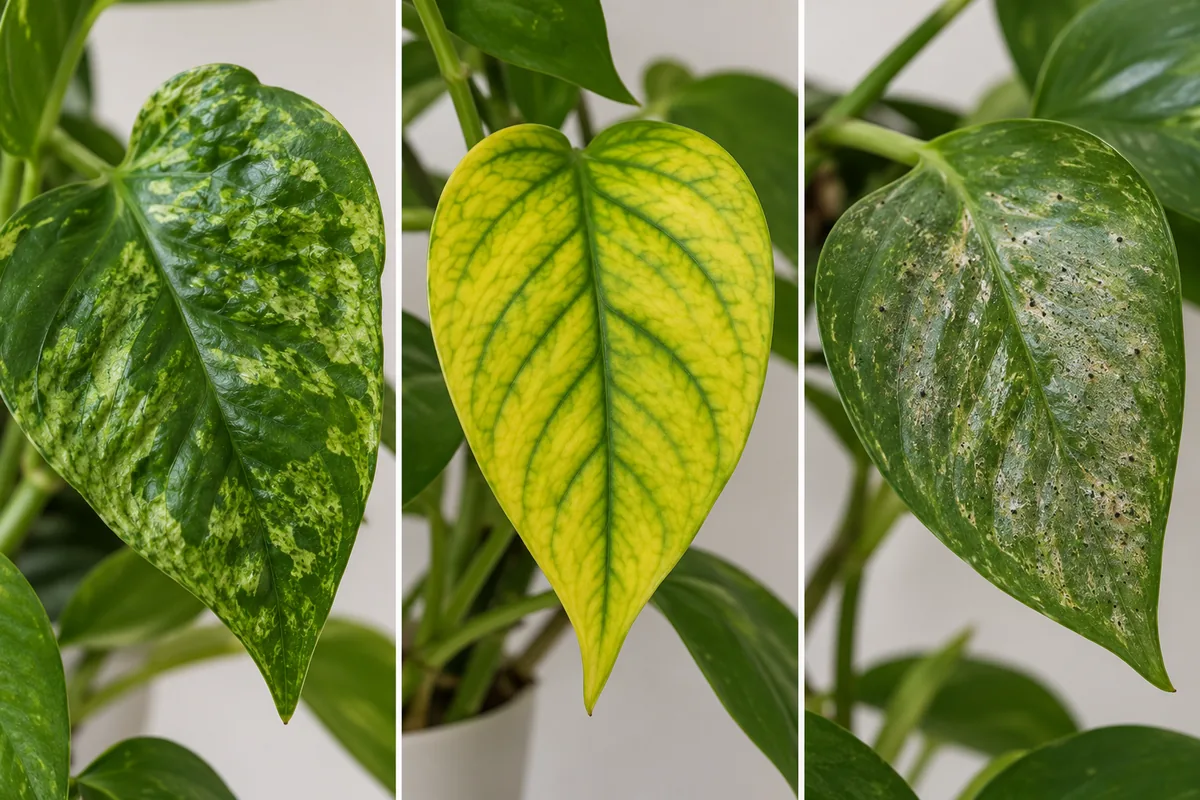
Yellow-green mosaic patterns, ring spots and small or distorted new leaves may point to a plant virus, but nutrient problems, chemical damage and thrips can look very similar, so appearance alone is rarely enough [2][5]. Most infected plants cannot be cured, so isolate first, then decide whether to keep the plant [1][2].
Key points
- Mosaic, ring spots and puckered new leaves suggest a virus, but they are easily confused with nutrient or environmental damage [2][5].
- No chemical treatment exists for plant viruses, and most infected plants do not recover, so the aim is to stop spread [1][3].
- Viruses move by sap-feeding insects, hands and tools, cuttings and grafts. Isolation, pest control and separate tools matter most [2][3][4].
- Sources disagree on keep or discard: some say destroy, while the RHS says mild cases may be kept [1][3].
How do I tell if it is a virus? Symptoms and look-alikes
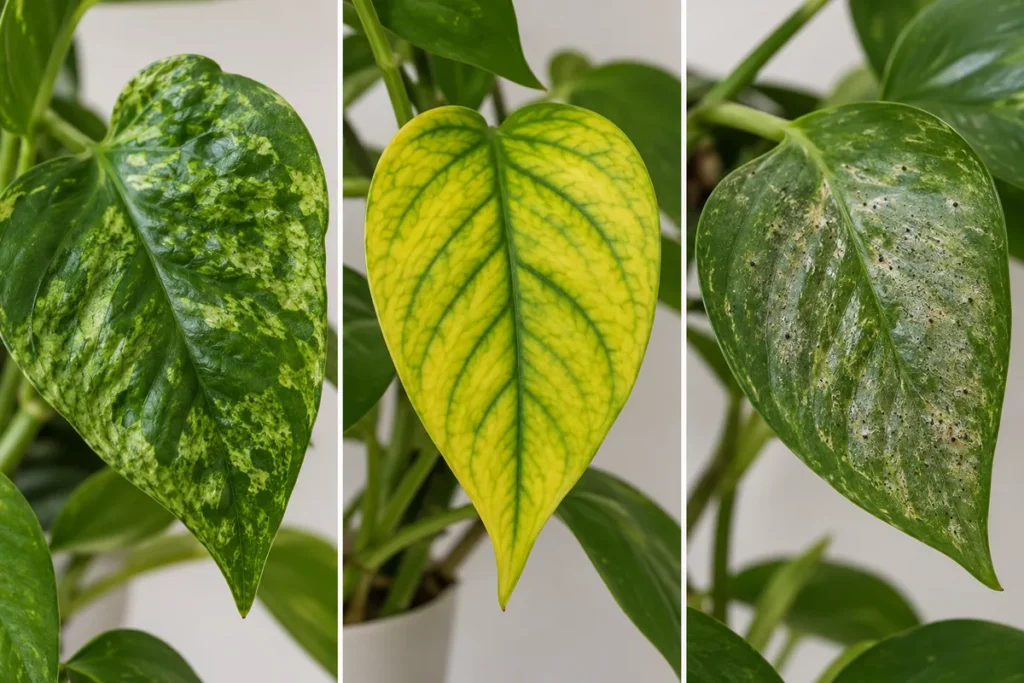
Common virus symptoms include a mosaic or mottle of light and dark green, pale ring patterns, necrotic or bleached areas, and small or malformed new growth [2]. The RHS adds vein clearing, puckered or rolled leaves and sometimes brown dead spots [3]. Flowers may show streaks of a second colour, called colour break [3][5].
The difficulty is that many non-viral problems look alike. University of Maryland Extension says these symptoms can be confused with nutrient deficiency or environmental effects such as air pollution [2]. The RHS notes that virus puckering resembles damage from hormone weedkillers [3]. For orchids, Iowa State lists nutrient imbalance, excess salts, strong light, insects or mites, and fungal or bacterial disease as possible look-alikes [5].
On a phone, swipe sideways to see every column.
| Clue | Possible cause | Next step |
|---|---|---|
| Irregular light and dark green mosaic, small or puckered new leaves, veins affected too | A virus is more likely [2][3] | Isolate, follow the steps below, consider testing |
| New leaves yellow with veins still green, symmetrical | Possibly a nutrient or pH issue (our inference) | See yellow new leaves with green veins |
| Silvery scratches and tiny black dots | Possibly thrips, which can also carry viruses [4] | See thrips |
| Twisted, puckered new leaves after a recent weedkiller or spray | Possibly chemical damage [3] | See distorted new leaves |
| Dead spots or rings on orchid leaves | Possibly a virus, but other causes are possible [4][5] | Isolate and ask for testing |
| Every new leaf has the same pattern and it looked like this at purchase | Possibly a naturally variegated cultivar | See variegated plants turning green |
Some viruses are even prized. The RHS mentions Abutilon mosaic virus, which creates the attractive pattern in variegated flowering maple (Abutilon pictum) [3]. So a mosaic does not always mean discard. If you cannot tell a cultivar pattern from a virus, isolate to be safe.
How do plant viruses spread?
Viruses cannot move by themselves. The RHS says common vectors are sap-sucking insects such as aphids, thrips and whiteflies, plus leaf-feeding beetles, plant-feeding mites, nematodes and soil fungi [3]. University of Maryland Extension names aphids, thrips and whiteflies, and UC IPM names aphids and thrips [1][2].
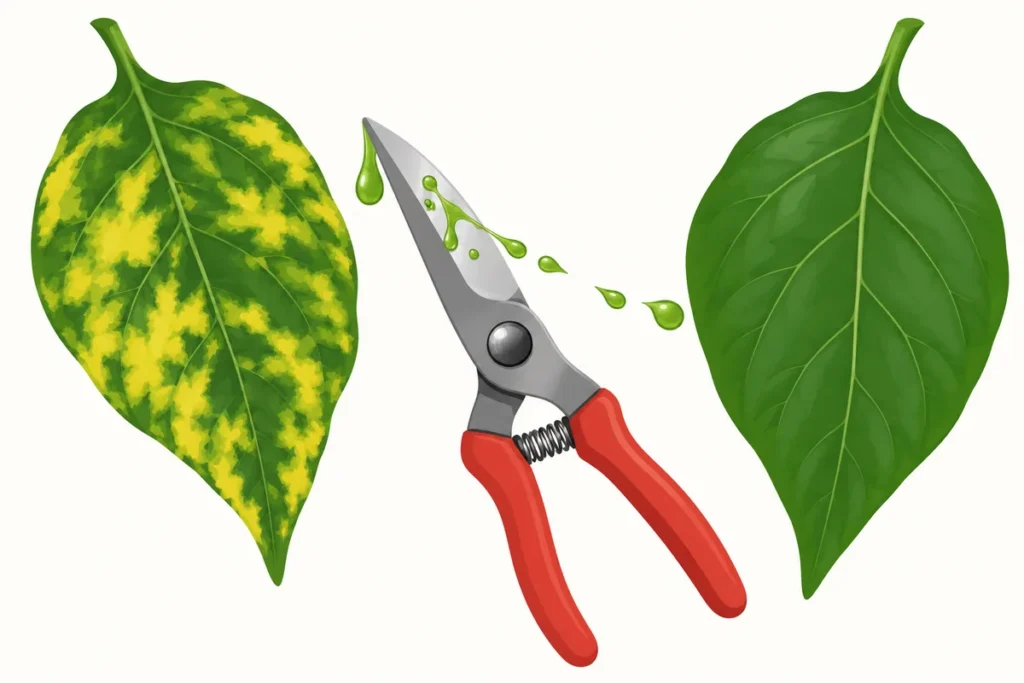
People and tools are another route. The RHS and the University of Wisconsin both say sap on knives or hands can carry viruses to healthy plants during trimming or deadheading [3][4]. Propagation carries risk too: viruses pass through cuttings, grafted material and bulbs, while seed transmission is less common [1][3].
The RHS says many viruses are killed quickly by heat and UV light in sunlight once outside a host, but some survive on pruning tools and a few can survive composting [3]. Wisconsin describes tobacco mosaic virus as very stable, found in dried plant tissue, clothing, work surfaces and tools [4].
The RHS also classes insect transmission as non-persistent (minutes to hours), semi-persistent (days) or persistent (lifetime, passed to progeny) [3]. That helps explain why a spray or two may not stop spread.
How can I confirm it is a virus?
Appearance alone is weak evidence. Iowa State says orchid viruses do not each produce characteristic symptoms, so precise visual diagnosis is virtually impossible and confirmation needs testing [5].
The Wisconsin clinic uses a quick serological dip-stick test for some orchid viruses such as Cymbidium mosaic virus, and has tested for INSV, TSWV, CMV and TMV [4]. Iowa State lists serology (ELISA), indicator-plant bioassays and electron microscopy [5]. Wisconsin warns that the virus amount varies with leaf age and infection time, so a dip stick can miss it. Sampling different ages of symptomatic tissue, and retesting a few days later, may be needed [4].
We have not verified a public virus testing service in Hong Kong suited to home plant owners, so we cannot name one. A practical first step is to send clear photos and a description to a nursery or plant clinic and ask what testing routes exist.
What should I do in the first few days?
- Isolate the plant and keep leaves from touching others.
- Stop sharing tools. Wisconsin says sap on tools or even hands can move virus to healthy plants [4].
- Check for vector insects: aphids, thrips, whiteflies [1][2][3]. Treat them in parallel; see thrips and aphids.
- Photograph new and old leaves weekly to see whether symptoms spread (our suggestion).
- Decide whether to keep or discard (next section).
- Disinfect tools and surfaces that touched the plant. Wisconsin advises decontaminating anything that contacted infected plants [4].
On disinfectants, the RHS recommends Virkon S for tools, available from agricultural suppliers [3]; we have not checked how to buy it in Hong Kong. Iowa State (an older 1996 article) mentions dipping tools in alcohol and flaming for several seconds, or dipping in a 10% bleach solution for several seconds [5]. Follow the product label for any disinfectant and do not mix it with other cleaners.
Should I throw the plant away? The sources disagree
UC IPM advises digging out and destroying infected plants because most cannot be cured [1]. The Wisconsin clinic recommends throwing out infected orchids after a positive test [4]. Maryland says managing virus diseases often involves removing the plant to protect neighbours [2].
The RHS is more flexible. If symptoms are mild and you can tolerate them, you may keep the plant, but it remains a source of infection, especially for viruses with wide host ranges such as Cucumber mosaic virus and Tomato spotted wilt virus. In that case you may prefer to destroy it [3].
Our reading is that a single plant, no shared tools and no thrips or aphids carries lower risk, so isolating and watching is reasonable. A large collection, orchids, or shared scissors raises the risk and makes discarding safer (our inference).
Viruses rarely kill plants, and well-grown plants can often tolerate them [3]. The decision is about infection risk against how much you value the plant, not about it dying tomorrow.
What should I avoid doing?
- Do not expect insecticide or fungicide to treat a virus. The RHS and Iowa State both say there is no chemical control [3][5].
- Do not take cuttings or divisions from a suspect plant. The RHS advises against propagating from any plant suspected of virus infection [3].
- Do not compost infected material, because a few viruses can survive composting [3].
- Do not use the same scissors on an infected plant and then a healthy one, and wash your hands in between [3][4].
- Do not keep adding fertiliser to a mosaic plant. The pattern may not be a deficiency [2].
- Milk or other home sprays are said online to treat viruses. We have found no university or botanic garden support for them, so we do not recommend them.
Advanced: why do symptoms come and go, or never show?
The RHS says infections can be mild or even symptomless, and symptomless plants can still be reservoirs of infection [3]. Symptoms also change with conditions: some viruses show more in spring when plants become active, and some symptoms fade when temperatures rise further [3]. That is why a plant may look better while the virus is still present.
A plant can carry more than one virus, and the symptoms depend on which viruses are present, their proportions, the order of infection, the plant’s own resistance and the environment [3]. Iowa State adds that orchids can carry a virus with no visible symptoms [5]. For a valued orchid, isolating and considering testing before adding it to a collection is likely to work better than reacting later (our inference).
Wisconsin’s case also warns that a negative result does not prove a plant is virus-free, because virus levels vary with leaf age and infection time [4].
How do I prevent it, and when should I ask an expert?
- Inspect leaves for mosaic, rings or distortion before buying, and isolate new plants first; see quarantine and tool hygiene.
- Prefer suppliers with testing records. Maryland advises buying certified virus-free stock and removing symptomatic plants promptly [2].
- Control aphids, thrips and whiteflies, and keep weeds down because weeds can harbour viruses [1][2][3].
- Use separate tools, or disinfect between plants, especially for orchids [4][5].
- If an orchid shows necrotic spots, the Wisconsin clinic suggests testing early for viruses, since orchids sometimes show few other signs [4].
Ask an expert if several plants show similar symptoms, if you propagate or sell plants, if symptoms keep spreading, or if you cannot tell a virus from a deficiency or pest. Clear photos, the plant name, purchase date and recent treatments make diagnosis easier.
Frequently asked questions
Is there a medicine for plant viruses?
No. The RHS says there are no chemical controls for plant viruses, and UC IPM says most infected plants cannot be cured [1][3]. What you can do is isolate, control insects, disinfect and decide whether to discard.
Does a mosaic pattern always mean a virus?
No. University of Maryland Extension says virus symptoms can be confused with nutrient deficiency or environmental damage [2], and the RHS says puckering resembles weedkiller damage [3]. Confirming needs testing, not just a photo.
Can I spread a virus on my hands?
Possibly. Wisconsin says viruses can move in sap on tools or hands during trimming [4]. Wash your hands and clean tools after handling a suspect plant.
Can I take cuttings from an infected plant?
The RHS advises against propagating from any plant suspected of virus infection [3], because viruses pass through cuttings [1][3].
If a test is negative, is my plant safe?
Not necessarily. Wisconsin says results depend on leaf age and infection time, so repeat testing may be needed [4].
Sources
- University of California IPM (UC IPM): “Viruses” — Virus symptoms, spread by aphids, thrips and cuttings, most infected plants cannot be cured, destroy them (flower and garden setting)
- University of Maryland Extension: “Virus Diseases of Shrubs” — Mosaic and mottle symptoms, confusion with nutrient and environmental damage, systemic infection with no cure, spread by insects and tools (shrub setting)
- Royal Horticultural Society (RHS): “Plant Viruses: Identification & Management” — Range of symptoms, symptomless carriers, seasonal symptoms, no chemical control, tool and propagation hygiene, whether to keep a plant
- University of Wisconsin Plant Disease Diagnostics Clinic: “March: Viral Villains – Gruesome Guests for Indoor Gardeners and Greenhouse Growers” — Dip-stick testing, tests can miss infection, spread in sap on hands and tools, discard and decontaminate after a positive
- Iowa State University Extension: “Virus Diseases of Orchids” — Orchid virus symptoms resemble other causes, visual diagnosis is hard, testing methods, disinfecting tools (a 1996 article)
Further reading
- Back to Plant Doctor
- Thrips: silvery scratches and black dots
- Aphids: how to remove them and when to use a product
- Quarantine and tool hygiene for new plants
- Distorted new leaves: pests, nutrients or chemicals?
- Why is my variegated plant turning green?
Sources checked: 31 October 2026. This is general guidance, not an on-site diagnosis. Always follow the product label.
