



Level: Intermediate
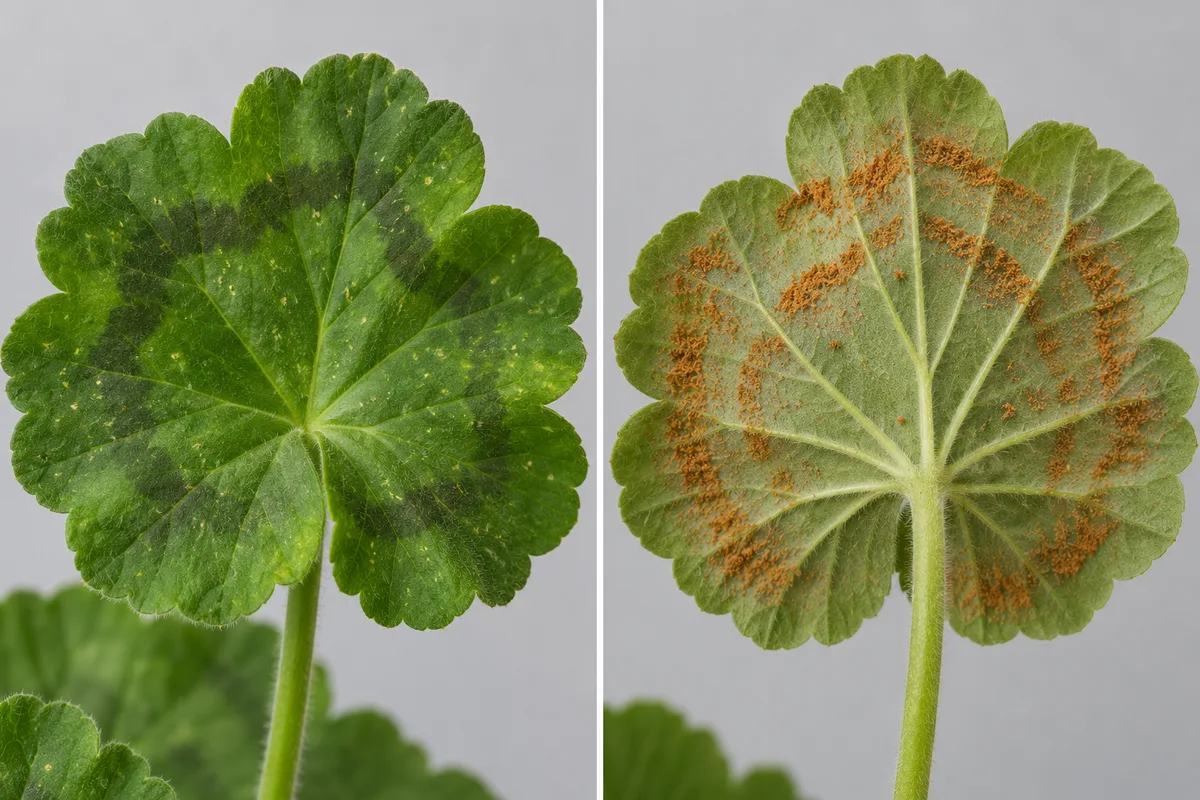
Orange to brown powdery pustules under a leaf, with small yellow specks on the upper side, are more often a rust fungus than anything else [1][2]. Isolate the plant, remove affected leaves into a sealed bag, and keep foliage dry. Follow product labels if you use a fungicide, and note that Hong Kong regulates pesticides [7].
Key points
- Rust usually shows as powdery pustules under the leaf and yellow specks on top, so always turn the leaf over [1][2].
- Neat rows of brown dots under a fern frond are normally spore clusters, not disease [5].
- Rust usually weakens a plant rather than killing it quickly, but more leaves tend to be affected over time [2][3].
- Universities and the RHS disagree on fungicides, and evidence for indoor pots is thin, so start with isolation and drier leaves [1][4].
How do I confirm it is rust? Turn the leaf over
Rust pustules are usually on the underside of the leaf and can be yellow, orange, purple, black or brown; some rusts also appear on the upper surface [2]. The first sign is often small yellow specks on top, followed by blister-like swellings underneath that release powdery spores [1]. Washington State University’s HortSense says rusts are usually easy to recognise because of the colourful, powdery spore masses [3].
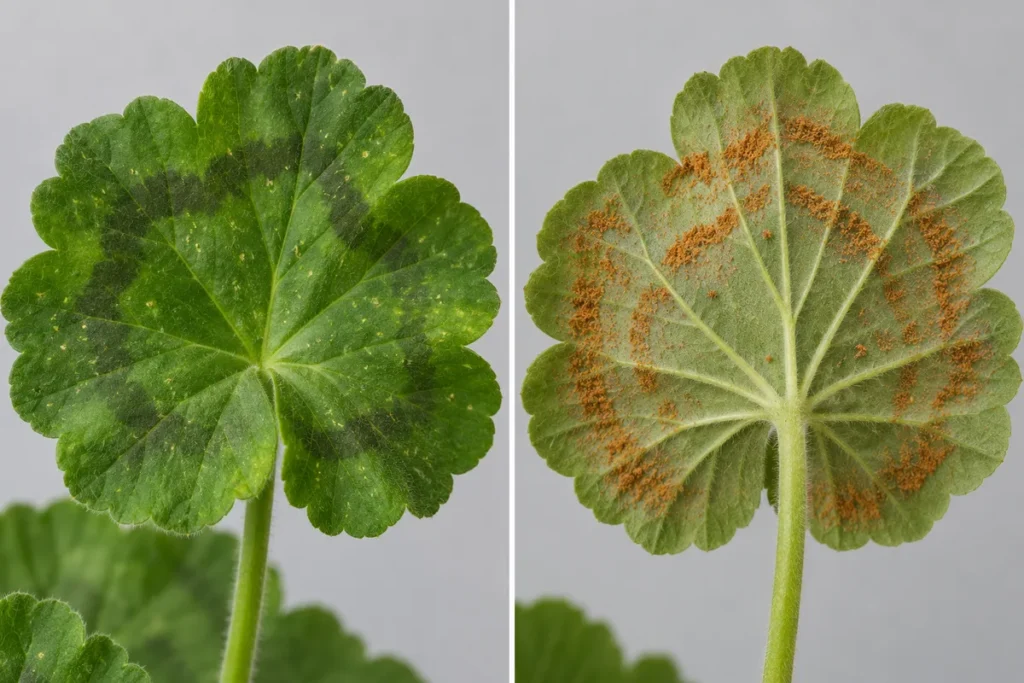
For zonal pelargoniums, the RHS describes yellow spots above and whitish blisters below, which turn into brown powdery spore masses, often in concentric rings. Badly affected leaves yellow and fall [4]. UConn also describes rings of pustules forming a target pattern under the leaf [1].
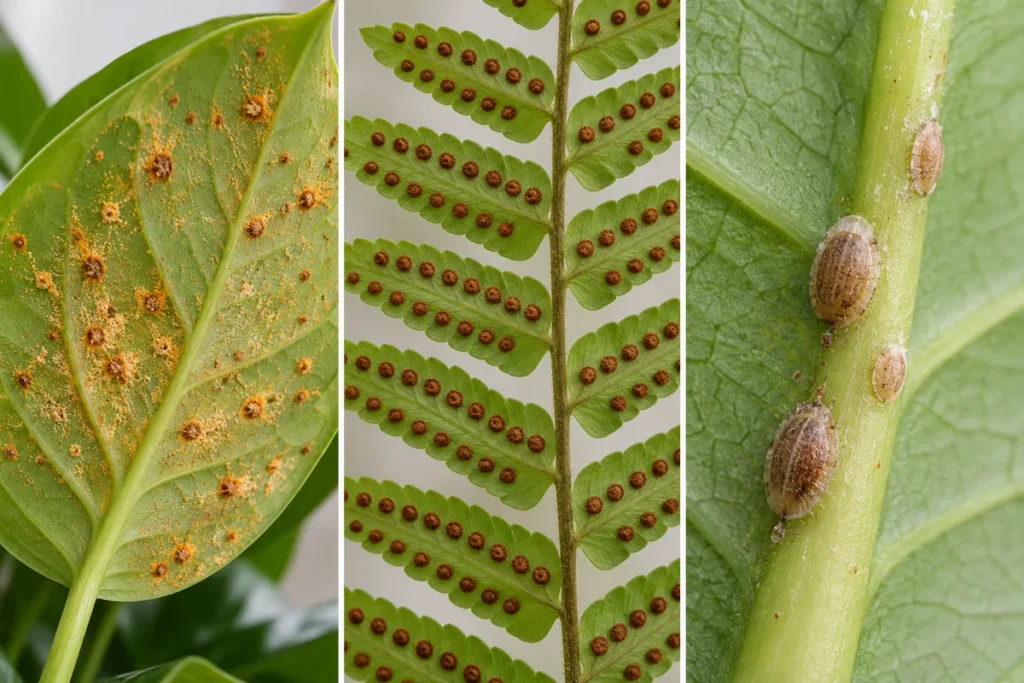
Orange-brown dots do not always mean rust. The table below helps you rule out common look-alikes. Where a clue is our own reasoning rather than something a source states, we say so.
On a phone, swipe sideways to see every column.
| Clue | Possible cause | Next step |
|---|---|---|
| Powdery orange-brown pustules, scattered or in rings, with yellow specks on top | Rust is more likely [1][2] | Isolate, remove leaves, follow the steps below |
| Two neat rows of round brown dots under a fern leaflet | Normal fern spore clusters (sori) [5] | No treatment; keep watching for real symptoms |
| Hard, raised bumps along veins or stems that flake off with a fingernail (our inference) | Possibly scale insects | See scale insects |
| Pale, corky bumps under the leaf with no powder | Possibly oedema | See corky bumps and oedema |
| White powder on the upper surface, not orange | Possibly powdery mildew | See powdery mildew |
| Brown round spots with a yellow halo but no powdery spores | Possibly a fungal or bacterial leaf spot | See leaf spots |
UMass Amherst points out that each rust has its own host plants and symptoms, so the same orange dot can mean different things on different plants [2]. If a photo still leaves you unsure, take a leaf to a nursery or plant clinic.
How does rust spread, and does Hong Kong humidity matter?
Rust spores travel on air currents and splashing water, and they need wet leaf surfaces to germinate [1][2]. UConn says mild, moist conditions favour rust [1]. So the key issue is not only humid air but how long the leaf stays wet.
The Hong Kong Observatory’s 1991-2020 normals give a yearly mean relative humidity of about 78%, roughly 82-83% from March to May and about 70% in December [6]. Given the conditions above, leaves may stay wet longer in spring. That link is our inference, not something the sources say about Hong Kong. The university material is mostly about greenhouses and nurseries, so homes and balconies may behave differently [1][2].
There is also a latent period. The RHS says the pelargonium rust fungus can sit in leaves for about two weeks before symptoms show, so a healthy-looking new plant may already carry it [4].
Most rusts are host specific and infect only certain plants [3]. One infected plant therefore does not mean every neighbour is at risk, but crowded, touching leaves still raise the chance of spread.
What should I do in the first week?
- Isolate the plant where air currents will not carry spores to others. Sources suggest keeping new or suspect plants apart for two to three weeks so any rust has time to show [1][2][4].
- Remove clearly affected leaves with clean tools, place them straight into a plastic bag and seal it, because spores spread easily on air [1]. HortSense says removing infected leaves early may work in home gardens, which is not a promise of success [3].
- Wash your hands and clean your scissors before touching other plants. This is our precaution; the sources give no specific method.
- Change how you water. Aim at the soil, not the leaves. If leaves must get wet, water in the morning so they dry quickly [2].
- Space plants so air can move between them [1][2].
- Check under leaves every few days and photograph new and old leaves to track progress (our suggestion).
These steps cut the number of spores and the time leaves stay wet. They do not remove fungus already inside a leaf. Spotted leaves usually do not return to normal, so judge progress by whether new growth stays clean.
Should I spray a fungicide? The sources disagree
UConn and UMass say preventive fungicides can help crops with a history of rust, and that growers should rotate chemical classes to limit resistance [1][2]. That advice is written for commercial greenhouses and nurseries, not for houseplants at home.
The RHS clearly advises against fungicides, even organic types, citing effects on biodiversity and soil health, and notes that homemade products are unregulated and untested [4]. HortSense suggests non-chemical options first and says to read the label whenever you use a pesticide [3].
Our position is that evidence for fungicides on indoor pots is weak, and we found no university guidance giving home doses. If you still consider one, choose a registered product suited to your plant and follow the label exactly. We do not offer home-made mixes. Fungicides count as pesticides under Hong Kong’s Pesticides Ordinance (Cap. 133), so check the label and registration details when buying [7].
Baking soda, milk, vinegar and garlic sprays are popular online. We have not found university or botanic garden support for them against rust, so we do not recommend them.
What should I avoid doing?
- Do not mist or soak the leaves to raise humidity, since rust needs wet leaves [1][2].
- Do not wipe off the powder and call it done. Wiping removes some spores, but the fungus is still inside the leaf and spores may spread [1].
- Do not leave removed leaves beside the plant or add them to compost. UConn advises sealing them in a bag and destroying them by burning, rapid composting or burying [1]. In a Hong Kong flat, sealing the bag and putting it in general waste is the practical option (our inference).
- Do not keep an affected plant with healthy ones, or swap or give it away.
- Do not mix chemicals or use products not labelled for the purpose [4].
Advanced: why do rusts differ from plant to plant?
Rust fungi are obligate parasites that need living plants. They seldom kill the host, but they reduce vigour, flowering and appearance [2]. Some rusts need two different host plants to finish their life cycle, while others need only one [1].
The RHS says pelargonium rust (Puccinia pelargonii-zonalis) needs no alternate host, and only one of its two spore types, the rusty brown urediniospores, seems to drive the disease. The other type is rare and has not been seen to germinate [4]. The RHS also says ivy-leaved pelargoniums are not affected [4], while UConn reports resistance in Regal, scented and ivy-leaf types [1]. The two statements are not identical, so real-world cultivars may still vary.
UMass explains that urediniospores spread the disease quickly in summer, and that rusts usually overwinter as a different spore type [2]. This matters little for home pots, but it helps explain why some rusts seem to vanish in winter and return later.
How do I stop rust coming back?
- Isolate new plants before adding them to your collection. The RHS suggests at least two weeks; UConn and UMass mention up to three [1][2][4].
- Look under the leaves before buying, and avoid plants with powdery dots or yellow specks [1].
- Reduce long wet periods on leaves: water the soil, water in the morning, and avoid crowding [1][2].
- UMass suggests keeping greenhouse humidity below 80% and moving air to stop condensation on foliage. That is a greenhouse figure and may be hard to measure or reach at home [2].
- Clear affected debris at the end of the season. UConn says unwanted geraniums should be discarded because carried-over stock can be a source of infection [1].
When should I get help, or give up?
If several plant types show the same dots, if new leaves are affected, or if you cannot confirm it is rust, take leaf photos to a nursery or plant clinic.
The RHS says that if plants are heavily infected and weakened, it may be sensible to dispose of them and start again [4]. UConn adds that severe infection causes leaf blighting and early leaf drop [1]. If only a few leaves are spotted and new growth stays clean, you can usually keep watching, because rust tends to weaken plants rather than kill them quickly [2].
Frequently asked questions
Can rust kill my plant?
UMass says rust fungi seldom kill their hosts, but they reduce vigour, flowers and appearance [2]. Severe infections can still cause heavy leaf loss [1].
Is wiping the orange powder off enough?
No. The powder is spores, and the fungus lives inside the leaf. Wiping removes only some and may scatter more [1]. Removing affected leaves, sealing them in a bag and keeping foliage dry is the better route [1][3].
How long before I know a new plant is clean?
The RHS says pelargonium rust can stay in leaves for about two weeks before symptoms appear [4]. Isolate new plants for a while and check under the leaves regularly [1][4].
My fern has rows of brown dots under the fronds. Is that rust?
If the dots are neat and regular, they are probably sori, the fern’s spore clusters [5]. Rust pustules are usually more scattered, with yellow specks on the upper side [1][2].
Is picking off the affected leaves enough for a pelargonium?
Removing leaves early may help, but HortSense only says it may be effective [3]. The fungus may already be in leaves that look clean [4], so keep checking.
Sources
- UConn Extension (Integrated Pest Management): “Rust Diseases on Ornamental Crops” — Rust appearance, spread and wet-leaf conditions, quarantining new plants, bagging infected leaves, keeping foliage dry (greenhouse and nursery setting)
- UMass Amherst Center for Agriculture, Food, and the Environment: “Rust Diseases of Ornamental Crops” — Where and what colour the spore masses are, obligate parasitism, rarely fatal, water management, protective fungicides per label (greenhouse setting)
- Washington State University HortSense: “Common Diseases: Rusts” — Rusts are easy to recognise, mostly host specific, non-chemical options first, removing infected leaves early
- Royal Horticultural Society (RHS): “Pelargonium Rust: How to Manage” — Pelargonium rust symptoms, latent period, isolating new plants, RHS advice against fungicides, discarding badly affected plants
- University of Wisconsin Division of Extension Horticulture: “Boston Fern, Nephrolepis exaltata ‘Bostoniensis’” — Sori on the underside of fern fronds are spore clusters, used here as a look-alike
- Hong Kong Observatory: “Monthly Meteorological Normals for Hong Kong (1991-2020)” — 1991-2020 monthly mean relative humidity
- Agriculture, Fisheries and Conservation Department, Hong Kong: “Pesticide Control and Related Information” — Pesticides, including fungicides, are regulated in Hong Kong under the Pesticides Ordinance (Cap. 133)
Further reading
- Back to Plant Doctor
- Powdery mildew: how to spot it and what to do
- Brown or black spots on leaves
- Quarantine and tool hygiene for new plants
- Scale insects: armoured and soft
- Corky bumps on leaves: could it be oedema?
Sources checked: 31 October 2026. This is general guidance, not an on-site diagnosis. Always follow the product label.
