



Level: Beginner
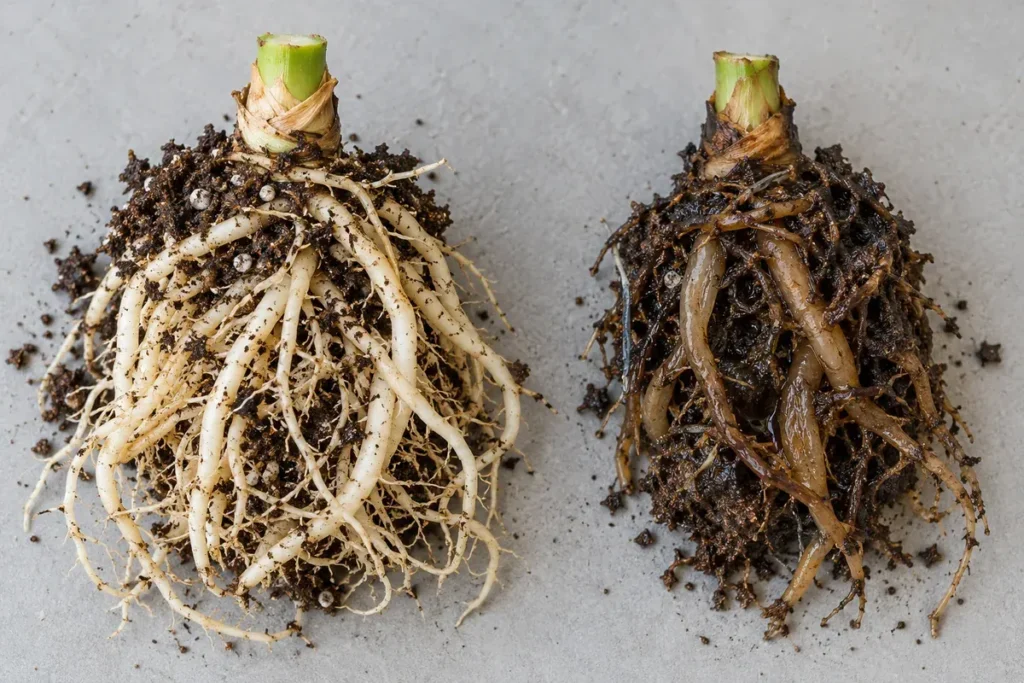
Root rot is damage to roots that sit in wet, oxygen-poor mix, and in some cases soil pathogens such as Pythium, Phytophthora or Rhizoctonia are involved [1][2]. The most reliable check is to unpot the plant: healthy roots look firm and pale, rotted roots look soft and dark [6].
Key points
- If a plant droops while the mix is still wet, check the roots before you add more water [1][4].
- Rot can come from low oxygen in saturated mix, from pathogens, or both. At home you cannot tell them apart by eye, but the response is similar: reduce wetness, cut away rotted roots, use clean mix [8][1].
- No source we read supports hydrogen peroxide or cinnamon, and one university clinic advises against fungicides for houseplants [4].
- If more than half the roots are damaged, the plant may not be worth keeping [6].
How can you tell root rot from underwatering?
Check the roots, because wilting alone does not settle it. Iowa State Extension says root rot usually shows as wilting of the lower leaves first, spreading upwards [1], and the University of Wisconsin clinic notes plants can wilt while the soil is still wet [4]. If the plant droops, hold off on watering until you have looked.
Slide the plant out of its pot. Chicago Botanic Garden describes healthy roots as firm and pale, and infected roots as soft, darkened and often smelly [6]. Iowa State adds that healthy roots carry many fine feeder roots, while rotted ones are mushy and brown or reddish [1]. Phipps Conservatory lists soil that stays wet right to the bottom of the root ball as a warning sign [7].
On a phone, swipe sideways to see every column.
| Clue | Possible cause | Next step |
|---|---|---|
| Lower leaves wilt, mix still wet | Root damage, including rot, is more likely | Stop watering and unpot to check [1][4] |
| Roots firm, pale, with fine roots | Roots look mostly healthy; wilting has another cause | Look at light, airflow and other problems; see overwatered or underwatered [1] |
| Roots soft, brown or reddish, maybe smelly | Root rot is likely | Follow the treatment steps below [1][6] |
| Plant stays wilted even after watering | Possibly Phytophthora-type rot (UC IPM describes landscape plants) | Do not add more water; unpot and check [3] |
| Stem base or roots dark, soft, break easily | Root or crown rot | Unpot soon; if damage is wide, consider stopping [2][6] |
| Mix smells bad but roots look normal | Possibly low oxygen or decaying organic matter | See smelly potting mix |
Hong Kong note: during humid spells the surface of the mix can stay damp for days. That alone does not mean the roots are rotting. Unpot and look.
Is it low oxygen or a pathogen?
It is often both, and you cannot separate them at home. A 2025 peer-reviewed review by Zhang and colleagues explains that once soil is saturated, oxygen runs out and roots switch to anaerobic respiration, so the harm comes from oxygen shortage rather than water itself [8]. Saturated mix alone can damage roots.
Pathogens add a second layer. Iowa State Extension says Pythium, Phytophthora, Rhizoctonia and Fusarium thrive in wet, poorly drained mix and mostly infect stressed or weak plants [1]. UC IPM likewise lists Fusarium, Pythium, Phytophthora and Rhizoctonia as common root and crown pathogens [2]. Our own inference, not stated by these sources, is that roots weakened by low oxygen may be easier for pathogens to attack.
- Low-oxygen damage: mix stays saturated, roots soften and darken, but no pathogen need be involved. Better drainage and air space are the focus [8].
- Pathogen involvement: Pythium is favoured by wet conditions, and the PNW handbook says some species develop faster once substrate passes about 25°C (77°F) [5]. UC IPM notes Phytophthora wilting does not recover after watering [3].
- Rhizoctonia and Fusarium: also common root pathogens [1][2], but none of the sources we read gave a visual test for telling them apart.
This matters because the PNW handbook says Pythium is hard to control once symptoms appear, so prevention counts for more than rescue [5]. Telling the pathogens apart needs professional diagnosis, so do not treat a guess as fact.

How do you treat confirmed root rot, step by step?
Stop adding moisture, remove the rotted roots, and repot into clean, free-draining mix. This matches the advice from Iowa State, Chicago Botanic Garden and Phipps [1][6][7], although none of them gives a recovery timetable.
- Stop watering and unpot. Iowa State says repotting may help and suggests watering less often [1].
- Shake off the old mix and inspect. Use sharp, clean shears to cut away brown, mushy roots [7]. Keep tools and containers clean or disinfested [5].
- Judge what is left. Chicago Botanic Garden says that if most roots are healthy you can cut off the damaged ones and keep the plant, but with more than half the roots damaged it may not be worth saving [6].
- Use fresh, free-draining mix and a pot with drainage holes. The Wisconsin clinic recommends a pasteurised commercial potting mix, not garden soil [4]. Phipps suggests a fast-draining mix with perlite [7].
- Do not reuse the old mix or drained water. The Wisconsin clinic advises against reusing both, and notes plastic pots are hard to disinfest [4].
- Wait before watering again. Phipps advises waiting until the roots have dried [7]. It also advises removing no more than about a tenth of the leaves at once [7].
For repotting detail, see how to repot a houseplant; for mix choice, see potting mix science. Avoid heavy feeding on damaged roots, since the PNW handbook warns that over-fertilising and high soluble salts can injure roots [5].
If the plant still droops or drops leaves after repotting, it may be repotting stress or unrecovered roots. See transplant shock.

Do hydrogen peroxide, cinnamon or fungicides work?
The evidence is weak. None of the university, botanic garden or peer-reviewed sources we read recommends hydrogen peroxide or cinnamon for root rot. They are widely repeated online, but they are not proven steps.
On fungicides, the University of Wisconsin clinic states it does not recommend chemical fungicides for houseplant root rot, citing limited products and cost, and says throwing the plant out is often the most practical choice [4]. The PNW handbook describes fungicides as mainly protective, with disease hard to control after symptoms show [5]. UC IPM says plants with substantial Phytophthora infection rarely recover [3].
If you do use any pesticide product, use only a locally registered one and follow the label exactly. Do not mix your own strengths.
What should you avoid doing?
- Adding water to a drooping plant before checking the roots [1][4].
- Putting gravel in the bottom of the pot. The Wisconsin clinic says not to [4]; see our look at gravel and drainage.
- Using garden soil or old potting mix [4].
- Reusing plastic pots without thorough disinfecting, which the clinic says is difficult [4].
- Planting directly in pots with no drainage hole. See decorative planters without drainage holes and avoid standing water at the base.
- Heavy feeding straight after damage [5].
How do you prevent root rot in a Hong Kong home?
Aim for good drainage, air in the mix and watering by need, not ‘less water because Hong Kong is humid’. Hong Kong Observatory 1991-2020 normals show monthly mean relative humidity from about 70% in December to about 83% in April and May, and about 19 rain days in June [9]. Those are outdoor averages, not the conditions in your flat or pot.
Iowa State Extension advises watering according to each plant’s needs rather than a fixed schedule [1]. Within one flat, a spot near an air-conditioner outlet, a window or a poorly ventilated corner may dry quite differently, and a windy high floor may dry some pots faster (a general observation, not a sourced figure). A finger in the mix, or the weight of the pot, is a safer guide, with a moisture meter as a cross-check.
Summer warmth deserves a note. The Observatory records a July mean temperature of about 28.9°C [9], and the PNW handbook says some Pythium species favour substrate above about 25°C [5]. But indoor pot temperature is not the same as outdoor air temperature, so these figures do not prove that Hong Kong summers always cause rot.
- Choose a free-draining mix and a pot with drainage holes [1][4].
- Check the mix before watering, not the calendar [1]; see how to water houseplants.
- Do not let saucers or cachepots hold standing water; see plant saucers and mosquitoes.
- If a plant sits near a dehumidifier, see houseplants and dehumidifiers.
When should you give up or ask a specialist?
Consider stopping when more than half the roots are damaged or the stem base is soft and dark. Chicago Botanic Garden says such a plant may not be worth keeping [6]. The Wisconsin clinic calls discarding the plant often the most practical and cost-effective option [4], and UC IPM notes heavy Phytophthora infection rarely recovers [3].
If the plant matters to you, or several plants show the same pattern, photograph the roots and mix and ask a plant disease clinic or a qualified plant professional. Do not escalate to stronger treatments on your own. Handle the old pot and mix with care and do not reuse them [4].
Giving up is not failure. If the cause was permanently wet mix and nothing changes, the next plant may suffer the same fate.
Check it step by step with Plant Doctor →
Frequently asked questions
How long does recovery take after root rot?
The sources give no standard time. Chicago Botanic Garden says the outcome depends on how long the roots stayed waterlogged and how much of the root mass was affected [6], and Phipps only says a plant may recover given enough time [7]. Watch for new roots or leaves and resist extra water or feed.
Why can a pot look dry on top yet still have rotted roots?
Because the surface dries first. Phipps lists soil that stays wet right down to the bottom of the root ball as a sign [7]. Unpot, or probe deeper with a finger.
Can I keep some of the old potting mix when repotting?
If you suspect root rot, it is better not to. The Wisconsin clinic advises against reusing mix or drainage water from affected plants [4]. Use fresh, free-draining commercial mix [4][6].
Do I have to give up a pot with no drainage hole?
Not necessarily, but planting straight into it raises the risk of standing water. The clinic recommends a pot with drainage holes when repotting [4]. You can also use a plain inner pot inside a decorative one; see decorative planters without drainage holes.
How should I treat the shears and old pot afterwards?
Keep tools clean or disinfested after cutting rotted roots [5]. The Wisconsin clinic says plastic pots are hard to disinfest and advises not reusing them [4].
Sources
- Iowa State University Extension: “Root Rots of Houseplants” — Pathogen groups, lower-leaf wilting, healthy versus rotted roots, watering by need
- University of California IPM (UC IPM): “Root, Stem and Crown Rots” — Common root-rot organisms, dark soft roots and stems, avoiding excess moisture
- University of California IPM (UC IPM): “Phytophthora Root and Crown Rot” — Phytophthora wilting that does not recover after watering; heavy infection rarely recovers (landscape plants)
- University of Wisconsin Plant Disease Diagnostics Clinic: “Root Rots on Houseplants” — Fungicides not advised for houseplants, discarding, reuse of pots and mix, drainage holes, gravel
- Pacific Northwest Plant Disease Management Handbook (Oregon State, Washington State, University of Idaho): “Greenhouse Plants, Ornamental-Pythium Seed Rot, Damping-off, and Root Rot” — Conditions favouring Pythium (wetness, substrate temperature), sanitation, fungicides mainly preventive
- Chicago Botanic Garden: “Overwatered Houseplants” — Unpotting to inspect roots, trimming rotted roots, fresh mix, when most roots are damaged
- Phipps Conservatory and Botanical Gardens: “Ask Dr. Phipps: Root Rot” — Signs of persistently wet root balls, trimming brown or mushy roots, fast-draining mix, waiting before watering
- Frontiers in Plant Science (peer-reviewed review, Zhang et al., 2025): “A review of soil waterlogging impacts, mechanisms, and adaptive strategies” — Saturated soil depletes oxygen and roots shift to anaerobic respiration
- Hong Kong Observatory: “Monthly Meteorological Normals for Hong Kong (1991-2020)” — 1991-2020 monthly mean relative humidity, temperature and rain days
Further reading
- Back to Plant Doctor
- Overwatered or underwatered? A side-by-side check
- Smelly potting mix: low oxygen, rot or organic matter?
- How to repot a houseplant: timing, steps and aftercare
- Gravel in Plant Pots: What a 2025 Study Actually Tested
- How to Use Decorative Planters Without Drainage Holes
Sources checked: 31 October 2026. This is general guidance, not an on-site diagnosis. Always follow the product label.
