



Level: Beginner
Repot only when the plant needs it: check the roots, choose a time when it is actively growing, move up to a pot that is only slightly bigger, and use a pot with drainage holes and potting mix [1][2][3]. Water thoroughly once afterwards, then wait until the plant needs water again [4]. Newly bought plants seldom need repotting at once [4].
Key points
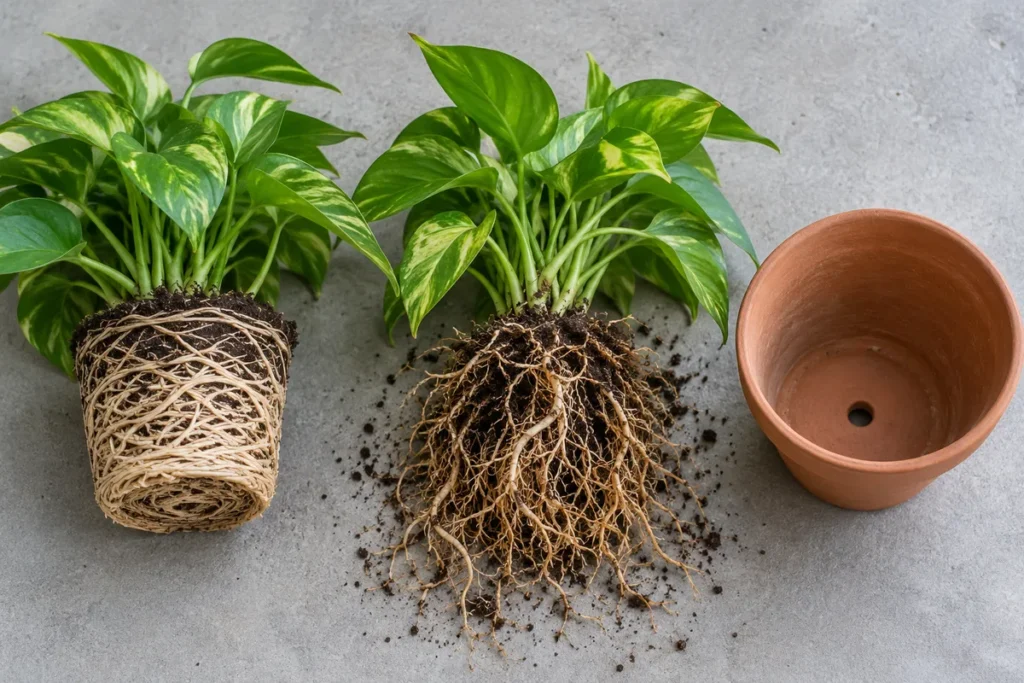
- Unpot gently and look: roots circling, or no visible mix in the bottom third of the root ball, suggests it is time [2].
- Go up only a little. The RHS says the new pot should be no more than one third larger [1].
- Use a pot with drainage holes and a potting mix, not garden soil [2].
- Water thoroughly after repotting, then wait until the mix needs water again [4].
Does my plant need repotting at all?
Often not. University of Missouri Extension says plants just brought home seldom need immediate repotting, and doing it at once adds strain while the plant is still adjusting [4]. Give new plants time to settle first.
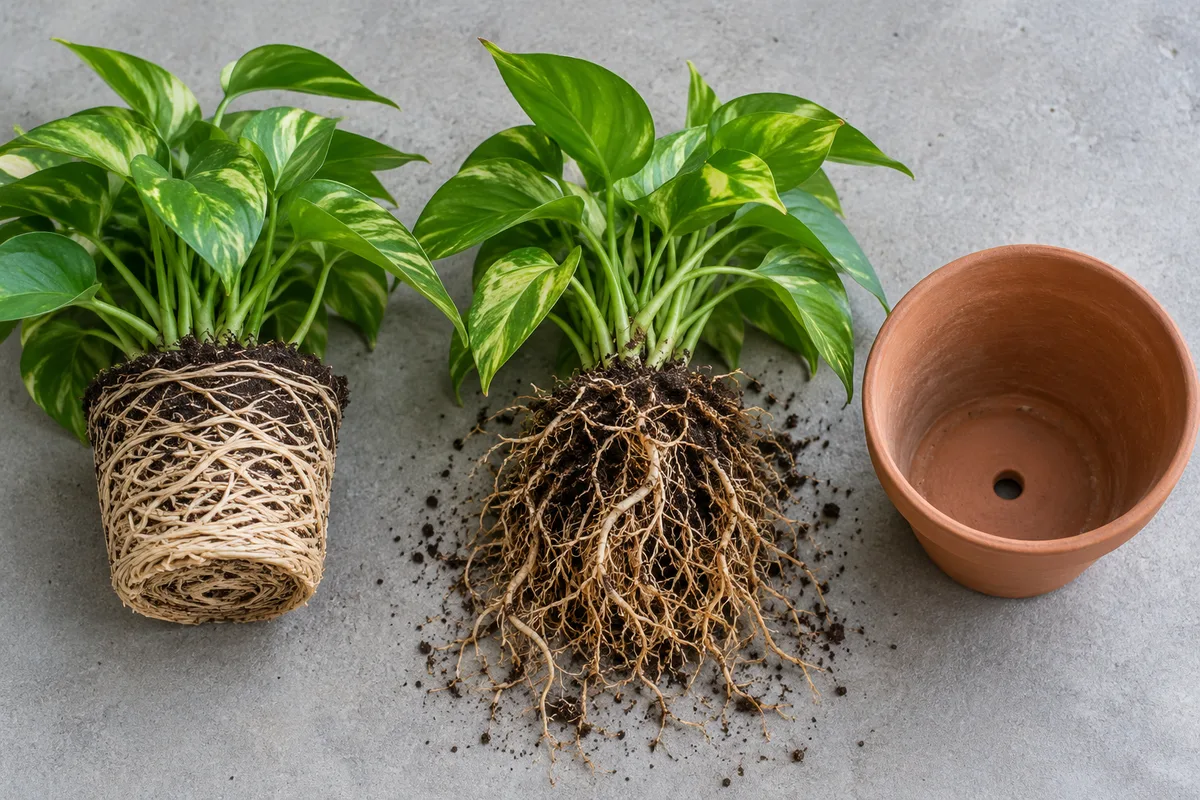
The most reliable check is to slide the plant out and look. Penn State Extension says that roots circling the root ball, or so dense that little mix shows in the bottom third, mean it is time [2]. University of Illinois Extension lists other clues: roots through the drainage holes, roots on the surface, a mass of roots, smaller new leaves and wilting between normal waterings [3].
On a phone, swipe sideways to see every column.
| Clue | Likely cause | Next step |
|---|---|---|
| Roots circle the root ball; little mix in the bottom third | Pot-bound roots [2] | Loosen the roots and move to a slightly larger pot |
| A few roots out of the drainage holes, but plenty of mix when unpotted | Only some roots have escaped (our own inference) | Unpot to check, then repot or trim the stray roots |
| Mix dries very fast and the plant wilts between waterings | Roots fill the pot and store little water [3] | Unpot and look; also rule out other causes |
| Drooping, wet mix, soft brown roots | Possible root rot; repotting is not the first step | See root rot |
| Newly bought plant with no obvious problems | Repotting not yet needed [4] | Observe and let it settle |
If the plant has just moved home and is drooping or dropping leaves, repotting may add stress; see transplant shock. To judge pot-bound plants in more detail, see root-bound plants.
When is the best time to repot in Hong Kong?
The principle is to repot when the plant is actively growing. Penn State Extension says spring is best, as the plant begins its natural growing season and roots grow into the new mix [2]; Illinois Extension says spring or early summer [3]. The RHS advises avoiding autumn and winter, since slow growth raises the risk of fresh compost staying too wet [1].
These recommendations come from places with distinct seasons. In Hong Kong, the Observatory’s 1991-2020 normals give a mean temperature of about 16.5 C in January, 23.0 C in April and 28.9 C in July [5]. The next two points are our own inference: many foliage plants start to grow as it warms from March to May, so they recover well from repotting; in high summer (roughly June to August) freshly disturbed roots may struggle with the heat, so avoid it unless you must.
If a plant is badly pot-bound, dries out extremely fast or has rotted roots, do not wait for the right season; delay can do more harm. Timing is a general rule only. Some species prefer snug roots, so check the species.
How big should the new pot be and does it need drainage holes?
The RHS says the new pot should be no more than one third larger than the old one [1]. Penn State Extension is less specific: slightly larger, because an oversized pot can look out of balance with the plant [2]. Neither suggests jumping several sizes.
The sources differ slightly: the RHS gives a ratio, Penn State just says slightly larger. For containers under 25 cm across, the RHS suggests a pot about 2.5-5 cm deeper and wider [1]. A bigger pot is not automatically better, because more mix dries more slowly; that is our own inference, as the sources do not explain why.
- Drainage holes are needed. Penn State Extension says excess water must drain so the mix does not become waterlogged, which can lead to disease [2].
- A decorative pot without holes. Keep the plant in a plastic pot with holes inside it and tip out the water after watering [2].
- Potting mix, not garden soil. Penn State says garden soil indoors could bring disease and pest problems [2]. Missouri Extension adds that adding soil to potting medium often leads to poor drainage [4].
- Reused pots. Wash them, then sanitise with one part bleach to nine parts water, following the product label [2].
For mix recipes, see potting mix science. On gravel in the pot base, see gravel in plant pots.
What are the steps?
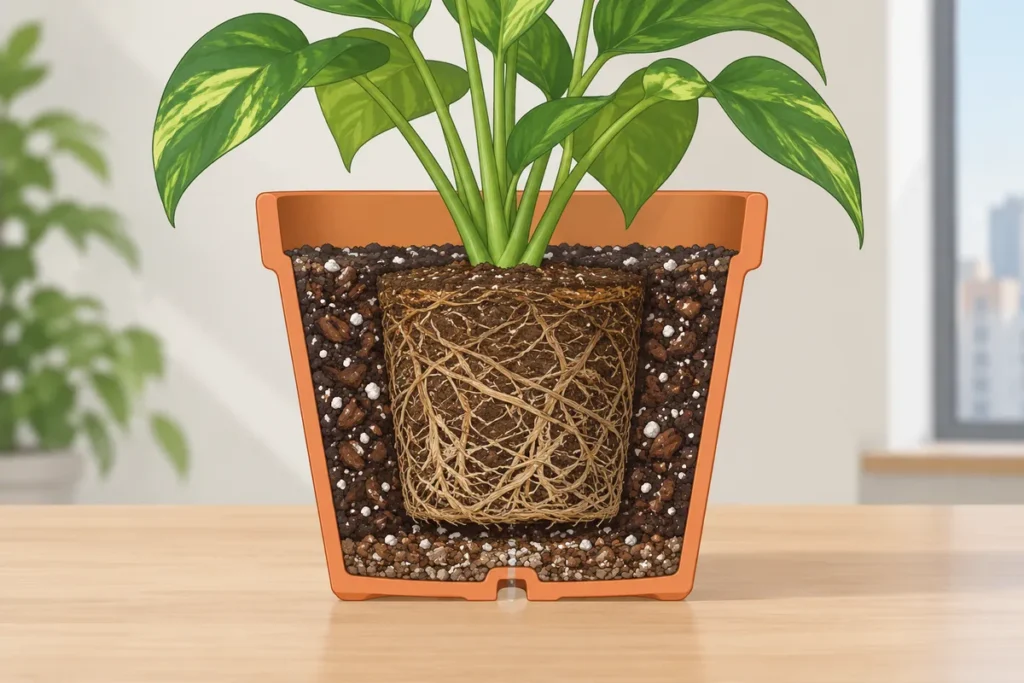
- Prepare a clean pot, fresh potting mix and tools. Wash old pots first [2].
- Slide the plant out gently, tapping the pot if needed. Do not yank the stem.
- Check the roots. Illinois Extension says to cut or unwind circling roots on root-bound plants [3]; the RHS says to tease them out and trim lightly if needed [1].
- If roots are very congested, the RHS says a light trim of up to 15% of the root system can be enough. That figure comes from container-plant guidance, so treat it as a guide for houseplants [1].
- Use the chance to look for soft, rotted roots. The RHS suggests trimming any you find [1]. If there are many, see root rot.
- Place a little mix in the new pot and set the plant at the same depth as before. Illinois Extension stresses this [3].
- Add mix around the sides and firm it gently without compacting. Missouri Extension warns against pressing so hard that the mix compacts [4].
- Leave a little space below the rim for watering [3][4].
- Water until it runs out of the drainage holes [1][2].
If there is a white crust of salts on the surface, Illinois Extension suggests carefully removing about the top inch of old mix [3].
How do I look after the plant afterwards?
Missouri Extension advises watering thoroughly, draining, and then not watering again until necessary [4]. The likely reason (our inference) is that fresh mix holds more water and the roots have just been disturbed.
- Watering: water thoroughly once, then use a finger to check; water when the upper mix has dried. See how to water.
- Position: put it back in similar light. Do not move it into strong direct sun at the same time, as freshly repotted plants cope less well (our inference).
- Feeding: the sources we read do not say when to start feeding after repotting, so we give no date. Follow the fertiliser label (our inference).
- Drooping or a few lost leaves: common for a few days; see transplant shock.
- White mould on the surface: can appear when new mix stays damp; see white mould on soil.
In Hong Kong’s humid weather or air-conditioned rooms, how fast mix dries varies a lot. After repotting, check with a finger below the surface. Mean relative humidity is about 78% for the year [5], but that does not mean plants need less water: judge by the mix.
What should I avoid, and when should I stop?
- Jumping to a much bigger pot. More mix dries slower and can stay too wet (our inference).
- Repotting a plant that is already rotting. Deal with the roots first; see root rot.
- Yanking the plant or tearing roots. Missouri Extension says to avoid excessive damage to the root system [4].
- Using garden soil. It may carry pests and disease [2].
- Thick gravel in the base to improve drainage. We found no source supporting gravel alone.
Consider stopping or asking for help if most roots are soft and rotted, if the stem base is soft, or if leaves keep dropping two to three weeks after repotting. For very large plants, ask a professional or replace only the top layer of mix. The RHS also notes that where a bigger pot is not practical, a light root trim and the same pot is an option [1].
Frequently asked questions
Should I repot a plant as soon as I bring it home?
Usually not. Missouri Extension says plants brought home from the greenhouse seldom need immediate repotting, and repotting adds strain [4]. Observe first and repot only if the roots are pot-bound or rotting.
How often should I repot?
There is no single answer. The RHS mentions every three to five years for most container plants, but that is general container guidance and does not map directly onto indoor foliage plants [1]. The roots and mix are a better guide [2][3].
Can I use garden soil?
Penn State Extension says garden soil in indoor containers may cause disease and pest problems; use a potting mix [2].
How long should I wait before watering again?
The sources give no number of days. Missouri Extension says water thoroughly, then wait until necessary [4]. Use a finger to check the mix.
Do I need gravel at the bottom of the pot?
We found no source supporting gravel alone for drainage. The key points are drainage holes and a loose mix [2].
Sources
- Royal Horticultural Society (RHS): “How to repot a plant: Expert Guide” — Timing, new pot size, teasing out circling roots, light root trim, first watering, checking for rotted roots (container plants, partly garden context)
- Penn State Extension: “Repotting Houseplants” — Judging pot-bound plants, slightly larger pot, drainage holes, no garden soil, cleaning reused pots, watering after
- University of Illinois Extension: “Repotting” — Signs a plant needs repotting, repotting while actively growing, cutting or unwinding circling roots, keeping the same depth, salt crust
- University of Missouri Extension: “Caring for Houseplants (G6510)” — New plants seldom need immediate repotting; water thoroughly then wait until needed; avoid root damage; do not compact
- Hong Kong Observatory: “Monthly Meteorological Normals for Hong Kong (1991-2020)” — 1991-2020 monthly mean temperature: 16.5 C in January, 23.0 C in April, 28.9 C in July; mean relative humidity 78% for the year
Further reading
- Back to Plant Doctor
- Root-bound plants
- Transplant shock
- How to water houseplants
- Root rot
- Is your houseplant planted too deep?
Sources checked: 31 October 2026. This is general guidance, not an on-site diagnosis. Always follow the product label.
