



Level: Advanced
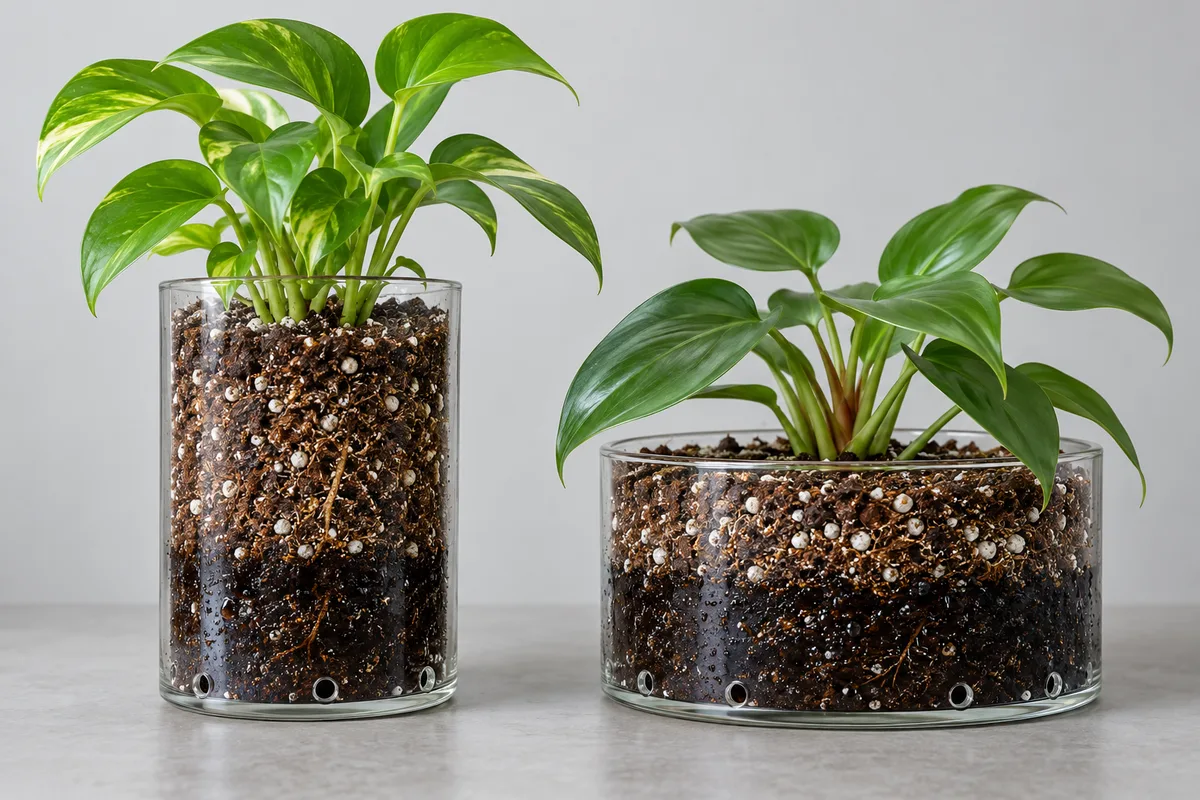
After watering, every pot keeps a saturated layer at the bottom, and the shorter the pot, the bigger the share of the mix that layer takes [1][2]. So judge a mix by how it balances air and water in its pores, together with pot height, not by a ‘free-draining’ label.
Key points
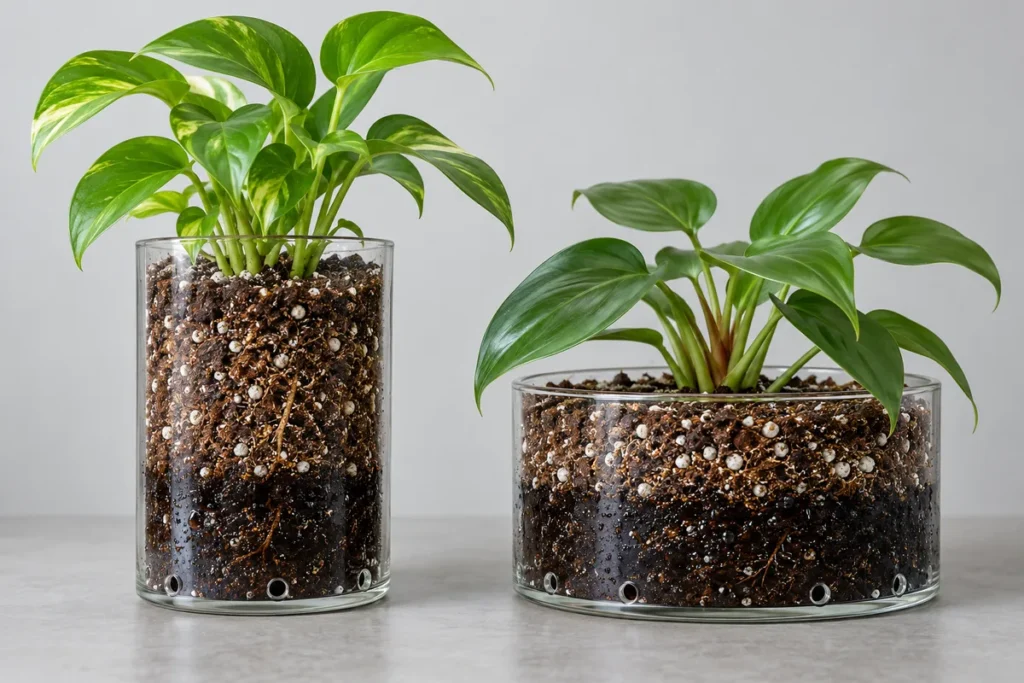
- Even pots with drainage holes keep a saturated zone with almost no air; it is proportionally larger in short pots [1][2].
- Peat and coir hold more water; bark and perlite let air in, and the blend decides how wet the mix stays [2][6].
- A ready-made peat-and-perlite mix suits most foliage plants, so you rarely need to mix your own [2][3].
- A gravel layer at the bottom is not a good fix, and garden soil carries risks [3][4][5].
Why does a pot with drainage holes still hold water at the bottom?
Because some mix at the base never drains. Purdue Extension calls this the perched water zone, says it has virtually no air space, and notes it makes up a larger share of the volume as the container gets shorter [1]. Virginia Tech agrees: taller containers drain more, shorter ones less, leaving more of the pores filled with water and less air. Container width does not affect drainage [2].
Pores do two jobs. Wide pores let air move, and narrow pores hold water. Purdue reports that soilless substrates are roughly three-quarters pore space, and that about 20–25 per cent air space is the ideal for greenhouse root growth [1]. That figure comes from greenhouse production, not home pots, so treat it as a rough guide only.
Our inference, since the sources do not test home pot shapes: the same mix in a shallow bowl-shaped pot will probably stay wetter than in a tall pot. If a shallow-potted plant is always damp, check pot height and mix texture as well as how often you water.
How can I tell whether my mix is too wet, too dense or water-repellent?
Start with what you can see, then decide whether to replace the mix. The table below gives first clues only.
On a phone, swipe sideways to see every column.
| Clue | Possible cause | Next step |
|---|---|---|
| Mix stays heavy for days after watering; saucer is always wet | Fine mix or short pot, so the saturated zone is a large share [1][2] | Let the mix dry, empty the saucer, and consider a coarser mix |
| Water pours straight out of the base, surface still dry | Dry peat or bark can repel water, so it runs down the gaps [1][2] | Water slowly in two or three rounds to rewet it [2] |
| Mix dries very fast | Small pot, terracotta, or a coarse blend [2][6] | Adjust to the plant; fast drying is not always a fault |
| Mix is dense and water soaks in slowly | Too much compost, which cuts air space [6] | Use less compost and a coarser blend next time |
Virginia Tech suggests three hand checks: lift the pot after watering and feel how light it is; cover the surface with your palm, turn the pot over and look for wet and dry patches; or poke a finger into the centre [2]. If your moisture meter and your hand disagree, see When the Moisture Meter and the Pot Disagree.
These checks cannot tell you whether the roots are healthy. If the mix smells or the stem base is soft, also read Root rot: how to tell, how to treat, when to give up.
What do peat, coir, bark and perlite each do?
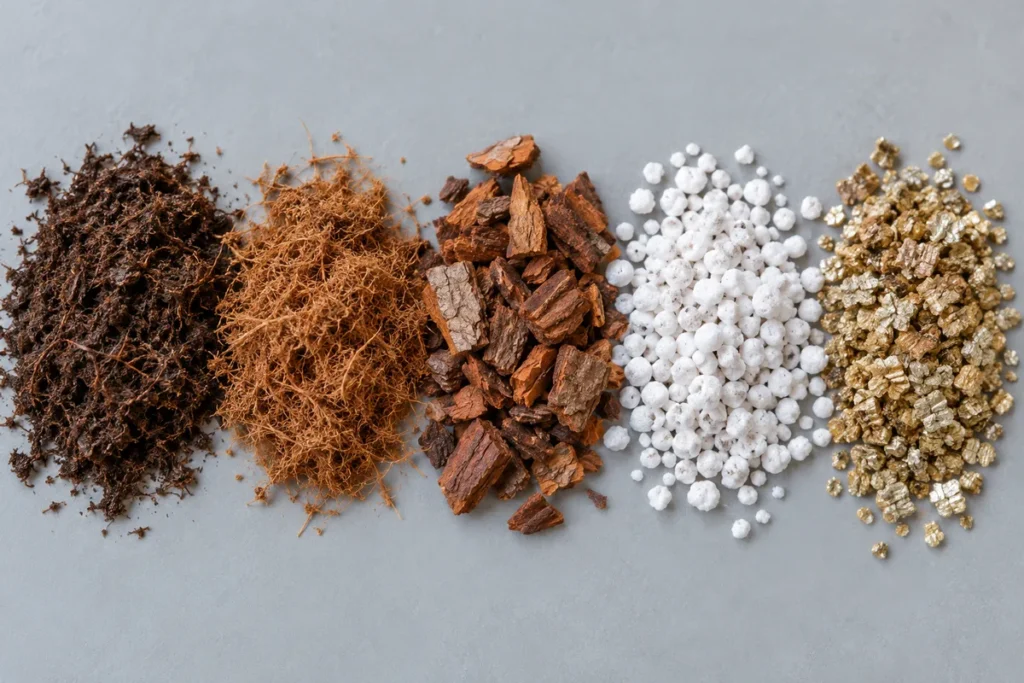
Broadly, fine or fibrous materials hold more water, and coarse ones drain faster [2].
- Peat and coir: hold moisture without turning to sludge, but give a mix more water and less air [2][6]. NC State notes that peat is not a sustainable resource and that substitutes are being researched [3].
- Bark: large particles give good aeration, but it is hard to rewet once dry [3], and it dries faster than peat [6].
- Perlite: improves drainage and aeration [6]. NC State warns it contains some fluoride, so avoid it for fluoride-sensitive plants such as spider plants and dracaenas [3].
- Compost: UNH advises no more than a third of the mix, because it reduces air space [6].
Where the sources differ: the University of Missouri advises avoiding garden soil in most cases, because it often leads to poor drainage, overwatering and root disease [5]. UNH lists sand as a common ingredient, added in large amounts for cacti and succulents [6]. NC State says a heavier mix suits windy rooftops [3]. They describe different goals, so how much soil or sand to add depends on the plant and where it stands.
How should I choose or blend a mix for my plants and my home?
For most foliage plants, a ready-made peat-and-perlite mix is enough [2]. NC State adds that buying a commercial mix is usually quicker and more reliable than blending your own [3].
- NC State lists common blends: 50 per cent peat with 50 per cent perlite, or 60 per cent peat, 20 per cent perlite and 20 per cent vermiculite [3].
- The University of Missouri suggests three parts peat, one part vermiculite and one part perlite for most houseplants [5].
- Epiphytic orchids need a very porous medium such as bark; cacti do well in peat-lite mix with an equal part of sterile sand [5].
- For plants prone to root rot or that prefer dry conditions, NC State suggests adding perlite for more air space [3].
Hong Kong context: the Observatory’s 1991–2020 mean relative humidity is about 70 per cent in December and about 83 per cent in April and May [7]. Our inference, as the source does not cover pot drying: in humid months the surface may dry more slowly, so the same schedule can leave the mix wetter. Check by hand rather than copying someone else’s ‘every X days’, and do not treat ‘Hong Kong is humid’ as a rule that every plant needs less water. See Hong Kong’s humid season.
On a windy high-rise balcony a heavier mix helps stop pots toppling [3], but it holds less air.
How do I fix a mix that stays too wet or dense?
- Check the pot has drainage holes. Plastic pots without holes can leave the mix saturated and lead to rot, and Virginia Tech suggests drilling some [2]. For decorative pots, see How to Use Decorative Planters Without Drainage Holes.
- Unpot and look at roots and mix. If roots are dark and soft, follow the root rot guide first.
- Repot into a coarser ready-made peat-and-perlite mix. Timing and steps are in how to repot a houseplant.
- Do not jump to a much larger pot: Virginia Tech warns this can leave roots in a zone that is too wet [2].
- Water until it runs from the base, and empty the saucer an hour later [5]. Virginia Tech says not to leave a pot standing in water for more than 60 minutes [2].
- If dry mix repels water, give two or three slow waterings to rehydrate it [2]. Purdue notes dry peat conducts water poorly, so a large volume simply runs off [1].
Which common habits should I avoid?
- Gravel at the bottom of the pot: NC State says not to, because water collects in the mix above the gravel [3].
- Adding garden soil to a peat mix: the University of Missouri links it to poor drainage, overwatering and root disease [5].
- Planting straight into a pot with no holes: it can leave the root zone saturated and cause rot [2][3].
- Flooding a dry pot once to ‘rinse’ it: dry peat lets water run straight through [1].
Evidence on gravel layers is mixed. NC State says gravel does little [3]. A 2025 PLOS ONE experiment measured whole-container water retention and found almost every drainage layer lowered it, with a 60 mm layer of coarse sand the most effective [4]. Our inference: the experiment measured the whole container, and the layer itself takes up space that mix would have filled, so a lower figure does not necessarily mean a better-aerated root zone. It is a single experiment, and more work is needed. See Gravel in Plant Pots: What a 2025 Study Actually Tested.
How do I prevent problems, and when should I get help or let go?
- Consider pot height along with the mix: the same mix stays wetter in a short pot [1][2].
- Terracotta usually dries the root zone faster; glazed pots hold water longer [2].
- Water by hand-check rather than by calendar.
- Read the ingredients on the bag rather than trusting ‘free-draining’ on the front [3].
If, after switching to a coarser mix and adjusting watering, the plant keeps yellowing, the stem base turns soft or the mix smells, root disease may be involved, and appearance alone cannot confirm it. See Smelly potting mix: low oxygen, rot or organic matter?, or ask a plant doctor or nursery to inspect it. If most roots are soft and brown, you may be able to propagate healthy cuttings, or decide to replace the plant.
Check it step by step with Plant Doctor →
Frequently asked questions
What is the difference between perlite and vermiculite?
Perlite is mainly used to improve drainage and aeration [6]. NC State suggests vermiculite and compost for plants with a high water requirement, to hold more water [3]. The ratio depends on whether the plant prefers drier or wetter conditions.
Is ordinary ‘houseplant compost’ good enough?
Virginia Tech says most commercial mixes are adequate for most houseplants; only orchids and some succulents need specialist mixes [2]. Read the ingredient label when you buy [3].
Is terracotta or plastic better?
Virginia Tech notes that water evaporates through terracotta walls, so the root zone dries faster, which suits dry-loving plants, while glazed pots are non-porous and keep the mix wetter for longer [2]. Choose to suit the plant and how you water.
Can I use a peat-free mix?
NC State notes that peat is not a sustainable resource and that alternatives are under research [3]. Peat-free blends vary at home, so check the ingredients and their water and air behaviour; see How to Choose a Peat-Free Potting Mix for Houseplants.
My mix is bone dry and water will not soak in. What now?
Virginia Tech suggests two or three slow waterings to rehydrate water-repellent dry mix [2]. Purdue notes that dry peat conducts water poorly, so one large pour mostly runs off [1].
Sources
- Purdue University Extension: “Understanding the Pores of a Soilless Substrate” — Pore space, air space, the perched water zone and container height (greenhouse substrate data)
- Virginia Cooperative Extension (Virginia Tech): “Properly Watering Container Houseplants” — Potting soil ingredients, container height and drainage, hydrophobic dry mix, pot materials
- NC State Extension: “North Carolina Extension Gardener Handbook, 18. Plants Grown in Containers” — Common mix components, example proportions, gravel at pot bottom, pots without holes, heavy mixes
- PLOS ONE (peer-reviewed, Rowe 2025): “Effect of drainage layers on water retention of potting media in containers” — Experiment on drainage layers and whole-container water retention
- University of Missouri Extension: “Caring for Houseplants” — Houseplant mix ratios, avoiding garden soil, orchid and cactus exceptions, saucer water
- University of New Hampshire Extension: “What is the best soil for potted plants?” — Roles of peat, bark, perlite, sand and compost
- Hong Kong Observatory: “Monthly Meteorological Normals for Hong Kong (1991-2020)” — Monthly mean relative humidity, 1991-2020
Further reading
- Back to Plant Doctor
- Overwatered or underwatered? A side-by-side check
- How to repot a houseplant: timing, steps and aftercare
- Root rot: how to tell, how to treat, when to give up
- Gravel in Plant Pots: What a 2025 Study Actually Tested
- How to Choose a Peat-Free Potting Mix for Houseplants
Sources checked: 31 October 2026. This is general guidance, not an on-site diagnosis. Always follow the product label.
