



Level: Beginner
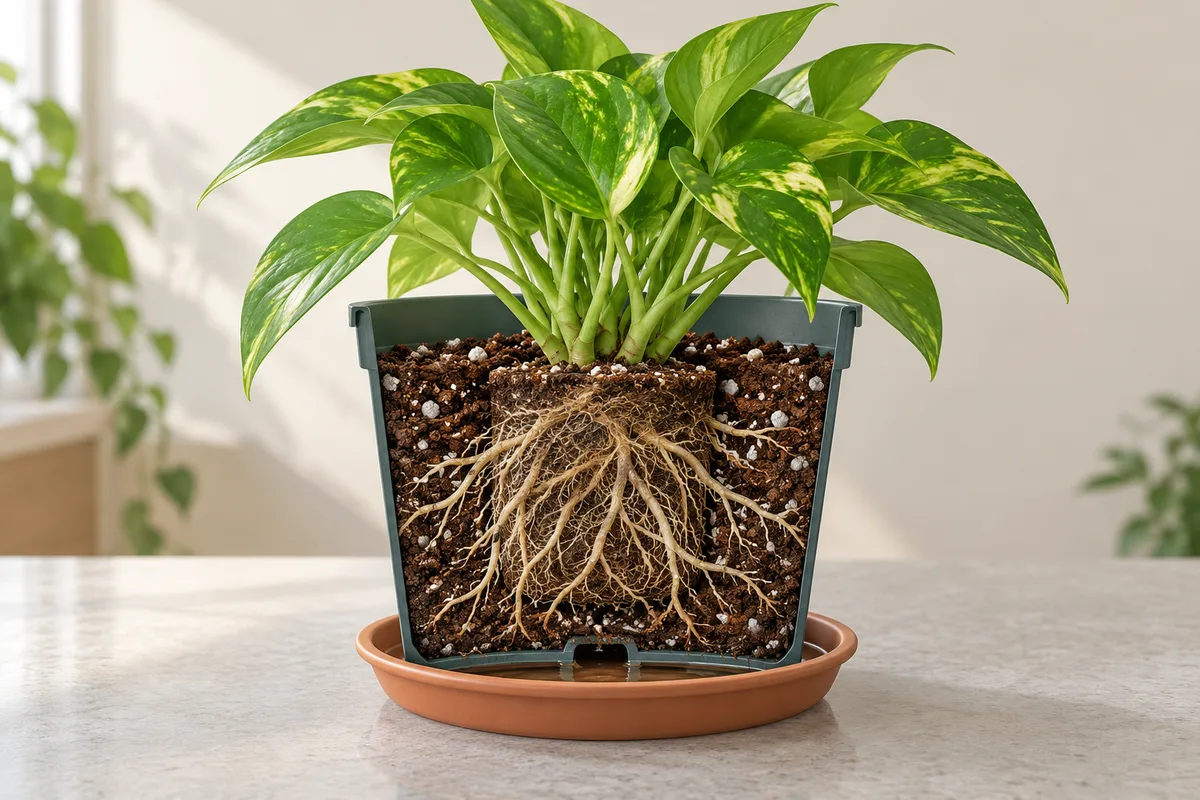
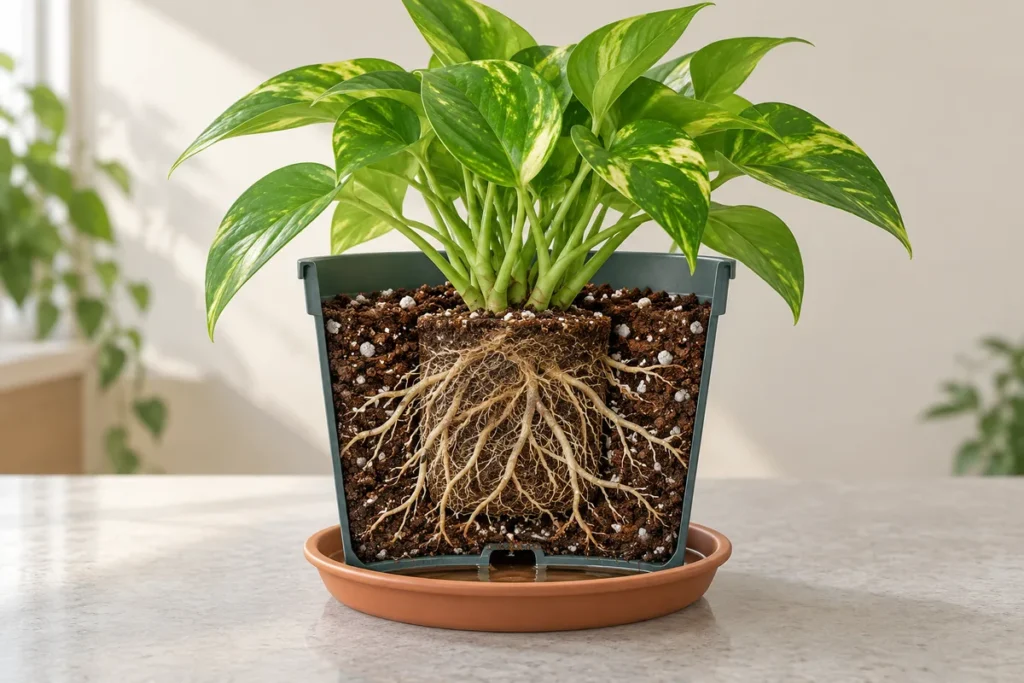
A houseplant that droops slightly or drops a few leaves after repotting or moving is more often adjusting to disturbed roots or different light than falling ill, and it usually needs time [1][4]. Check how damp the mix is, water it through once, keep it in one spot and leave everything else alone for now.
Key points
- Mild drooping and a few lost older leaves can be part of adjustment; extension services say plants need time to re-establish roots [1][7].
- Check the mix first: dry means water thoroughly, constantly cold and wet means think about waterlogging.
- After repotting, do not feed, do not move the plant again and avoid big light changes [3][6].
- Worsening symptoms, soggy mix or soft lower leaves mean it is time to look at the roots.
Is drooping after repotting normal, and how do I check?
Slight drooping can be normal. University of Illinois Extension says repotting is stressful, that plants may wilt or die back a little, and that with time, water and the right light they usually build a new root system [1]. Purdue Extension notes that new tree and shrub transplants have small root systems and are often short of water [5]. Applying that principle to pots is our inference, because the source describes landscape planting.
To check, push a finger a knuckle deep into the mix and judge how damp it is. Then see whether the whole plant droops or only the lower leaves turn yellow and soft. Purdue lists wilting, yellowing and leaf curling as signs of transplant stress [5], but these overlap with root rot and underwatering, so the mix and the timeline decide.
On a phone, swipe sideways to see every column.
| Clue | Possible cause | Next step |
|---|---|---|
| Whole plant slightly limp a few days after repotting, mix slightly damp, no smell | Disturbed roots cannot keep up with water loss from leaves (our inference; principle in [5]) | Keep it in a steady place, do not feed, water again only when the mix has dried to a suitable point |
| Droopy, mix dry through, pot feels light | Simple dryness, or new mix that drains very fast | Water thoroughly until it runs out of the base and empty the saucer [1] |
| Lower leaves yellow and soft, mix stays cold and wet, sour smell | Waterlogging or root rot, possibly linked to a pot that is too large or mix that is too fine | Unpot and look at the roots; see root rot |
| Yellowing and leaf drop within 1 to 2 months of a move, new leaves appearing | Change in light; older leaves are being replaced [3][7] | Keep the position and adjust light gradually; do not move it again |
| Scorched leaf edges and a white crust on the mix | Fertiliser salts, not repotting | See fertiliser burn |
What should I do in the first few weeks?
Aim for steadiness and a thorough first watering. Penn State Extension advises watering the new pot well, letting it drain, then putting the plant in its intended spot [2]. Illinois Extension adds that for indoor pots you should tip out excess water from the saucer after about 20 minutes [1].
- Water thoroughly straight after repotting until water drains out [2].
- After about 20 minutes, empty the saucer [1].
- Put the plant in light similar to what it had before, and do not use repotting as a chance to change its position drastically [3].
- Afterwards check the mix by hand and water when it has dried to a suitable point, not by the calendar.
- Remove only dead or clearly damaged leaves. Illinois suggests trimming dead foliage after watering [1]; keep healthy leaves.
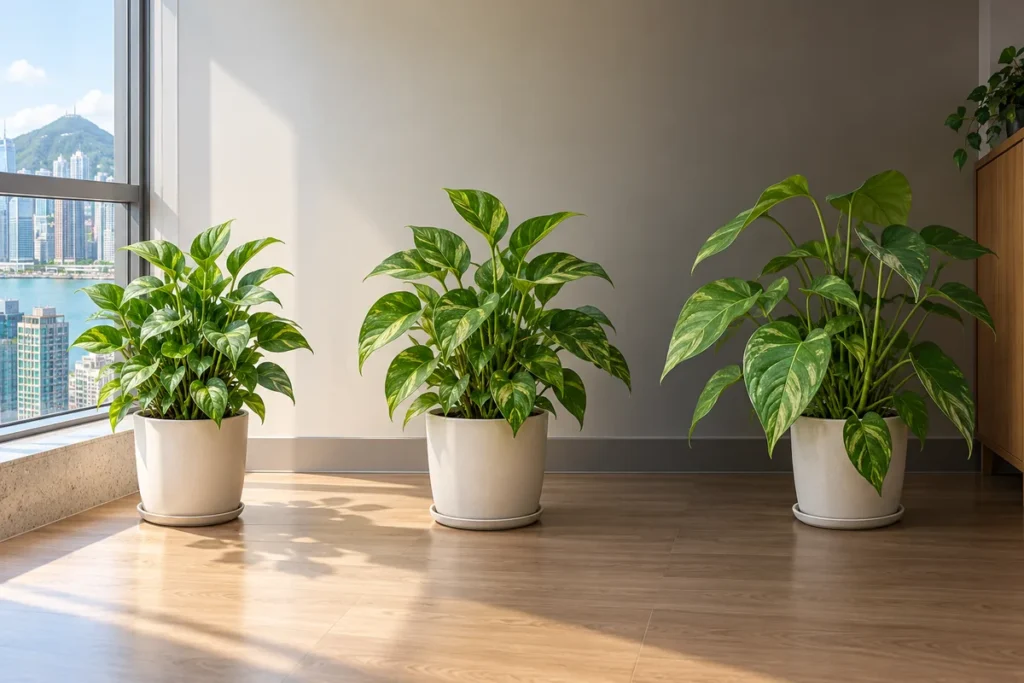
In an air-conditioned Hong Kong flat or during the humid spring season, mix dries slowly after repotting and stays wet easily. Waiting and checking by hand is safer than following a schedule.
How does shock from moving differ from repotting stress?
A move mainly stresses a plant through light. Virginia Tech Extension explains that plants grown in strong light make thick, small, less efficient sun leaves. In lower light they must either convert those leaves or drop them and grow larger, more efficient shade leaves [3]. University of Missouri Extension likewise says plants drop leaves while acclimating to life indoors [4].
To soften the shock, Virginia Tech advises lowering light gradually. For new plants grown in bright conditions, it suggests starting near a bright window and moving them to the permanent, dimmer spot over 4 to 8 weeks [3]. Penn State says plants moved indoors can take 1 to 2 months to adjust, with new growth after that [7]. These sources mostly describe moving US plants from outdoors to indoors. Moving from a shop to a small Hong Kong flat or an air-conditioned room follows a similar principle, but we found no direct figures for it.
If a repot and a move happen together, try to separate them: deal with the pot first, let the plant settle, then adjust its position slowly. That is our own suggestion, and no source compares the two approaches.
What should I avoid after repotting?
- Do not feed. Nebraska Extension says newly repotted, unrooted or wilted plants should not be fertilised [6]. See fertiliser burn for how to spot overfeeding.
- Do not add lots of water just because it droops. Check the mix first. If it stays wet, extra water adds to the oxygen shortage; see overwatering or underwatering.
- Do not choose a much bigger pot. Illinois recommends a pot about two inches wider in diameter, and warns that an oversized pot can lead to root rot because the plant cannot use the water [1].
- Do not put gravel in the bottom. The same source says a gravel layer does not improve drainage and can do the opposite [1]. See what a 2025 study tested.
- Do not plant deeper. Purdue says deep planting suffocates roots (tree setting) [5], and Illinois advises keeping the plant at its original height [1]. See replanted too deep.
- Do not stack changes. Moving, pruning and swapping mix all at once adds stress (our inference).
How can I prevent shock next time?
Prevention comes down to timing and technique. Penn State says the best time to repot is spring, when the plant naturally starts growing, so roots grow into the new mix and new foliage appears [2]. Hong Kong Observatory 1991-2020 normals give a mean of about 16.5 degrees C in January and about 28.9 degrees C in July [8], so Hong Kong spring does not map neatly onto a temperate one. We found no source naming the best Hong Kong month; a reasonable approach (our inference) is to avoid the coldest and hottest days and repot when the plant is pushing new leaves.
- Water an hour before repotting so the plant is hydrated [1][2].
- Soak a new clay pot overnight so it does not pull water from the mix [2].
- Use a light, well-draining potting mix, not garden soil [2]; see potting mix science.
- Tease out matted or circling roots gently rather than tearing them [2].
- Leave about an inch of space below the rim for watering [1][2].
- Full steps are in how to repot.
When should I suspect rot or ask for help?
If symptoms keep getting worse over the first weeks rather than levelling off, stop treating it as adjustment. A persistently cold, wet mix, many yellow soft lower leaves, a soft stem base or a sour smell point more to waterlogging or rot, so unpot and inspect the roots (our advice). See root rot.
If there is no new growth for one to two months and leaves keep falling, compare with no new growth. For large or valuable plants, or if you are unsure what is happening in the pot, ask an experienced plant shop or horticulturist to look in person, because an article cannot see your roots.
None of this is a diagnosis; what you find at the roots is what really counts.
Check it step by step with Plant Doctor →
Frequently asked questions
How long does a plant take to recover after repotting?
There is no fixed number; it depends on the species, how much the roots were disturbed and the conditions. Penn State Extension says plants moved indoors can take 1 to 2 months to adjust before new growth [7]. If things are not worsening, keep observing.
Should I trim leaves after repotting?
Only remove leaves that are dead or clearly damaged. Illinois Extension suggests trimming dead foliage after watering [1]. Healthy leaves still make food, so we would not cut many off to reduce water loss (a cautious view of ours that no source tests).
Can I fertilise straight after repotting?
We would not. Nebraska Extension says newly repotted, unrooted or wilted plants should not be fertilised [6]. Some fresh potting mixes already contain fertiliser, so check the product label.
My plant dropped leaves after I moved it. Is the new spot wrong?
Not necessarily. Plants moved from strong to weak light often drop older leaves and grow new ones suited to lower light [3][4]. If the spot is very dim and the plant keeps shedding without any new leaves, consider more light.
Why are the leaves yellowing after repotting?
Transplant stress itself can cause yellowing [5]. Check the mix: if it stays cold and wet and smells sour, suspect waterlogging or root rot instead.
Sources
- University of Illinois Extension: “Tips for Repotting Houseplants” — Repotting stress, new pot size, watering beforehand, planting height, no gravel layer, emptying excess water
- Penn State Extension: “Repotting Houseplants” — Repotting timing, loosening roots, choice of mix, soaking new clay pots, watering in afterwards
- Virginia Tech Cooperative Extension: “Indoor Plant Culture” — Sun leaves versus shade leaves, shock from sudden light change, 4 to 8 weeks of gradual adjustment
- University of Missouri Extension: “Snowbird season for houseplants” — Plants drop leaves when moved indoors; stepping down light gradually reduces it
- Purdue University Cooperative Extension: “Transplant Shock of Trees and Shrubs (BP-31)” — Symptoms of transplant stress, small root systems running short of water, deep planting suffocating roots (trees and shrubs; used for the principle only)
- Nebraska Extension (Lancaster County): “Success With Houseplants – Fertilization” — Newly repotted, unrooted or wilted plants should not be fertilised
- Penn State Extension: “Before the First Frost: Bringing Your Plants Indoors for Winter” — Yellowing and leaf drop after moving indoors is a common response; adjustment takes about 1 to 2 months
- Hong Kong Observatory: “Monthly Meteorological Normals for Hong Kong (1991-2020)” — 1991-2020 monthly mean temperature
Further reading
- Back to Plant Doctor
- How to repot: timing, steps and aftercare
- Root rot: how to tell, how to treat, when to let go
- Overwatering or underwatering? Side-by-side comparison
- Is your houseplant planted too deep?
- Spring Is Repotting Season: the repotting guide
Sources checked: 31 October 2026. This is general guidance, not an on-site diagnosis. Always follow the product label.
