



Level: Beginner
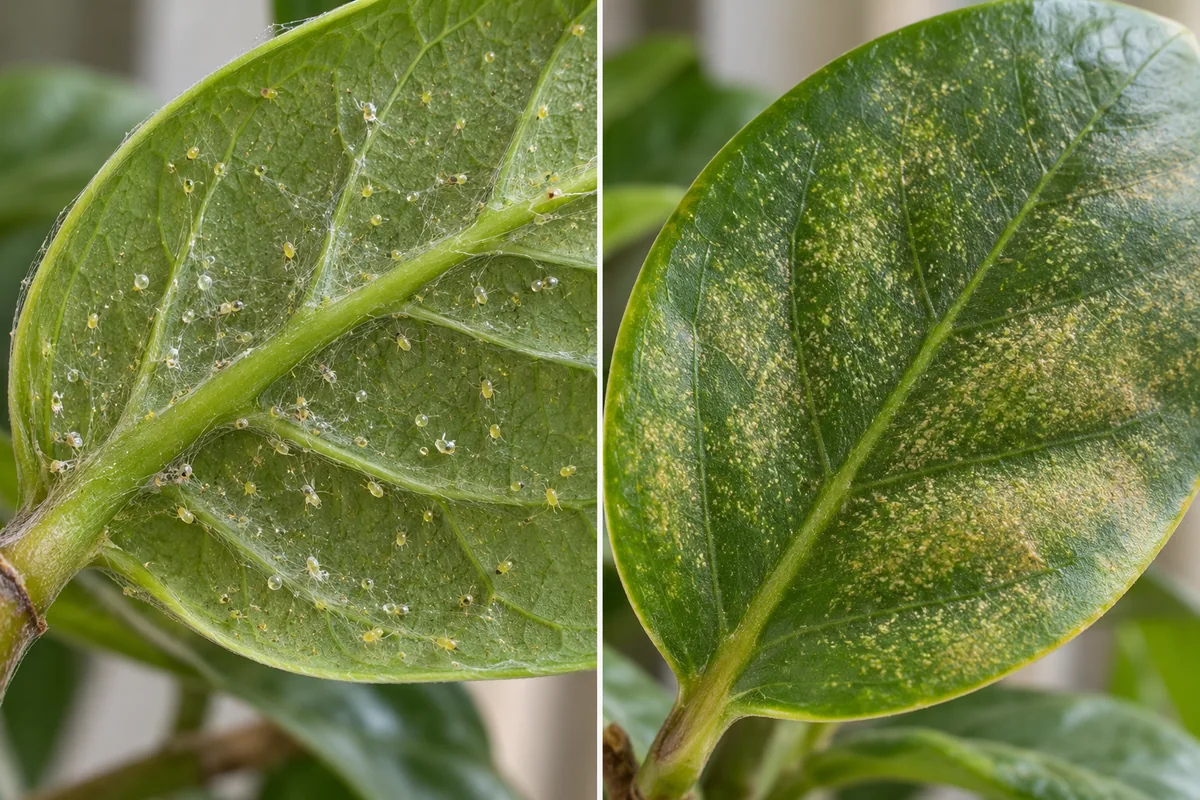
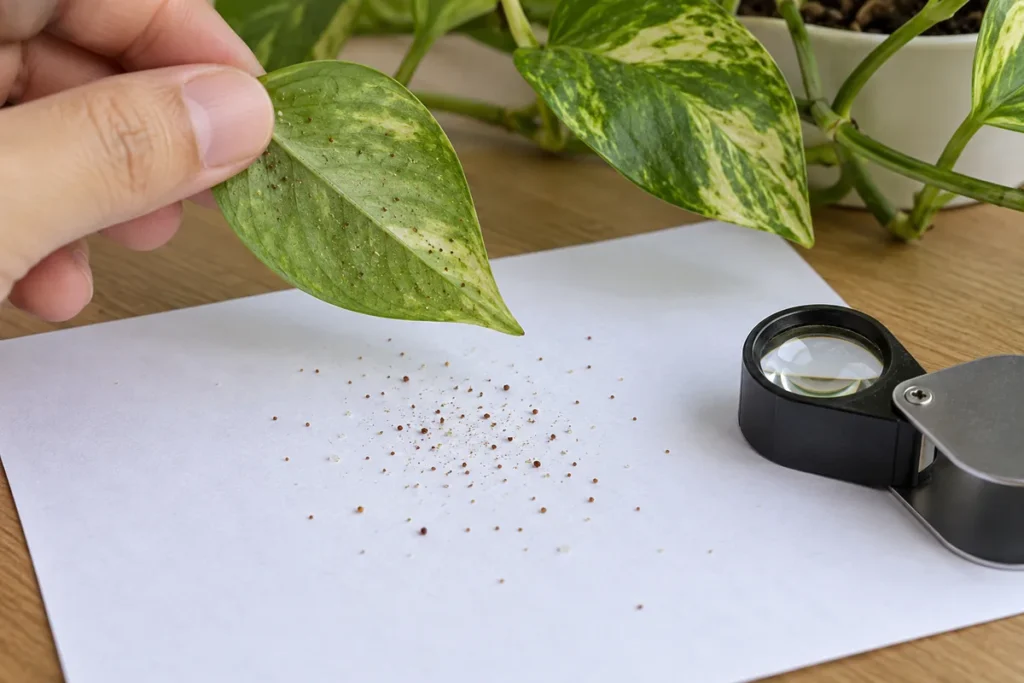
Spider mites are tiny arachnids that colonise leaf undersides and suck cell contents, first causing pale speckles and, in heavier cases, fine webbing [1][2]. Confirm them with a hand lens, or by shaking a leaf over white paper and watching for moving specks [1][2].
Key points
- Pale speckles may be mites or may resemble drought stress, so check the leaf underside with a lens or white paper [1][2].
- For light to moderate cases, rinse thoroughly with lukewarm water, repeated at least weekly, as WSU advises [4].
- Spraying water and raising humidity only reduce risk. The RHS says they will not control this mite alone [3].
- Avoid broad-spectrum insecticides: UC IPM says they can trigger mite outbreaks. Hong Kong allows only registered pesticides, used to the label [1][5].
How do I know it is spider mites and not thirst?
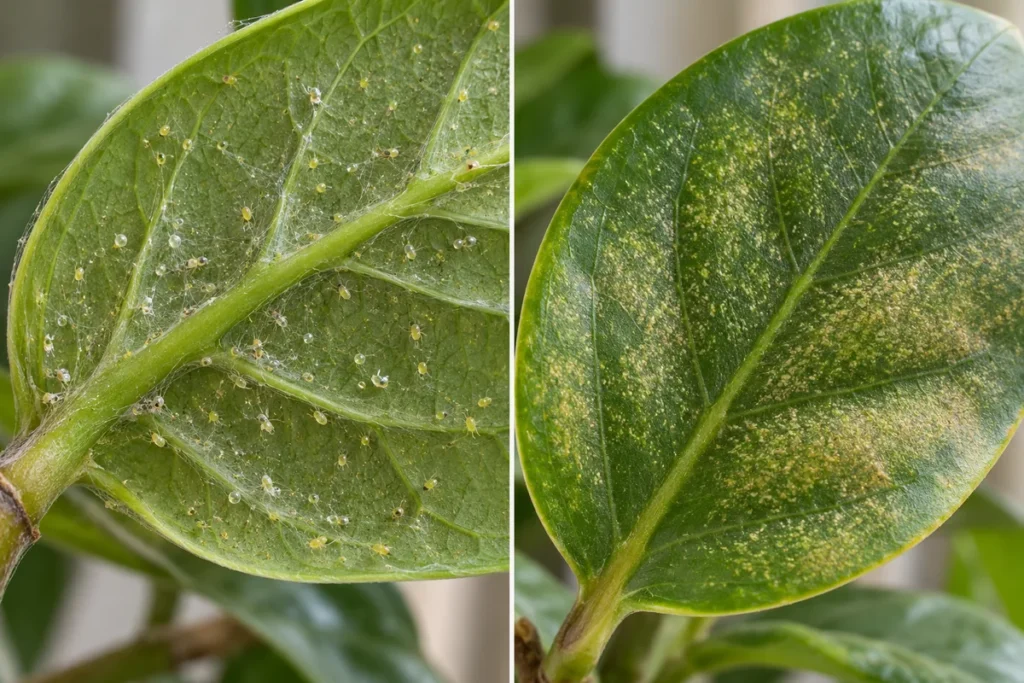
Always check the underside of the leaf. UC IPM describes spider mites as tiny moving dots, under 1/20 inch long, with eight legs, living in colonies mostly under leaves, sometimes hundreds in one colony [1]. The RHS describes a fine pale mottling on the upper leaf surface, and many tiny yellowish-green mites with white cast skins and egg shells below [3].
The damage is easily mistaken for drought. University of Minnesota Extension says the symptoms may be confused with drought stress [2]. UC IPM adds that you usually notice stippled or yellow leaves before you see the mites, and you need a 10X hand lens [1].
- Pick a speckled leaf, turn it over and light it from the side.
- Look with a 10X lens for specks, cast skins, eggs or fine silk [1].
- Hold the leaf over white paper and tap it. Look for tiny specks that fall and move; both UC IPM and Minnesota describe this check [1][2].
- Treat only once mites are confirmed. UC IPM stresses checking they are present before treating [1].
On a phone, swipe sideways to see every column.
| Clue | Possible cause | Next step |
|---|---|---|
| Pale speckles above; tiny moving dots or cast skins below | More likely spider mites | Isolate and rinse, see the treatment steps [1][3] |
| Fine silk between leaves and stems with specks crawling | More likely mites; UC IPM says webbing helps separate them from aphids and thrips | Isolate at once [1][4] |
| Leaves droop or edges dry but the underside is clean | Possibly water stress or root trouble | See over- versus underwatering and drooping plants |
| Silvery patches with tiny black dots | Possibly thrips | See thrips |
| Sticky leaves and white waxy fluff | Possibly mealybugs or another sap-sucker | See mealybugs |
Hong Kong tip: a humid spell does not rule out mites. Air-conditioned rooms can be very dry, so look at the leaf rather than guess from the weather.
Why do mites appear in Hong Kong flats?
Spider mites like warm, dry conditions. The RHS says the mite thrives in warm, dry conditions [3], and Washington State University says they thrive in the warm, dry conditions found in most homes [4]. UC IPM notes a generation can finish in under a week when temperature and food suit them [1].
The Observatory’s 1991 to 2020 normals show a yearly mean relative humidity of about 78%, a July mean temperature of about 28.9 degrees C, and a December mean humidity of about 70% [6]. Those are outdoor figures and do not describe your home. Our inference is that a spot under constant air conditioning, in direct sun or by a vent can be locally drier and hotter, raising the risk.
WSU lists the routes in: new plants, outdoor plants brought indoors, and open screens in summer. Mites then spread by leaf contact, walking or drifting on silk strands [4].
What do I do first?
Isolate, then rinse. WSU advises isolating infested plants because mites move mainly by leaf contact, walking or drifting on webbing [4].
- Move the plant away from others so leaves do not touch [4].
- In a shower or sink, rinse thoroughly with lukewarm water, especially all leaf undersides. WSU suggests repeating at least weekly and wrapping a bag around the pot to keep soil in [4].
- Minnesota notes a strong water spray can dislodge mites and wash away their webbing [2]. Reduce the pressure on delicate plants; that caution is ours, as the sources give no pressure figure.
- Cut off the worst leaves and bag them.
- Recheck every few days with a lens. UC IPM notes mites are sometimes gone by the time damage shows, and plants often recover [1].
UC IPM’s quick tips suggest spraying or misting leaf undersides at least once a day on infested plants [1]. However, the RHS says regular spraying and high humidity reduce risk but will not control the mite on their own [3], so treat this as a support measure only.
Soap, oil or insecticide: what does the evidence say?
UC IPM says sprays of water, insecticidal oils or soaps can be used, covering the leaf undersides completely, and not when plants are water-stressed or very hot [1]. Minnesota says soaps and horticultural oils are reasonably effective but kill only mites they touch, have no residual action and may need repeating [2]. Both sources mainly describe gardens and landscapes, so test on one or two plants first when using them indoors [1].
Home-made soap is risky. Minnesota notes insecticidal soaps are made from potassium salts of fatty acids and warns not to mix your own because it can burn plants [2].
Broad-spectrum insecticides can make things worse. UC IPM says insecticides used on other pests often cause mite outbreaks, partly by killing natural enemies and partly by stimulating mite reproduction [1]. Minnesota also advises avoiding long-lasting products such as bifenthrin and permethrin because they kill natural enemies [2].
Hong Kong law: AFCD states that under the Pesticides Ordinance (Cap. 133), only registered pesticides may be distributed and used in Hong Kong [5]. Choose a product with a registration number and your plant on the label, and follow it exactly. WSU advises against chemical controls on indoor edible plants such as herbs [4]. For pet or child safety, ask a vet or doctor. This article gives no home-made mixes.
The RHS mentions predatory mites as biological control, but in a glasshouse setting [3]. It is hard to justify for a few home pots.
What should I avoid?
- Do not only spray the top of the leaf. The mites live underneath, and spraying is only supportive [1][3].
- Do not overwater to fix dry air. WSU warns against it [4], and Minnesota warns overwatering can cause root rot [2].
- Do not reach for a strong broad-spectrum insecticide. It may increase mites [1][2].
- Do not mix your own soap. It can burn leaves [2].
- Do not treat before you have seen mites. Confirm first [1].
- Do not rinse once and stop. Keep checking with a lens [1][4].
How do I prevent a return?
Quarantine new plants and plants brought in from outdoors for about a month and inspect them regularly; WSU says to continue until they are clean for at least a month [4]. Keeping plants healthy also helps: WSU says strong plants tolerate damage better [4], and UC IPM says water-stressed plants are most likely to be damaged [1].
On humidity, WSU suggests standing the pot on (not in) a tray of pebbles and water, or daily misting [4]. But the RHS says humidity only reduces risk [3], and the sources we read did not measure how much misting or pebble trays raise humidity in a home. The evidence is weak, and the effect may be small in an air-conditioned or dehumidified flat.
Cutting dust is reasonable. UC IPM says mites prefer hot, dusty conditions [1], but that is mainly outdoor information, so its indoor value is our inference.
When should I give up or call an expert?
WSU says heavily infested plants may be too damaged to survive and put other household plants at risk, so it advises discarding them [4]. The RHS adds that heavy attacks can severely weaken or even kill plants [3].
If mites keep returning after several weeks of rinsing, many plants are affected, or the plant is an edible herb, ask a local horticulturist or plant shop rather than treating it yourself. Seal discarded plants in a bag.
Check it step by step with Plant Doctor →
Frequently asked questions
Are spider mites actually spiders?
No. They are arachnids, related to spiders and ticks. UC IPM says they have eight legs and adults are under 1/20 inch long [1]. Most make silk webbing, which gives them the name [1].
Do spider mites bite people?
The sources we read give no information on bites; they describe mites feeding on leaf cell contents [1]. If you have a skin reaction, ask a doctor.
Why does extra watering not help?
Because the problem is mites, not thirst. Minnesota says the symptoms may be confused with drought stress [2], and it warns overwatering can lead to root rot [2].
Do garlic water or toothpaste remedies work?
We found no university or botanic garden source supporting them, so the evidence is weak. UC IPM mentions plant-extract products formulated as acaricides [1]; if you use one, choose a registered product and follow the label.
How long should I isolate a plant?
For plants moved indoors, WSU advises about a month, continuing until the plant has been clean for at least a month [4]. The same principle seems sensible for infested plants, but the actual time depends on your rechecks.
Sources
- University of California IPM (UC IPM): “Spider Mites” — Appearance, colonies under leaves, webbing, stippling, hot dry and water-stressed conditions, hand lens, water and soap or oil sprays, outbreaks after broad-spectrum insecticides (mainly landscape setting)
- University of Minnesota Extension: “Twospotted spider mite” — Symptoms resemble drought stress, white-paper check, strong water spray, do not make home-made soap, no residual effect so repeats needed (garden setting)
- Royal Horticultural Society (RHS): “Glasshouse red spider mite” — Warm dry conditions, speckles above and mites and cast skins below, spraying and humidity only reduce risk, predatory mites (glasshouse setting)
- Washington State University Extension: “Houseplant Pests: Spider mites” — Indoor spread routes, month of quarantine, weekly shower rinse, humidity tactics, no chemicals on edible plants
- Agriculture, Fisheries and Conservation Department, Hong Kong (AFCD): “Pesticide Registration and Control” — Pesticides Ordinance (Cap. 133): only registered pesticides may be distributed and used in Hong Kong
- Hong Kong Observatory: “Monthly Meteorological Normals for Hong Kong (1991-2020)” — Hong Kong monthly mean temperature and relative humidity (1991-2020)
Further reading
- Back to Plant Doctor
- White spots on leaves: mineral marks, mildew or insects?
- Thrips: identification and control
- Quarantine and hygiene for new plants
- Integrated pest management for houseplants
- Air conditioning and houseplants
Sources checked: 31 October 2026. This is general guidance, not an on-site diagnosis. Always follow the product label.
