



Level: Beginner
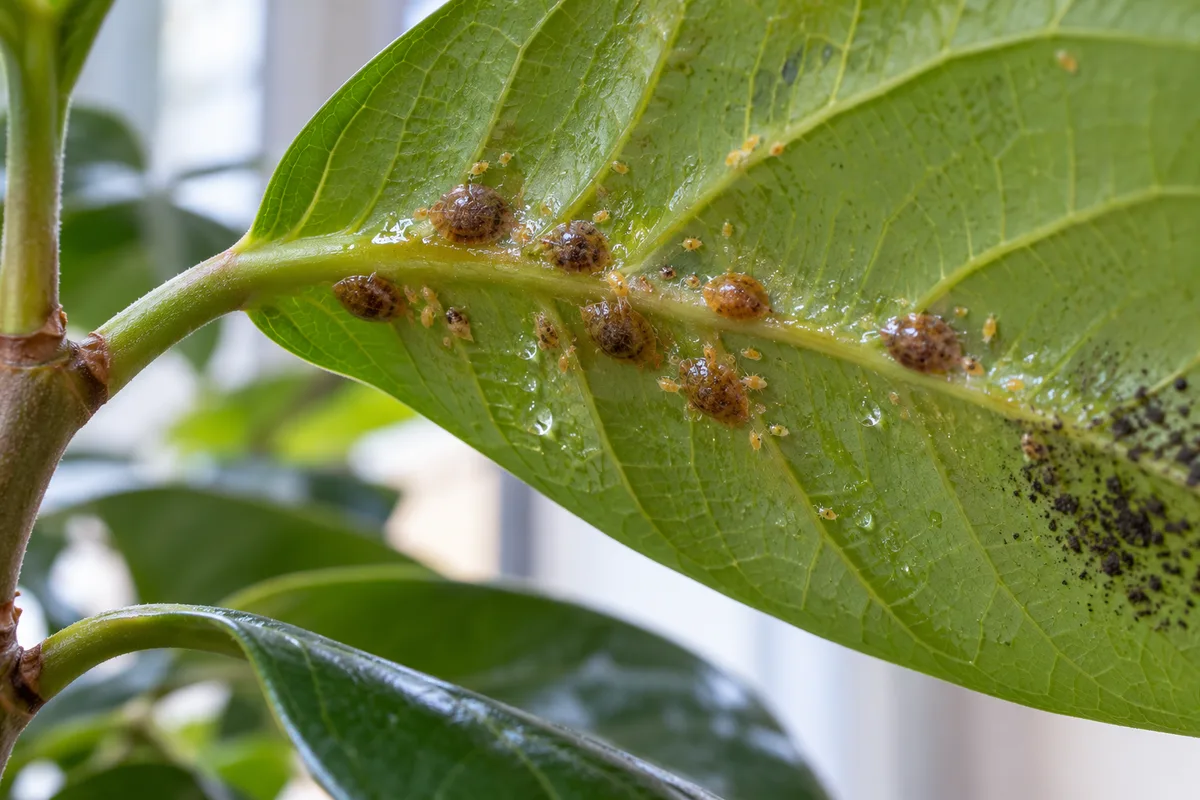
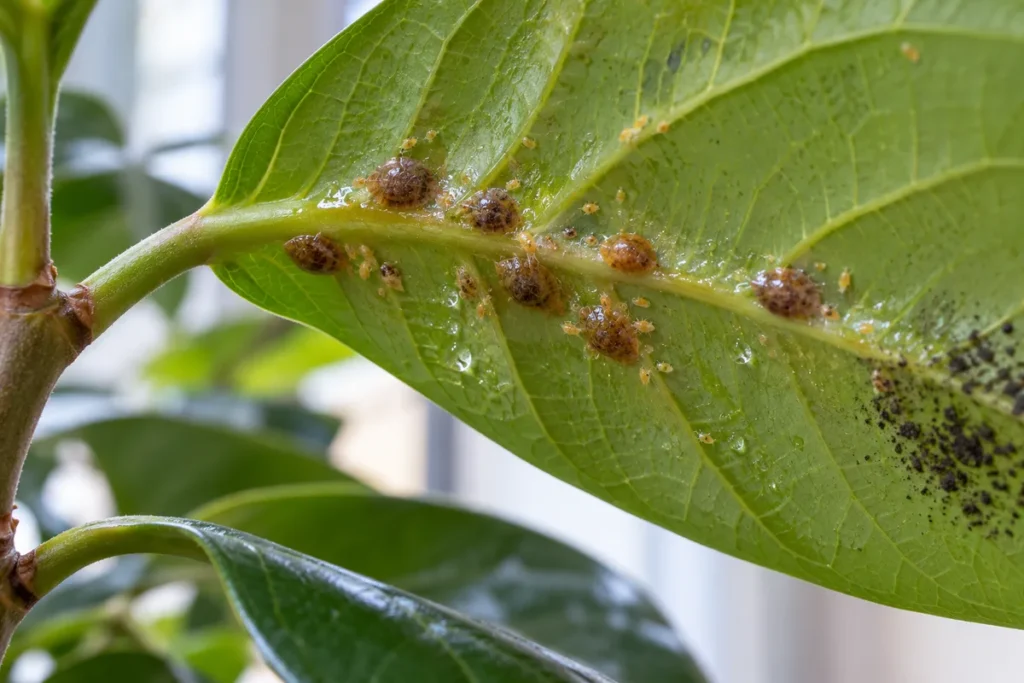
Scale insects are small, brown, shell-like or domed bumps that stay fixed on stems, leaf veins and leaf undersides. Scrape one and an insect body sits underneath, and soft scales also leave sticky honeydew [1][5]. They are hard to clear, so expect to isolate, clean repeatedly and keep checking [2].
Key points
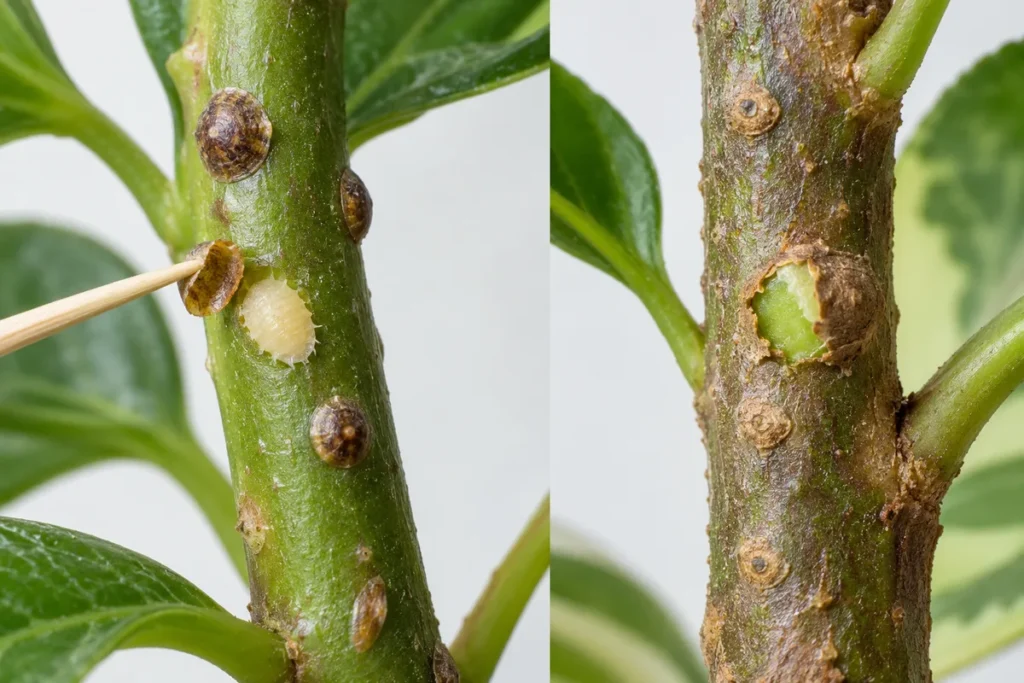
- Scrape to confirm: an insect body or cottony egg mass under the cover means scale; green plant tissue means a natural plant feature [3].
- Sticky leaves usually point to soft scale, but armored scale generally makes no honeydew, so a clean leaf does not rule scale out [1][5].
- Isolate first, then hand-remove and prune; follow product labels and repeat treatment [2][3][4].
- For severe or recurring infestations, discarding the plant is a sensible choice [2][4].
How do I tell scale from a natural bump on the plant?
Scrape gently with a toothpick or blunt knife. WSU says some plant structures resemble scale; if green or creamy white tissue shows beneath, it is the plant, and if a six-legged insect, or a cottony mass with eggs or crawlers, shows beneath, it is scale [3].
Look in the usual places. University of Maryland Extension says brown soft scale sits along leaf veins, on leaf undersides and petioles, and can hide under orchid leaf sheaths or in tight new growth [4]. Iowa State describes most houseplant scales as tan or brown, 1/16 to 1/4 inch across, either domed or flat and oval [2].
On a phone, swipe sideways to see every column.
| Clue | Possible cause | Next step |
|---|---|---|
| Brown domed bumps, insect body under the cover, sticky leaves | Soft scale, often brown soft scale [1][4][5] | Isolate, remove one by one, recheck every few days |
| Tiny flat shells whose covers lift off, leaves not sticky | Armored scale, which generally makes no honeydew [1] | Hand removal matters more; product choices differ from soft scale [1][5] |
| Sticky leaves but no shells found | Honeydew from aphids, mealybugs or whiteflies, or scale hiding in leaf sheaths | Read sticky leaves: tracing the honeydew and search every crevice |
| White cottony fluff | Possibly mealybugs, or the egg mass of scale | See mealybugs |
| Green tissue under the bump | A natural plant feature, not scale [3] | No treatment; keep watching |
These are visual clues, not a diagnosis. One plant can carry two pests at once. If unsure, take a clear photo and ask a specialist.
What is the difference between soft and armored scale?
UC IPM says armored scales are tiny and flat, have covers that usually come off the body, and do not make honeydew. Soft scales are larger, more rounded, make honeydew, and their cover cannot be lifted off because it is the body [1]. Mississippi State Extension says most houseplant scales are soft scales, and sticky leaves are often the first sign [5].
This changes the treatment. UC IPM says imidacloprid works on soft scales but not armored scales, and can trigger cottony cushion scale outbreaks [1]. Mississippi State says horticultural oil usually works better on armored scale [5]. Both are landscape or greenhouse contexts, so for a home pot check that the label allows indoor use [4].
What should I do in the first week?
- Isolate the plant. WSU advises keeping infested or newly bought plants apart for about a month and inspecting regularly [3].
- Stop leaves from touching others. Mississippi State says crawlers spread on touching leaves or on a handler’s clothing [5].
- Prune heavily infested leaves and shoots [2][3].
- Remove scales by hand with a toothpick, blunt knife or alcohol-moistened cotton swab [2][3]. WSU warns excess alcohol may harm some plants, so test one leaf and wait a few days [3].
- Wash off honeydew and sooty mould with lukewarm water and wipe nearby surfaces [3]. See also black sooty mould.
- Recheck leaf undersides and veins every three to four days. That interval is our suggestion; the sources give no number. Use a magnifying glass for crawlers [3].
Do alcohol, soap, oil and systemic products work?
Iowa State says there is no easy cure, and sprays must be applied thoroughly, repeatedly and persistently, weekly for a month or more [2]. One spray is rarely enough.
- Alcohol swabs and hand removal: Iowa State, WSU and Mississippi State all describe them for light infestations on small plants [2][3][5]. Slow, but low-risk if tested on one leaf first.
- Soap and horticultural oil: UC IPM says oil sprayed when crawlers are active gives good control on landscape plants [1]. WSU says many chemical options work best on crawlers, which is why close monitoring matters [3]. Adults under shells are harder to reach.
- Systemic products (imidacloprid): the sources disagree. Mississippi State says soil treatment usually controls soft scales [5]. Iowa State says granular soil products have limited effect and discourages home use over toxicity concerns [2]. UC IPM notes it does not control armored scale [1]. We do not recommend adding one yourself; with pets or children at home, read the label and ask a vet or doctor.
- Any pesticide: follow the product label only. University of Maryland Extension says products must be labelled for indoor use unless treated while the plant is outdoors [4]. WSU does not recommend chemical controls on edible plants grown indoors [3].
We give no home-made recipes or concentrations. Iowa State mentions diluted dish detergent, but that is older US advice and we do not repeat it.
What should I avoid?
- Spraying once and stopping: adults are shielded and crawlers keep hatching [2][3].
- Wiping only the honeydew: it does not remove the source [3].
- Heavy alcohol use: WSU warns it can damage leaves [3].
- Extra fertiliser: WSU says scale thrives on high-nitrogen plants [3].
- Letting ants climb the pot: ants protect scales from natural enemies [1][6].
- Keeping plants touching: leaf contact and handling move crawlers [5].
How do I stop it coming back in a Hong Kong flat?
University of Maryland Extension says brown soft scale occurs worldwide and can arrive on shipments from anywhere, so inspect new houseplants thoroughly [4]. Quarantine new plants, and plants brought in from a balcony, for about a month [3], and check undersides, veins, petioles and leaf sheaths.
UMD adds that on indoor plants several overlapping generations can occur year round; one generation takes about 60 days and three to seven generations a year is typical [4]. Our inference, not stated by the source, is that steady air-conditioned temperatures may make seasonal breaks less likely.
After a typhoon, plants moved in from the balcony deserve the same month of isolation. Ants trailing up a plant often signal honeydew [1][6]. For a full routine see quarantine and hygiene.
When should I give up on the plant or call a professional?
Iowa State says that unless the plant is especially valuable, many people find it best to discard infested plants before the pests spread [2]. University of Maryland Extension agrees for heavy infestations [4], and WSU says heavily infested plants may be too damaged to save [3].
- Several rounds of cleaning still leave new insects.
- New growth keeps distorting or dying back.
- The plant is too large to inspect leaf by leaf.
- Pets, children or edible plants are involved: read the label and ask a vet or doctor.
Seal the plant in a bag before binning so crawlers do not drop onto others, and wash the pot and saucer. For wider planning see IPM for houseplants and choosing pest-control products.
Check it step by step with Plant Doctor →
Frequently asked questions
Are scale insects harmful to people?
The plant sources we read describe harm to plants, not people [2]. Honeydew makes furniture sticky and sooty mould can grow on it [2][3]. If you have allergies or health worries, ask a doctor.
My leaves are sticky but I see no insects. What now?
Soft scales, aphids and whiteflies can all make honeydew [3]. Armored scales generally do not [1]. Turn leaves over and check veins, petioles and new growth, and read sticky leaves.
Which houseplants get scale most?
University of Maryland Extension lists a very wide host range for brown soft scale, including orchids, ferns, ficus, monstera and schefflera [4]. Any plant deserves a regular look at the undersides.
Can I just wash or wipe the scale off?
Light infestations can be wiped or scraped off, but Iowa State stresses repeated, persistent work [2]. Washing alone is not supported as a fix; it mainly removes sooty mould [3].
How long does a systemic product take to work?
The sources give no reliable timing, so we do not state one. Follow the label and keep watching for new insects and honeydew [5].
Sources
- University of California IPM (UC IPM): “Scales” — Armored versus soft scales, crawlers, ants protecting scales, imidacloprid not effective on armored scales (landscape plants)
- Iowa State University Extension: “Scale Insects on Houseplants” — Houseplant scale appearance, honeydew, difficulty of control, hand removal, persistent sprays, granular products, discarding
- Washington State University Extension (WSU Pestsense): “Scale insects” — Scrape test, roughly one-month quarantine, test alcohol on one leaf first, high nitrogen favours scale
- University of Maryland Extension: “Scale Insects on Indoor Plants” — Brown soft scale locations, overlapping indoor generations, honeydew and leaf deformity, indoor labelling, discarding heavy infestations
- Mississippi State University Extension: “Insect Pests of Houseplants” — Sticky leaves as first sign, spread by touching leaves or handling, systemic products versus horticultural oil
- University of California IPM (UC IPM): “Ants” — Ants tend honeydew producers and protect scales and aphids
Further reading
- Back to Plant Doctor
- Sticky leaves: tracing the honeydew
- Mealybugs: how to spot and treat them
- Quarantine and hygiene for houseplants
- Integrated pest management for houseplants
- A calm plan for an office plant with pests
- Black sooty mould on houseplant leaves
Sources checked: 31 October 2026. This is general guidance, not an on-site diagnosis. Always follow the product label.
