



Level: Beginner
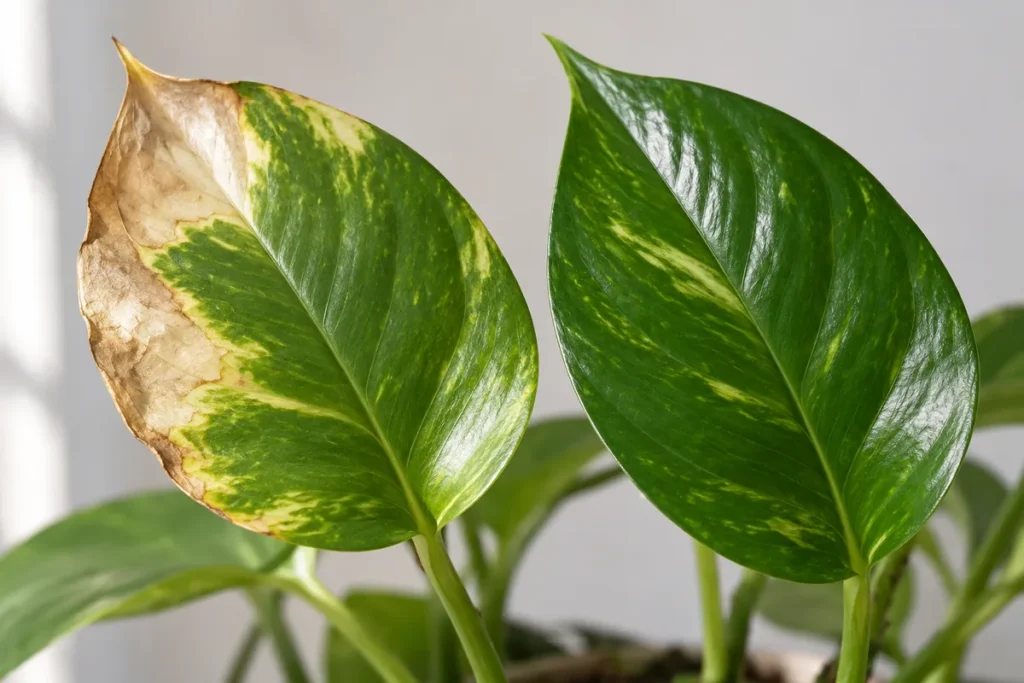
Houseplant sunburn usually appears soon after a plant is moved closer to a window, balcony or light source: pale, tan or papery patches on the side facing the light [1][2]. Move the plant out of harsh direct sun first, then raise light gradually, and never move an indoor plant straight into full sun [3]. Brown tissue does not turn green again.
Key points
- Sunburn is linked to a recent move and sits on the lit side of the leaf [2]. Ask whether the plant moved closer to a window or balcony lately.
- Move back before you prune. The RHS suggests setting the plant a few feet back from a south- or west-facing window, or using filtered light [1].
- Raise light gradually. Iowa State Extension suggests starting in full shade and adding light over about 10 to 14 days [3].
- Cut off leaves that are fully brown or shrivelled, and keep mostly green ones until new growth appears [1].
How can you tell sunburn from disease or underwatering?
Check timing and position. UC IPM links sunburn to a recent move of the plant [2], and the RHS says strong direct sun, such as a south-facing window in summer, can cause brown scorched patches, and leaves may look washed out [1]. A patch on the side facing the light that appeared in the last few days fits sunburn.
Be careful, because many things leave spots. The RHS notes that cleaning products or aerosols leave pale spots, dark spots with yellow margins may be fungal, and hard tap water sprayed on leaves can leave calcium marks [1]. The table below gives clues, not a diagnosis.
On a phone, swipe sideways to see every column.
| Clue | Possible cause | Next step |
|---|---|---|
| Recently moved to a window or balcony, dry pale or tan patch on the lit side | Sunburn is more likely | Move back or filter the light; see below [1][2] |
| Wet-looking dark spots with yellow edges, also on shaded leaves | Possible leaf spot disease | Read brown or black leaf spots and keep leaves dry [1] |
| Only the tips and edges are dry, whichever side faces the light | May relate to dry air, salts or water | Read brown leaf tips |
| Pale marks like water drops that wipe off | Cleaning-product residue or hard-water deposits | Water at the pot edge, avoid spraying leaves [1] |
| Overall washed-out colour and drooping with very dry mix | Too much light and thirst can occur together | Read drooping and wilting [2][4] |
When you photograph the damage, include the leaf top and underside, and the plant’s position relative to the window, so you can compare later.
Why does moving closer to a window cause sunburn?
Leaves adapt to the light they grew in. UC IPM links sunburn to a recent move [2], and Iowa State Extension says plainly not to move houseplants from indoors into full sun, warning of leaf burn, discolouration and leaf drop [3]. That advice is about moving plants outdoors. Applying it to a sunny indoor window is our inference: a jump from dim to harsh sun carries a similar risk.
Variegated plants need extra care. The RHS says scorch is most likely on the paler parts of the leaf [1]. Do not assume a bright window suits a variegated cultivar just because it is bright.
Heat and moisture may also play a part. UC IPM links sunburn on landscape trees to warm weather and often to low soil moisture [4]. That page does not cover indoor plants, so treat it as background, not a rule for pots.
What are the Hong Kong window and balcony risks?
Hong Kong Observatory 1991–2020 normals show a mean daily maximum of about 31.6°C in July and 31.3°C in August, and July and October are the sunniest months at roughly 197 hours each [5]. In short, strong sun is not only a midsummer matter. Autumn can still scorch a plant moved without care.
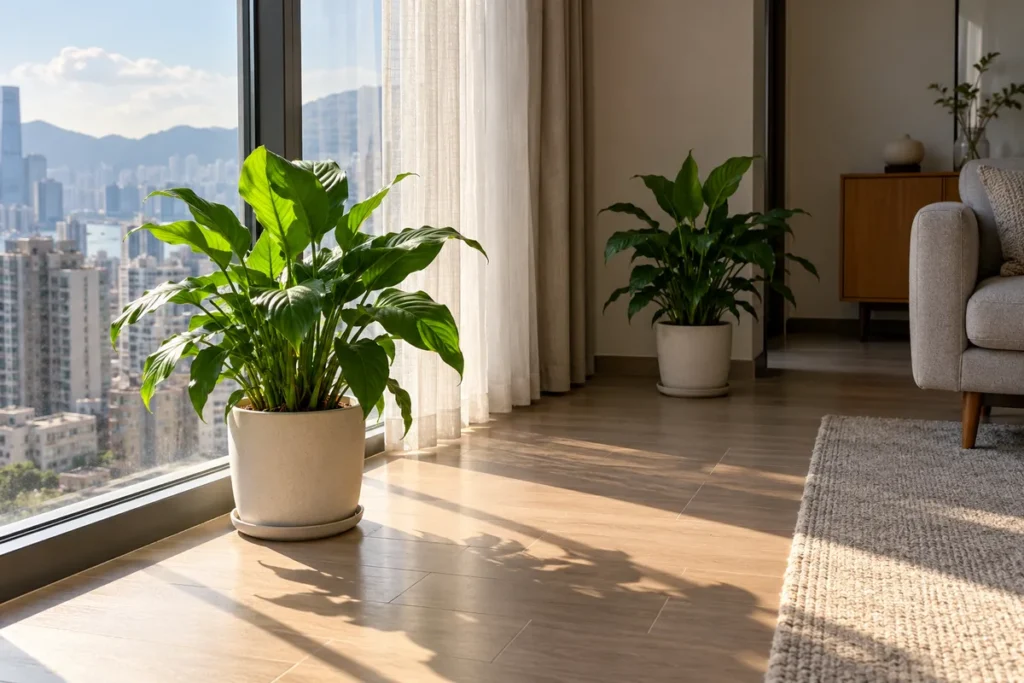
A west-facing high-floor window, an unshaded balcony, or a move on a clear day may raise the risk. That is our inference, as no source goes through these cases one by one. A practical test is to look at the hottest part of the afternoon and see whether a patch of direct sun actually falls on the leaves.
Hong Kong tip: before and after typhoons, plants are often shuffled indoors or next to windows. Check light changes afterwards, and keep them clear of air-conditioning outlets.
What should you do step by step?
- Move out of harsh direct sun. The RHS suggests a few feet back from a south- or west-facing window, or filtered light [1].
- Keep watering normal. Do not flood a damaged plant. Check the mix as usual; if thirst is a worry, see how to water.
- Cut off fully brown leaves. The RHS says completely brown or shrivelled leaves will not recover, while mostly green ones can stay until new growth appears [1].
- Raise light gradually afterwards. Iowa State Extension suggests starting in full shade and adding light over about 10 to 14 days [3]. That schedule is for moving plants outdoors, so adjust for the plant indoors.
- Check every few days. If new spots grow, go back to the clue table and consider leaf spot or pests.
Do not overcorrect. Iowa State Extension notes that a plant leaning or stretching towards the light needs a brighter spot [3]. The aim is a middle position, not as far from the window as possible.
What should you avoid?
- Moving an indoor plant straight into full sun. Iowa State Extension advises against it [3].
- Heavy pruning in one go. The RHS only suggests removing fully brown or shrivelled leaves [1].
- Spraying cleaners or aerosols on damaged leaves. The RHS says they can leave pale spots [1].
- Adding fertiliser or lots of water to compensate. No source we read supports this for sunburn.
- Putting succulents in full sun suddenly. Iowa State Extension says fleshy stems and leaves can be permanently damaged [3].
How do you prevent it next time?
The key is to go gradually. After any change of position, begin in gentler light and add time slowly. Iowa State Extension says to cover plants with cloth or shade material when no full-shade spot is available [3]. By a window, a sheer curtain does the same job.
Keep newly bought or recently moved plants apart from the rest while you watch them. If a plant fades or struggles for a long time, read light, PPFD and DLI and leggy plants to understand both ends, too little and too much light.
When should you worry or ask an expert?
One damaged leaf is usually a limited problem. If most leaves are turning brown, new leaves are spotting, or spots come with softness or a smell, do not treat it as sunburn alone. Roots or disease may be involved; read root rot or brown or black leaf spots.
For a valuable plant, or if the cause is unclear or getting worse, take clear photos with the plant name and window direction and ask a professional horticulturist. None of the sources gives a recovery timetable, so we will not give a number of days.
Frequently asked questions
Will a sunburned leaf turn green again?
The RHS says fully brown or shrivelled leaves will not recover, while mostly green ones can stay until new growth appears [1]. We found no source saying tan, papery tissue repairs itself.
Can plants burn behind glass?
Yes, possibly. The RHS says strong direct sun, for example from a south-facing window in summer, can scorch leaves [1]. The sources we read did not measure the effect of glass, so a window is not automatically a safe spot.
How long should a plant take to adjust to a sunnier place?
Iowa State Extension suggests starting in full shade and adding light over about 10 to 14 days, then watching for several weeks [3]. That is for moving plants outdoors in Iowa. Hong Kong summer sun is strong, so be more cautious and respond to the leaves.
How do I tell sunburn from underwatering?
Sunburn is tied to a recent move and the lit side [2]. Thirst depends on the mix and overall wilting. UC IPM notes that too much light can also cause wilting or general yellowing [2], so check the mix as well.
Should I spray a fungicide on sunburned leaves?
Sunburn is not an infection, and none of the sources we read suggests a spray. The focus is on moving out of harsh sun and adjusting gradually [1][3].
Sources
- Royal Horticultural Society (RHS): “How to help a poorly houseplant” — Scorch from strong direct sun, paler variegated areas, moving back a few feet, cutting fully brown leaves, other spot causes
- University of California IPM (UC IPM): “Houseplant Problems” — Sunburn is linked to a recent move; excess light can also cause wilting and general yellowing
- Iowa State University Extension: “Moving Indoor Plants Outside for the Summer” — Gradual light acclimation over about 10 to 14 days, starting in full shade, permanent damage on succulents (indoor-to-outdoor setting)
- University of California IPM (UC IPM): “Sunburn” — Sunburn is tied to warm weather and low soil moisture (landscape trees, not indoor plants)
- Hong Kong Observatory: “Monthly Meteorological Normals for Hong Kong (1991-2020)” — 1991-2020 monthly mean maximum temperature and bright sunshine hours
Further reading
- Back to Plant Doctor
- Brown or black spots on leaves
- Brown crispy leaf tips and edges
- Plant care in Hong Kong summer heat
- Balcony stress for plants
Sources checked: 31 October 2026. This is general guidance, not an on-site diagnosis. Always follow the product label.
