



Level: Beginner
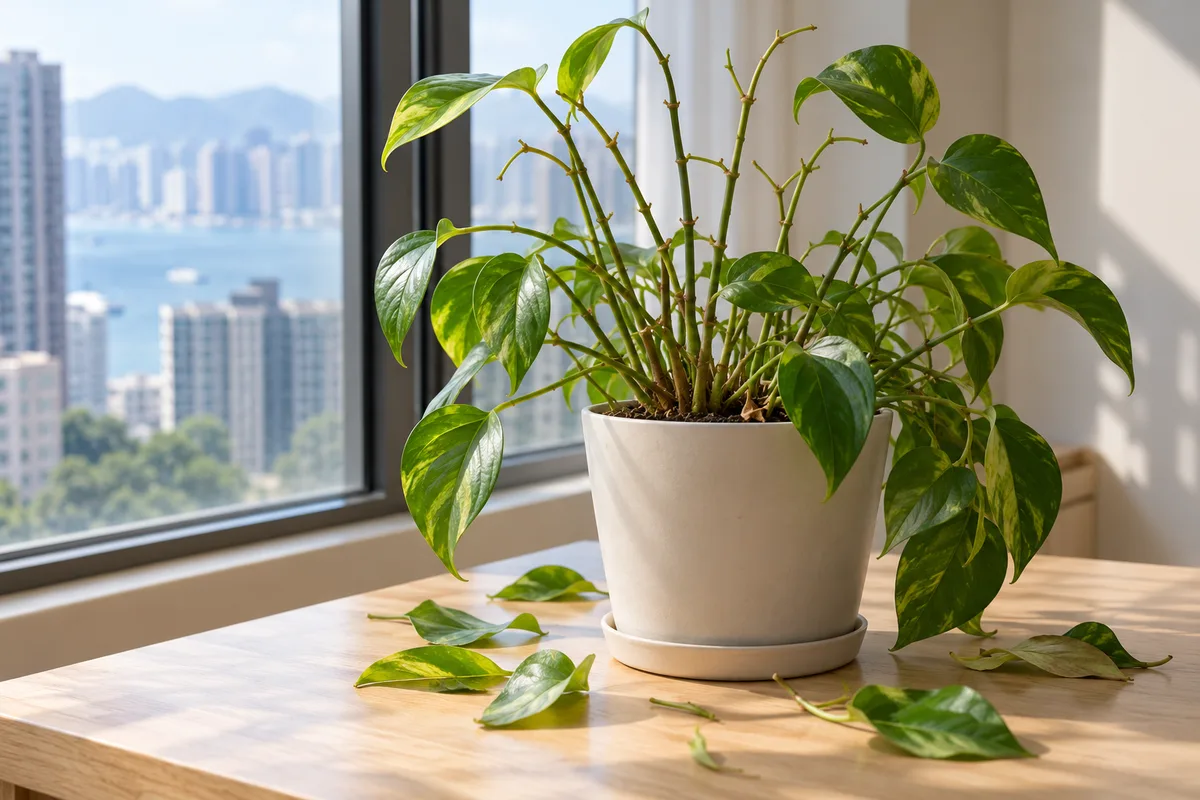
A plant that drops many leaves suddenly is often responding to a recent change, such as a shift in light, a move, a draught, or soil that is too wet or too dry [1]. Roots and pests can also cause it [5][6]. Ask what changed in the last week or two, then check the environment, the soil, the roots and the leaf undersides in that order.
Key points
- A few old inner leaves dropping is normal; losing many at once is worth investigating [1].
- A sudden change in light, drafts, and soil that is too wet or too dry can all trigger leaf drop, so start with what changed [1][3].
- If nothing changed or the soil stays wet, check the roots; root-rot wilting is often mistaken for underwatering [6].
- Fine dots and webbing under the leaves may mean mites; confirm before treating [5].
Is sudden leaf drop always a problem?
Not always. Iowa State University Extension says losing the occasional older, inner leaf on an otherwise healthy plant is normal [1]. A large batch at once, or loss of young green leaves, deserves a proper check.
The University of Minnesota Extension says yellowing and leaf drop after bringing plants indoors is common, especially on tropicals such as hibiscus, Ficus and citrus, and that they usually recover with good care [2]. Clemson also notes plants may yellow or drop leaves while adjusting to lower light [3]. A short spell of leaf drop after a move does not necessarily mean the plant is sick.
Hong Kong note: moving flat, switching windows, turning the air conditioner on for the season, or bringing a plant home from a shop all count as environmental changes. These sources mostly describe US outdoor-to-indoor moves, so applying them to a Hong Kong flat is our inference.
How do I work out the cause, step by step?
Ask what changed in the last week or two, then rule things out from easiest to hardest. Iowa State also lists leaf-drop causes in that order, from easiest to hardest to fix [1].
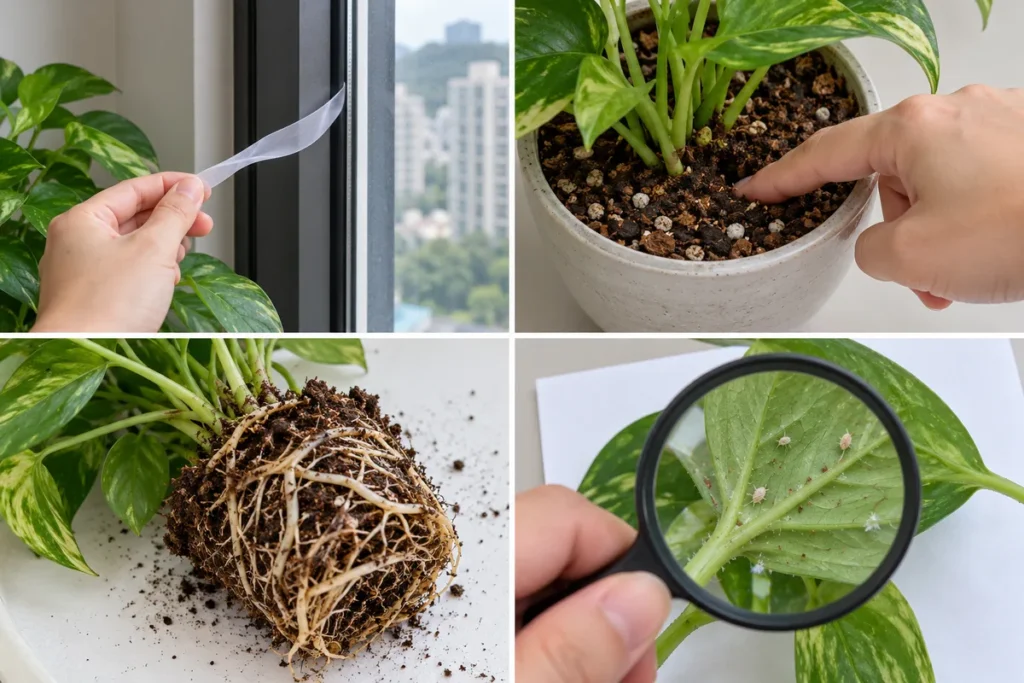
- Environmental change: light, position, draughts, air-conditioner airflow [1].
- Soil moisture: push a finger about one knuckle deep and note whether it is wet, damp or dry.
- Roots: if the soil stays wet and the plant is limp, unpot it. Healthy roots should be firm and white [6].
- Leaf undersides: tap a leaf over white paper and watch for tiny moving dots [5].
- Which leaves fell: older leaves first can point to too little light [4].
On a phone, swipe sideways to see every column.
| Clue | Possible cause | Next step |
|---|---|---|
| Recently moved, changed window, or light suddenly brighter or dimmer | Sudden light change | Keep the new spot and avoid more moves; adjust gradually next time [1][3] |
| Plant stands by a door, vent or direct air-conditioner airflow | Draughts or temperature swings | Move it clear of the airflow [1] |
| Soil stays wet, lower leaves limp then drop | Waterlogged roots, possible root rot | Unpot and check roots; see root rot [6] |
| Soil bone dry, leaves thin or crisp | Underwatering | Water thoroughly; see over- versus underwatering [1] |
| Older leaves drop first, stems long and sparse | Chronically low light | Add light or move closer to the window; see leggy plants [4] |
| Fine pale dots, later yellow or reddish leaves that drop | Mites | Confirm over white paper; see spider mites [5] |
Two causes can overlap, for example a move followed by an extra-generous watering. Ruling out one at a time is more reliable than betting on a single answer.
How can a change in light or position cause leaf drop?
Iowa State says too much light, too little light and a sudden change in light intensity can all cause leaf drop, and some species such as weeping fig and tropical hibiscus drop leaves rather than scorch [1]. The idea that the plant reallocates resources after a sudden change is our own reasoning; the source describes the effect only.
The University of Minnesota Extension lists dropped leaves, especially older ones, among the signs of too little light [4]. If you moved a plant somewhere dimmer, the drop may continue rather than being a one-off.
Day length may play a part too. Minnesota says shorter days can signal some plants to go dormant [2]. We suspect shorter winter days in Hong Kong could do something similar, but that source is about the US climate, so treat it as a possibility only.
- Iowa State suggests moving plants to much brighter light over several weeks [1].
- Clemson describes stepping plants from sun to light shade, heavy shade and then indoors over about a week [3].
Do draughts and air conditioning matter?
Iowa State advises keeping plants away from draughts from doors, heat vents and windows, and not trapping them between a window and its curtain, where night and day temperatures can differ widely [1]. By the same logic, direct air-conditioner airflow may expose plants to quick temperature changes, which is our inference.
Hong Kong Observatory 1991-2020 normals give a January mean of about 16.5°C and a July mean daily maximum of about 31.6°C [7]. Indoor and window-side conditions can swing a lot with season and air-conditioner settings, so use a thermometer near the pot; the Observatory figures are only the territory-wide background.
The gap between a window and curtain is a common plant spot in Hong Kong flats: hot in sunshine, cold against the glass at night.
How do I tell a watering problem from root rot?
Iowa State says soil that is too wet or too dry can each cause leaf drop [1], so consider both directions. Root-rot wilting is also often mistaken for underwatering, which leads people to water more [6].
If the soil is still wet but the plant is limp, hold off watering and unpot it. Healthy roots should be firm and white with many feeder roots, while rotted roots are mushy and brown or reddish [6]. If the roots look normal, go back to the environment and pests.
Iowa State also advises watering according to each plant’s needs rather than a fixed schedule, in a well-drained mix [6]. For more detail on waterlogged roots, see root rot.
How do I check for pests?
UC IPM says mite damage starts as pale stippling on leaves, and later the leaves turn yellowish or reddish and drop [5]. Mites prefer hot, dusty conditions and damage is worst on water-stressed plants [5]. That page covers landscape plants and houseplants.
The check is simple: shake a few off a leaf onto white paper, where disturbed mites move and are easier to see [5]. Minnesota also recommends keeping new or returning plants apart from the rest [2].
Confirm the pest before treating. Always follow the product label and do not mix your own formula. Pesticide use in Hong Kong is regulated by law, so check with the relevant government department.
What should I do, and what should I avoid?
The core approach is to stabilise conditions and change one thing at a time.
- Pick a steady, draught-free spot and leave the plant there for now [1].
- Correct watering: water only when the pot is dry enough for that plant, then water thoroughly. If it stays wet, unpot and check the roots [6].
- Clear fallen leaves from the pot surface so damp leaf litter does not sit on the soil (our inference).
- Check every few days for new drop or new buds before deciding the next step.
What to avoid:
- Do not respond to leaf drop with extra water, fertiliser or an immediate repot; feeding is not first aid (our inference).
- Do not change light, position and watering together, or you will not know what helped.
- Do not prune hard straight away; keep stems that still carry leaves and wait for new growth.
How do I prevent it, and when should I ask for help?
Prevention comes down to gradual change. Move plants between light levels over days to weeks [1][3], and keep new or returning plants separate while you check the leaf undersides [2].
If most leaves have dropped, stems turn soft or black, roots are widely rotted, or there is no new growth a month after you have corrected the conditions, consider asking a nursery or horticulturist, and accept that some plants cannot be saved. Follow product labels for any treatment and keep pets and children in mind.
Check it step by step with Plant Doctor →
Frequently asked questions
Will a plant regrow after dropping leaves?
It depends on the cause. If light or a move triggered it, Minnesota says plants usually recover with proper care [2]. With root rot, recovery depends on how much of the root system is damaged [6].
Is leaf drop normal for a newly bought plant?
It can be. Clemson notes plants may yellow or drop leaves while adjusting to lower light [3]. Keep it in one stable spot and observe before repotting or pruning hard.
Should I fertilise a plant that has dropped leaves?
The sources we used do not recommend fertiliser as a fix for leaf drop. Check environment, watering, roots and pests first; feeding without a known cause may muddy the picture (our inference).
Why do the older leaves go first?
Minnesota lists dropped older leaves among signs of too little light [4], and Iowa State says shedding old inner leaves can be normal [1]. If it continues heavily, check light and position.
Can air conditioning make a plant drop leaves?
Possibly. Iowa State advises keeping plants away from drafts and temperature swings [1], and direct air-conditioner airflow is a similar situation (our inference). Move the plant out of the airflow and watch for a week or two.
Sources
- Iowa State University Extension: “Diagnosing Houseplant Problems from Improper Environmental Conditions” — Leaf-drop causes: sudden light change, drafts, too wet or too dry, low humidity; normal shedding of old leaves
- University of Minnesota Extension: “Bringing houseplants in for winter” — Yellowing and leaf loss after moving indoors is common; shorter day length; pest check before moving in
- Clemson Home & Garden Information Center: “Moving Houseplants Indoors & Outdoors” — Plants may yellow or drop leaves while adjusting to lower light; adjust light gradually
- University of Minnesota Extension: “Lighting for indoor plants and starting seeds” — Signs of too little light include dropped leaves (especially older ones), leggy stems, variegation reverting to green
- University of California IPM (UC IPM): “Spider Mites” — Leaf stippling, later yellow or reddish leaves that drop; white-paper shake test (landscape and houseplants)
- Iowa State University Extension: “Root Rots of Houseplants” — Root-rot wilting is often mistaken for underwatering; healthy versus rotted roots; check roots and mix before watering
- Hong Kong Observatory: “Monthly Meteorological Normals for Hong Kong (1991-2020)” — 1991-2020 monthly mean, minimum and maximum temperature and relative humidity
Further reading
- Back to Plant Doctor
- Root rot: how to tell, treat and know when to give up
- Overwatering versus underwatering
- Transplant shock
- Air conditioning and plants
- Leggy plants
Sources checked: 31 October 2026. This is general guidance, not an on-site diagnosis. Always follow the product label.
