



Level: Beginner
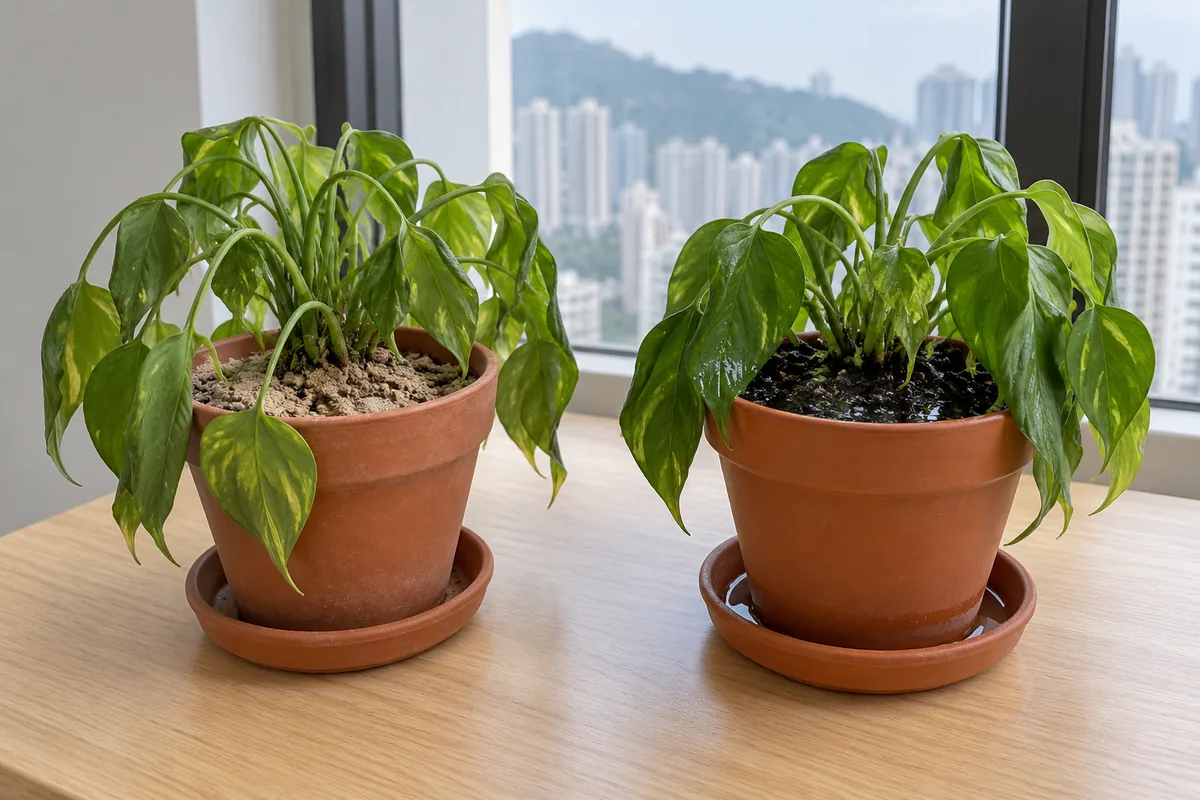
A plant droops when its leaves are not getting enough water. The soil may be too dry, or damaged roots may be unable to move water up [1][2]. Do not add water on reflex: feel the soil first, and unpot the plant if it stays wet.
Key points
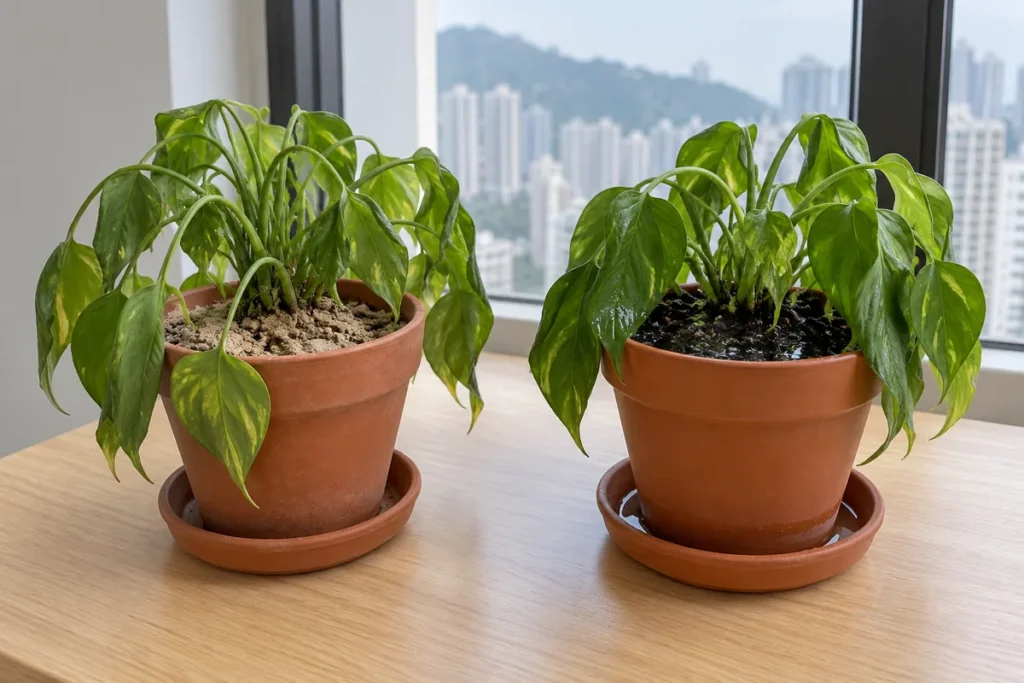
- Drooping has opposite causes: too little water wilts a plant, and so can wet soil that has damaged the roots [1][2].
- Check the soil before watering. Iowa State suggests watering once the soil is dry, before the plant starts to wilt [2].
- If the soil is wet and the plant still droops, suspect the roots. Unpot and look; do not add water [2][3].
- Strong sun, dry air, a root-filled pot and pests can also cause drooping, so water is not the only suspect [3][4][5].
How do I tell too dry from too wet?
Feel the soil, then look at the leaves. UC IPM says too little water makes foliage wilt, discolour and drop early [1]. The same page says excess moisture kills roots [1]. Both end in limp leaves, so the soil and the other clues have to separate them.
On a phone, swipe sideways to see every column.
| Clue | Possible cause | Next step |
|---|---|---|
| Soil bone dry, pot feels light, leaves firm up gradually after watering | More likely too dry [1][3] | Water thoroughly until it drains, then watch |
| Soil still wet, lower leaves limp or yellowing | More likely too wet, root damage [1][2] | Stop watering and unpot; see root rot |
| No improvement after watering, roots packed in the pot | Possibly pot-bound, too little soil to hold water [3] | See root-bound plants |
| Droops in afternoon sun at the window, recovers in shade or at night | Possibly too much midday sun [4] | Move back for now; see leaf sunburn |
| Fine dots on leaves, webbing underneath | Possibly spider mites [5][6] | Tap a leaf over white paper; see spider mites |
| Tiny flies at the soil surface, sudden wilt | Possibly fungus gnat larvae at the roots [5] | See fungus gnats |
Hong Kong tip: during the humid spell the soil surface may stay damp for days. That says nothing about root health. Push a finger into the soil rather than guessing from the weather.
What should I do first when a plant droops?
Beginners need three checks and no products. Push a finger into the soil, look at the drainage hole and saucer, and lift the pot to feel its weight.
- Soil dry: water thoroughly until water runs out of the base, then empty the saucer.
- Soil still wet: pause watering and put the plant somewhere bright without direct sun until the top of the soil dries.
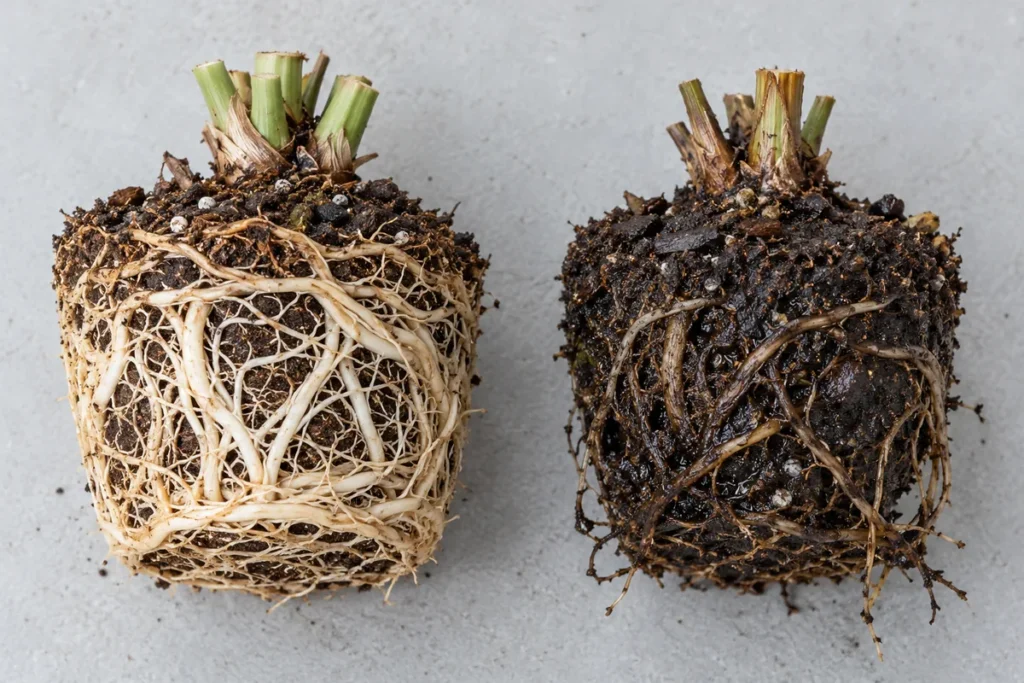
- Still drooping after a few days: ease the plant out of the pot and look at the roots [2][3].
- If water is ruled out, check sun exposure, pests and pot size.
Iowa State notes that a damaged root system can cause wilting, and the wilting then prompts more watering, which makes things worse [2]. That loop is the commonest trap.
Why do damaged roots make a plant droop?
Roots take up the water, so damaged roots starve the leaves even in wet soil. Clemson says overwatering reduces the oxygen available for root growth [3]. UC IPM says excess moisture kills roots and that overwatering is the more common fault [1].
For the advanced reader: roots sitting in waterlogged mix get less oxygen and take up less water, while the leaves keep losing it. That mechanism is our own inference; the sources do not spell it out. A pot full of roots is a different root problem, since Clemson says there is not enough soil to hold water for all of them [3].
For how to recognise rot and what to do about it, see root rot. We do not repeat it here.
Can light, dry air or pests make a plant droop?
Yes. The RHS says too much midday sun can make leaves droop or scorch yellow [4], and that in dry air leaves lose water faster than the roots can replace it [4]. UC IPM adds that the low humidity typical of indoor spaces favours mites [5], and that mites cause stippling and hit water-stressed plants harder [6].
A word on Hong Kong. HKO normals for 1991 to 2020 show mean relative humidity of about 81% in July and 74% in January [7]. That is outdoor air. Air-conditioned rooms can differ, and we found no source measuring it, so do not assume your plant lives in humid air.
UC IPM also lists sudden wilting as a symptom of fungus gnat larvae [5]. Tiny flies at the soil surface are a reason to read about fungus gnats.
What should I avoid doing?
- Do not water just because it droops. Confirm the soil is dry first [2].
- Do not give small sips every day. UC IPM says overwatering mostly happens because water is applied too often [1]; follow the soil, not the calendar.
- Do not jump to a much bigger pot. Iowa State advises a container that is not too big [2].
- Do not add fertiliser or fungicide on a hunch. We found no university or botanic garden support for doing so on a drooping plant; the evidence is weak.
- Do not leave the pot standing in water; see saucers and mosquitoes.
If you treat mites or gnats with a pesticide, follow the product label. We did not check Hong Kong’s pesticide rules for this article; ask AFCD.
How do I stop it happening again?
Water by the soil, not the date. Iowa State suggests watering before the plant begins to wilt, once the soil has dried [2], and UC IPM suggests setting timing from the plant and its environment [1].
- Use pots with drainage holes. For decorative pots without them, see the guide to pots without drainage holes.
- If roots fill the pot, go up one size, not several [2][3].
- In summer heat and in an air-conditioner’s airflow, watch how fast the soil dries. Check plants more often around typhoons, when conditions change quickly.
- Photograph leaves and soil over several days to compare; see photographing plants for diagnosis.
When should I ask for help, or let go?
If most roots are soft and dark after unpotting, or the stem base has gone soft, recovery is unlikely. Consider saving healthy cuttings instead of clinging to the whole pot. UC IPM says excess moisture kills roots [1], but none of our sources gives a cut-off for how much damage is too much, so that call depends on your plant.
If you see many insects, webbing, or several plants going downhill together, photograph them and ask a nursery or plant clinic. Follow product labels for any treatment and never mix your own recipe.
Check it step by step with Plant Doctor →
Frequently asked questions
How long does a wilted plant take to recover after watering?
None of our sources gives a standard time. If the cause is simple dryness, leaves usually firm up gradually after a thorough watering. If nothing changes in a few days, roots, light or pests may be involved, so unpot and check [1][2].
Why is my plant still drooping after I watered it?
Water is only one cause. Damaged roots, a pot full of roots, or too much sun can all keep leaves limp, so when watering does not help, check the roots and the setting [2][3][4].
My leaves droop but are still green. Is that serious?
Early dryness or strong sun can make leaves droop before they change colour [1][4]. Check soil and position the same day rather than waiting for colour change.
Does misting help a drooping plant?
The RHS mentions misting or a damp gravel tray to raise humidity [4], but we found no source measuring how well it works. In our view misting does little for a root-water problem, and the evidence is weak.
My plant droops all the time in an air-conditioned room. What now?
Dry air favours mites, according to UC IPM [5], and water-stressed plants suffer more from them [6]. Move the plant out of direct airflow and check leaf undersides for fine dots and webbing.
Sources
- University of California IPM (UC IPM): “Water Excess or Deficiency” — Too little water causes wilting; excess moisture kills roots; overwatering is the commoner fault
- Iowa State University Extension: “Diagnosing Houseplant Problems Related to Poor Culture” — A damaged root system also causes wilting, which can prompt more watering; watering timing
- Clemson Cooperative Extension (HGIC): “Houseplant Diseases & Disorders” — Pot-bound plants, chronic underwatering, and overwatering reducing root oxygen
- Royal Horticultural Society (RHS): “Leaf damage on houseplants” — Underwatering, strong midday sun and dry air can all cause drooping; overwatering can cause oedema
- University of California IPM (UC IPM): “Houseplant Problems” — Fungus gnat larvae can cause sudden wilting; low indoor humidity favours mites
- University of California IPM (UC IPM): “Spider Mites” — Mites cause stippling and webbing; water-stressed plants suffer more; check over white paper
- Hong Kong Observatory: “Monthly Meteorological Normals for Hong Kong (1991-2020)” — Hong Kong monthly mean relative humidity and temperature
Further reading
- Back to Plant Doctor
- Overwatering vs underwatering: a clue-by-clue comparison
- Root rot: how to tell, what to do, when to give up
- How to water: timing and method
- Plant saucers and mosquitoes: a Hong Kong home checklist
Sources checked: 31 October 2026. This is general guidance, not an on-site diagnosis. Always follow the product label.
