



Level: Intermediate
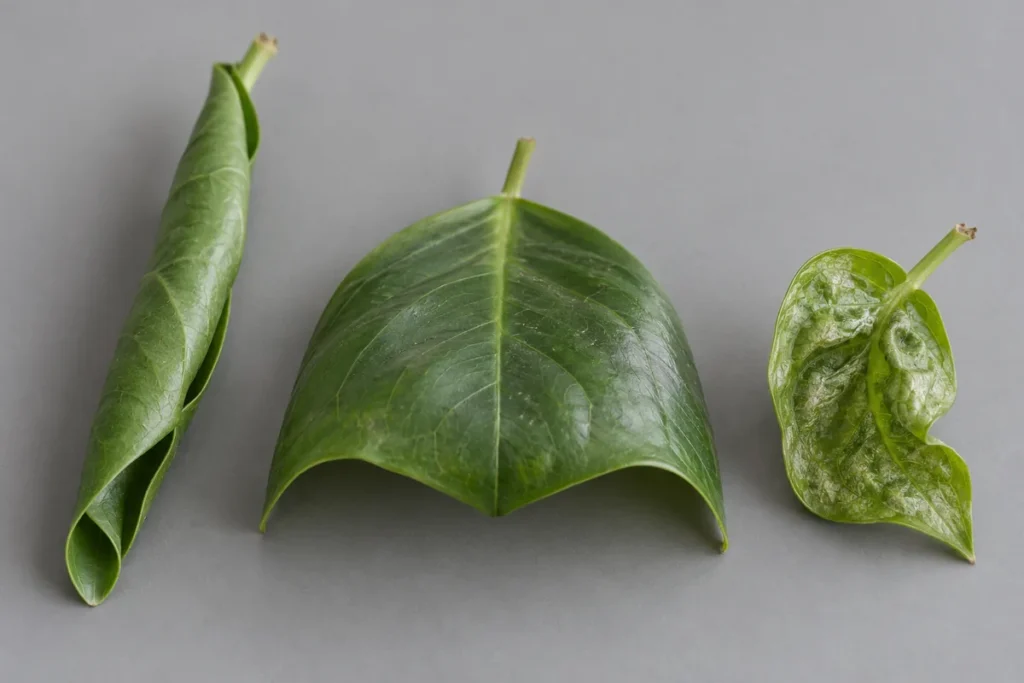
Leaves can curl because of thirst, dry air, cold, strong light or pests, and the direction of the curl alone is not enough to name the cause [1][2][3]. Work out which leaves are affected, check the undersides, and think about what changed recently.
Key points
- The sources we read give no general rule that upward curl means one thing and downward curl another; the RHS gives only specific examples [1].
- If only new leaves are crinkled or distorted, check for sap-sucking pests such as aphids or thrips first; if older leaves curl, look at water and surroundings [3][4].
- Chronic underwatering can cause curling, often with wilting [2].
- Mites show up as fine dots and webbing; UC IPM’s spider mite page does not list curl as a sign [5].
Does upward versus downward curl really mean anything?
A little, but there is no general rule. The RHS says some plants, Maranta for example, curl their leaves inwards in bright light and dry air, and that cold, dry conditions can turn leaf margins outwards [1]. Those are observations about particular plants in particular conditions, not a rule for every plant.
Popular guides often say downward curl means overwatering and upward curl means thirst. The university and botanic-garden sources we read do not state that rule. The evidence is weak, so do not change your watering on direction alone.
A better habit: note where the curling is, whether new or old leaves are involved, whether the whole leaf or just the edge curls, then check the soil and the undersides.
Quick-check table: what should I look at first?
On a phone, swipe sideways to see every column.
| Clue | Possible cause | Next step |
|---|---|---|
| Older leaves curl inwards, soil dry, leaves may droop too | Possibly chronic underwatering [2] | Water thoroughly; see drooping plants |
| Bright window spot and dry air, leaves curl inwards | Possibly bright light plus dry air, as with Maranta [1] | Move back from the glass and watch for changes |
| Cold draught or cold snap, margins curl outwards or leaves drop | Possibly cold or cold, dry air [1][2][3] | Move away from gaps and cold air; see cold snaps |
| Only new leaves crinkled or distorted, maybe silvery marks | Possibly thrips [4] | Tap over white paper; see thrips |
| New leaves curled, clusters of tiny insects underneath | Possibly aphids [3] | See aphids |
| Fine dots on leaves, webbing underneath | Possibly spider mites [5] | See spider mites |
| Watering swings between wet and dry while new leaves open | Possibly irregular watering [1] | Steady the routine; see how to water |
Hong Kong tip: a sun-baked summer window and the mouth of an air conditioner are both extreme spots indoors. The sources do not measure either, so use the back of your hand to judge how hot or cold the spot is.
How do I tell environment from insects?
Look at the undersides, then compare new and old leaves. UC IPM says aphids can make leaves curl and distort [3]. For thrips it lists distorted, curled shoot tips and leaves, with silvering and dark specks of excrement [4]. That thrips page deals mainly with garden plants, so applying it to houseplants is our inference.
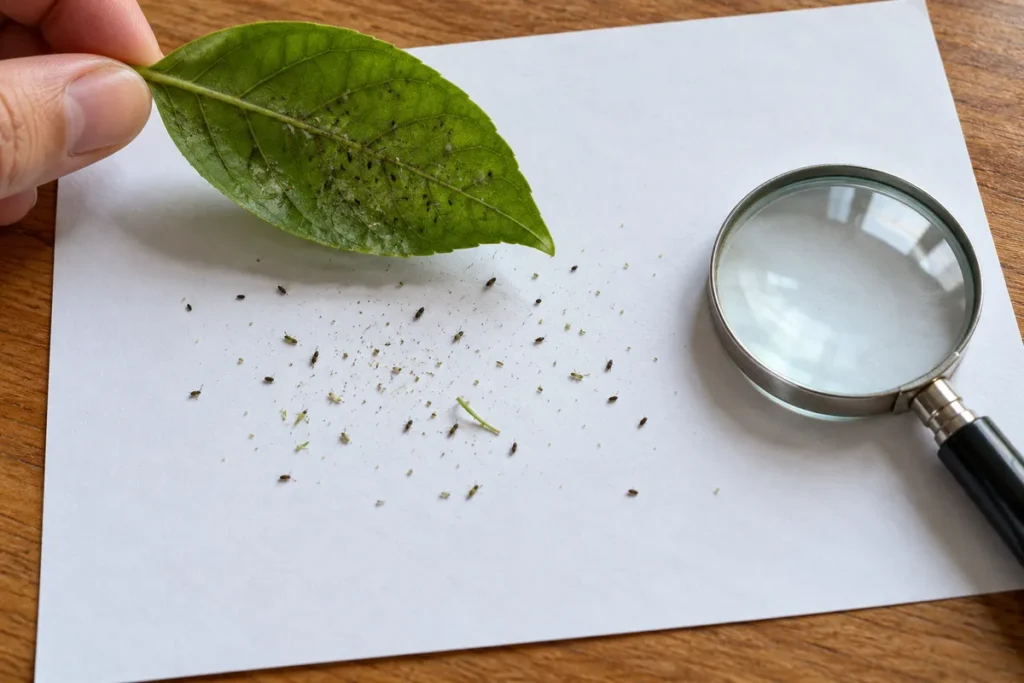
UC IPM suggests shaking foliage over white paper to see what falls out [4][5]. Tap a leaf above the paper, wait a few seconds, and use a magnifier. Specks that move may be insects; still specks are probably dust.
For mites, UC IPM describes stippling then webbing, with leaves turning bronze, yellowish or reddish before dropping, and does not mention curl [5]. If leaves curl but there are no dots or webbing, do not assume mites.
What should I do when leaves curl?
- Photograph the plant and note which leaves are curled, so you can compare later.
- Feel the soil. If dry, water thoroughly; if still wet, do not add water.
- Tap leaves over white paper and check the undersides for insects or webbing [4][5].
- Move the plant away from cold draughts, window gaps and harsh direct sun, and watch for a few days [1][3].
- If you find insects, isolate the plant and treat as the product label says; never mix your own recipe.
Leaves that have already curled rarely return to their old shape, and the sources give no recovery time. What matters is whether new leaves come through normally.
What should I avoid?
- Do not add or cut water because of curl direction alone [1].
- Do not spray insecticide at the first curl. Confirm there are insects first.
- Do not rely on misting as a fix. We found no university or botanic-garden support for it curing curl; the evidence is weak.
- Do not move the plant sharply between very different spots. Cold or temperature swings can stress it too [2][3].
Always follow the product label for any insecticide. We did not check Hong Kong’s pesticide rules for this article; ask AFCD.
How do I prevent curling leaves?
Stable conditions help. The RHS mentions irregular watering while new leaves develop as one cause of leaf problems [1], and UC IPM advises keeping plants away from cold drafts near windows and doors [3].
- Water when the soil has dried, thoroughly each time; avoid swinging between soggy and bone dry.
- Check leaf undersides regularly, and again when new leaves appear.
- HKO normals for 1991 to 2020 give mean relative humidity of about 81% in July and 74% in January [6]. An air-conditioned room can be much drier, so do not judge your plant by outdoor air.
- Keep new plants apart for a while and watch for insects.
When should I get help or let go?
If new leaves keep coming in distorted, insects are multiplying, or several plants decline together, photograph them and ask a nursery or plant clinic. For more on distorted growth, see distorted new leaves.
A few curled older leaves with normal new growth rarely justify giving up; remove the worst-damaged leaves if you wish.
Frequently asked questions
Does upward curl mean thirst?
It can, but there is no general rule. The RHS says Maranta leaves curl inwards in bright, dry conditions [1], and chronic underwatering can curl leaves [2]. Still check the soil and other clues.
Does downward curl mean overwatering?
The sources we read do not link downward curl to overwatering. The RHS only notes that cold, dry conditions can turn leaf margins outwards [1]. Do not cut watering on direction alone.
Are curled new leaves a sign of pests?
Worth checking first. UC IPM says aphids can curl and distort leaves [3] and thrips feeding can curl shoot tips [4]. Dryness and other conditions can also be involved, so check the undersides and the soil.
Can I flatten a curled leaf?
The sources say nothing on this. We would not force it, as it may tear; watch whether new leaves grow normally.
Can an air-conditioned room make leaves curl?
The RHS says cold, dry conditions can curl leaf margins outwards [1], and UC IPM advises keeping plants away from cold drafts [3]. No source measures air-conditioned rooms, so judge by the airflow where your plant sits.
Sources
- Royal Horticultural Society (RHS): “Leaf damage on houseplants” — Bright light with dry air curls leaves inwards; cold dry air curls margins outwards; irregular watering as new leaves develop
- Clemson Cooperative Extension (HGIC): “Houseplant Diseases & Disorders” — Chronic underwatering can cause wilting and leaf curling; chilling can cause leaf drop
- University of California IPM (UC IPM): “Houseplant Problems” — Aphids can curl and distort leaves; low indoor humidity favours mites; keep plants from cold drafts
- University of California IPM (UC IPM): “Thrips” — Thrips distort and curl shoots and leaves and leave silvering; shake over white paper (mainly garden plants)
- University of California IPM (UC IPM): “Spider Mites” — Mites show stippling then webbing; like hot, dusty conditions; the page does not list curl as a sign
- Hong Kong Observatory: “Monthly Meteorological Normals for Hong Kong (1991-2020)” — Hong Kong monthly mean relative humidity and temperature
Further reading
- Back to Plant Doctor
- Drooping, wilting plant: too dry or too wet?
- Distorted new leaves: pests, nutrients or chemical damage?
- Spider mites: how to confirm and what to do
- Photographing a plant problem so it can be diagnosed
Sources checked: 31 October 2026. This is general guidance, not an on-site diagnosis. Always follow the product label.
