



Level: Intermediate
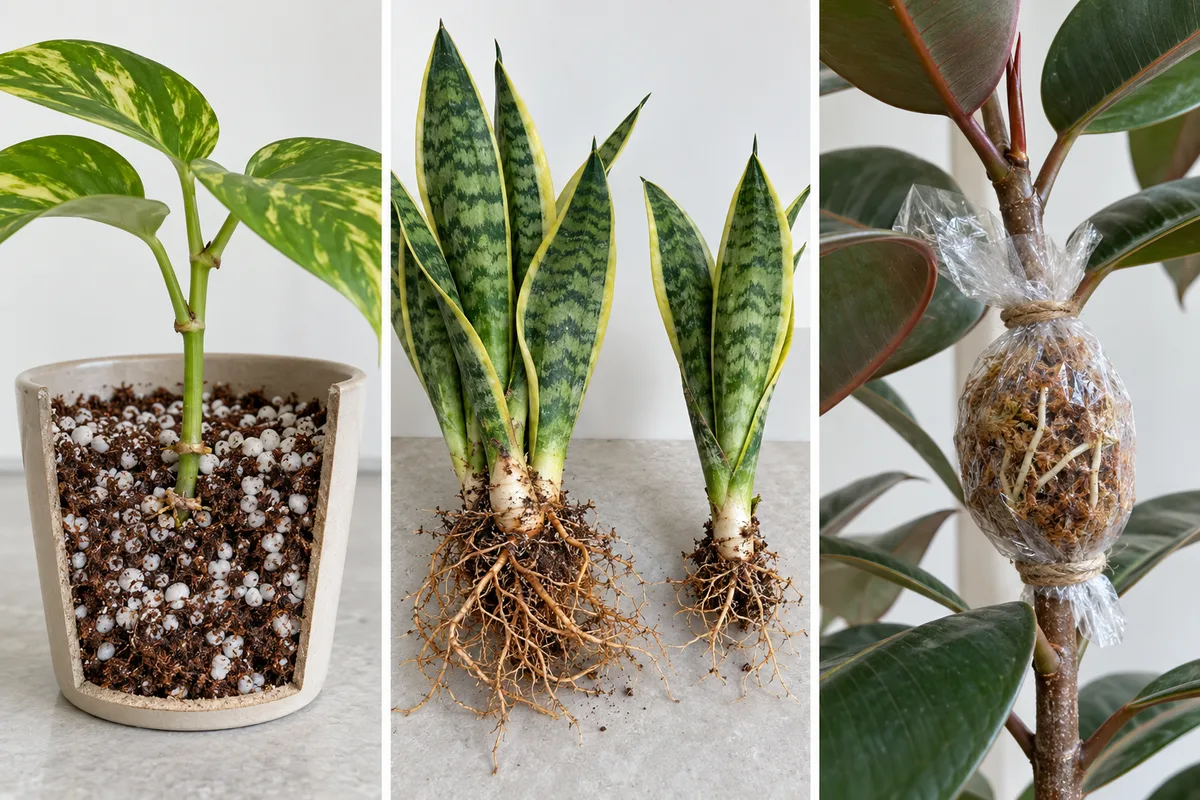
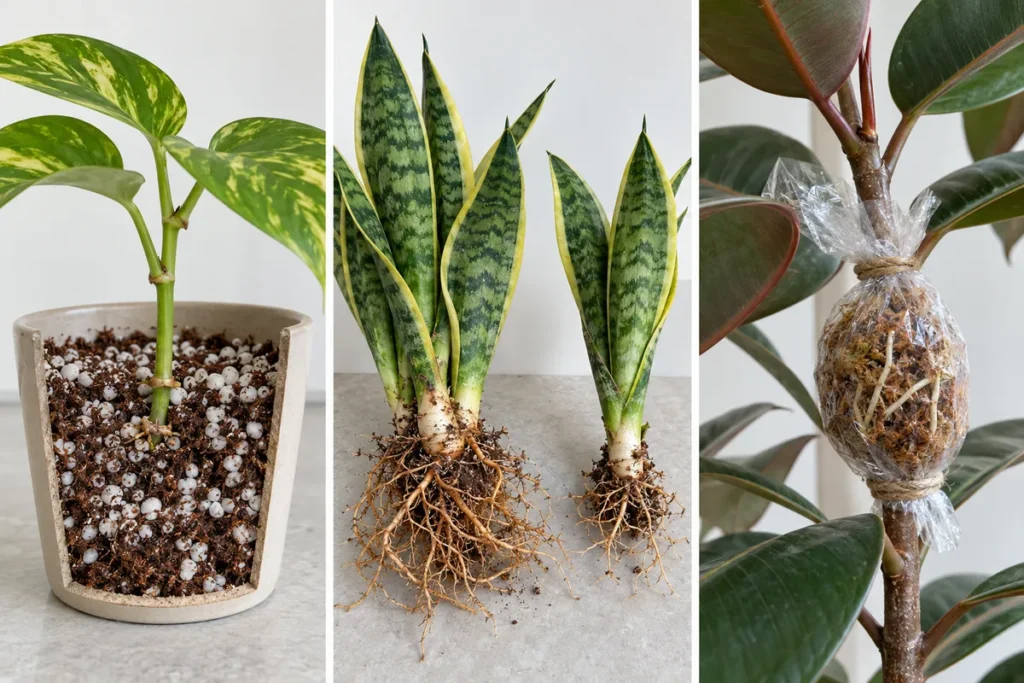
Stem cuttings suit jointed, soft stems, division suits clump-forming plants and air layering suits stiff, tall stems [1][3][4]. All three start with a healthy parent plant and clean tools and media [1][4].
Key points
- Match the method to the plant’s shape: jointed stem, clump or stiff tall stem [1][3][4].
- Use clean tools and disease-free media, never field soil [1][4].
- Water rooting is disputed: Illinois Extension advises against it, other sources list it as an option [1][2][4].
- Rooting takes weeks to months and varies by plant, so patience is part of the method [1][3].
Should I choose cuttings, division or air layering?
It depends on how the plant grows. The Illinois Extension plant table assigns different methods to different plants, and many plants suit more than one [2]. Common cases:
On a phone, swipe sideways to see every column.
| Plant shape | Suitable method | Examples named in sources |
|---|---|---|
| Trailing or jointed stems | Stem cuttings | Pothos, philodendron and monstera are listed for cuttings [2]; dumb cane and dracaena respond well to stem sections [1] |
| Clumps or offsets | Division | Snake plant and peace lily [2]; Missouri Extension calls division the easiest method for plants that make offsets [4] |
| Runners with plantlets | Natural layering | Spider plant and strawberry begonia [1] |
| Stiff, non-flexible, tall or leggy stems | Air layering | Rubber plant, fiddle-leaf fig, dumb cane [3] |
Not every plant suits every method. Penn State Extension warns that some plants respond poorly to vegetative propagation [1]; for species not listed, look for species-specific guidance.
How do I take a stem cutting?
- Choose vigorous, healthy shoots and cut just below a node, removing leaves from the lower half [4].
- Length differs by source. Penn State says a 2- to 3-inch piece (about 5 to 8 cm) with at least two nodes [1]; Missouri Extension says most cuttings should be 4 to 6 inches (about 10 to 15 cm) [4]. Both stress nodes, so treat at least two nodes as the floor and adjust length by plant. That is our own reasoning.
- Use rooting hormone as Missouri Extension suggests, except on easy plants such as coleus [4]. Iowa State warns that too much can slow rooting [3]. Follow the product label.
- Insert into clean media. Penn State says to push the stem upright so at least one node is buried, or lay it flat with half covered [1].
- Keep the medium moist but not soggy, in bright light out of direct sun. Missouri Extension suggests covering with a plastic bag, away from direct sunlight [1][4].
- Pot on once roots are about 1 inch (2.5 cm) long. Missouri Extension calls the move from humid, moist conditions to drier ones the most critical step, so watch young plants closely for the first weeks [4].
Illinois Extension advises sterilising cutting tools by dipping them in denatured alcohol before and between cuts [2]. See quarantine and tool hygiene.
Is rooting in water acceptable? The sources disagree
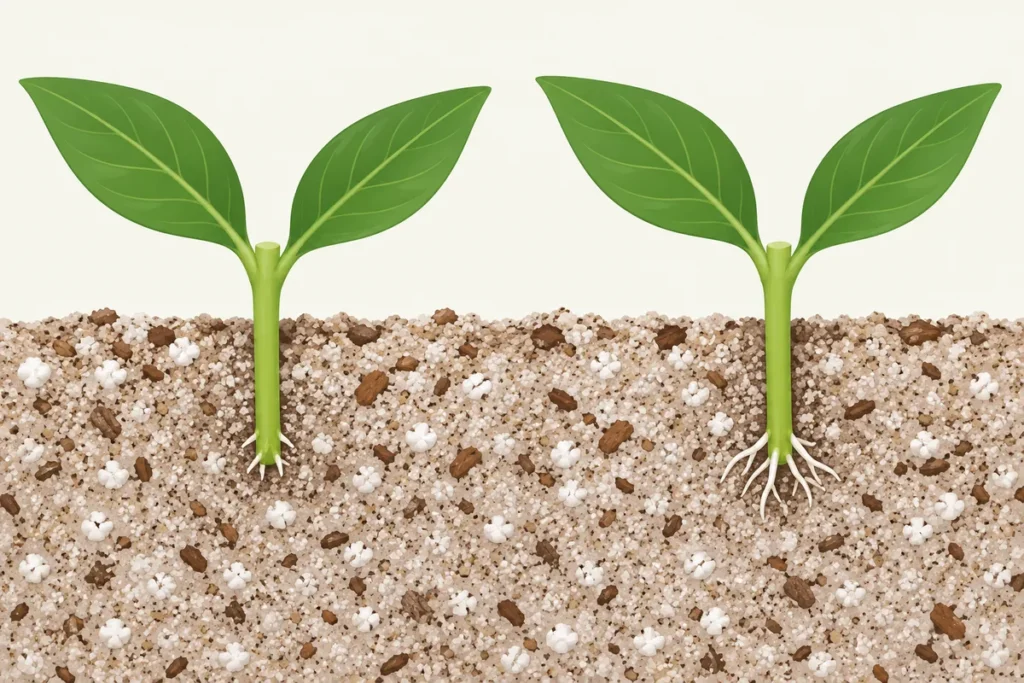
You can try it, but Illinois Extension clearly advises against it, saying water-grown roots tend to be weak and adapt poorly to potting mix [2]. Penn State lists water as one rooting medium for leaves, stem tips and stem sections [1], and Missouri Extension’s plant notes say pothos, philodendron and coleus will root in water [4].
None of these sources compares the two approaches directly. Our reading: water rooting works for some plants, but the move into compost needs care. Rooting straight into a medium avoids that step; this is our inference.
How do division and layering work?
Division suits clump-forming plants. Penn State says to pull or cut plantlets apart and replant them immediately [1]. Missouri Extension adds that young divisions should be kept constantly moist [4].
Natural layering uses runner plantlets, which are separated from the parent once they have rooted [1]. Air layering suits stiff stems and can restore a tall or leggy plant [3].
- Pick a point 12 to 18 inches (about 30 to 46 cm) below the tip and strip the leaves there [3].
- On dicots such as rubber tree and fiddle-leaf fig, cut around the stem to the woody centre, make a second cut one inch below, join them, peel the bark ring and scrape the surface [3].
- Dust with a little rooting hormone, pack moist sphagnum moss around the wound, wrap in clear plastic and tie above and below [3].
- Keep the moss damp. When several inches of roots have formed, cut just below the lower tie, unwrap and pot up [3].
Iowa State says roots usually appear within several weeks, though some species take several months [3].
When should I do it, and what about Hong Kong temperatures?
Iowa State calls early spring ideal for layering, while saying most houseplants can be layered at any time of year [3]. Penn State gives no fixed months and says to learn each plant’s best timing [1]. Missouri’s table shows variation: gardenia roots best in midsummer, hydrangea in spring or early summer [4].
Penn State advises rooting-medium temperature of 75 to 80°F (about 24 to 27°C) [1]. Hong Kong Observatory 1991–2020 monthly means are 23.0°C in April, 26.3°C in May, 28.3°C in June, 25.7°C in October and 16.5°C in January [5]. Our inference: April to October is close to the advised range, while January and February are cooler and rooting may be slower. Air-conditioned room temperatures differ from outdoor normals, and the sources do not cover that.
What should I avoid?
- Field soil as rooting medium: Missouri Extension says it packs tightly when wet and is prone to disease [4].
- Dirty pots and tools: pots, medium and equipment must be clean and sterile [4].
- Waterlogged media: keep it evenly moist, not soggy [2].
- Leaving rooted cuttings too long before potting: Illinois advises not to wait too long [2].
- Over-applying rooting hormone, which can slow rooting [3].
- Pulling cuttings up constantly: Missouri Extension suggests only occasionally and carefully lifting a few to check roots [4], and Penn State simply says to be patient [1].
When should I give up or ask for help?
If a cutting turns black and soft it has probably rotted and may need replacing. Missouri Extension notes dieffenbachia is subject to rot during rooting, so avoid overwatering [4]. Judging rot by appearance is ours; the sources give no standard. See stem rot.
Some plants simply do not respond to some methods [1]. If a sensible setup fails several times, switch method or ask a grower who knows the species. For named cultivars or protected varieties, check you are allowed to propagate them first. That is a general reminder, not from the sources.
Frequently asked questions
Can I propagate from pieces I pruned off?
Yes, pruned tips are a common source. See pruning basics. Use healthy, vigorous shoots and clean tools [4].
How long do roots take?
Iowa State says layered roots usually show within several weeks, but some species need months [3]. Penn State also warns some plants take months and advises patience [1].
Why did my cutting turn black?
Missouri Extension says some plants, such as dieffenbachia, rot easily during rooting, so avoid overwatering and keep everything clean [4]. Compare the clues in root rot and stem rot.
Do I need a bigger pot once roots appear?
Not necessarily bigger, but a separate pot. Missouri Extension suggests potting on at roughly 1 inch of root and watching the first weeks [4]. See repotting.
Sources
- Penn State Extension: “Propagating Houseplants” — How stem cuttings, division and layering are done; media, temperature, humidity and hygiene
- University of Illinois Extension: “Propagation (Houseplants)” — Tool sterilising, media choice, advice against water rooting, plant-by-plant method table
- Iowa State University Extension: “How to Propagate Houseplants by Air Layering and Simple Layering” — Air layering steps, suitable plants, timing, time to root, rooting hormone use
- University of Missouri Extension: “Propagating Houseplants (G6560)” — Cutting length, rooting hormone, sterilising, media, transplanting, division, plant-by-plant notes
- Hong Kong Observatory: “Monthly Meteorological Normals for Hong Kong (1991-2020)” — Hong Kong monthly mean temperatures (1991-2020), compared with rooting temperature advice
Further reading
- Back to Plant Doctor
- Pruning basics: when and where to cut
- Quarantine and tool hygiene
- How to repot: timing, steps and aftercare
- Stem rot: soft, blackening stem bases
Sources checked: 31 October 2026. This is general guidance, not an on-site diagnosis. Always follow the product label.
