



Level: Intermediate
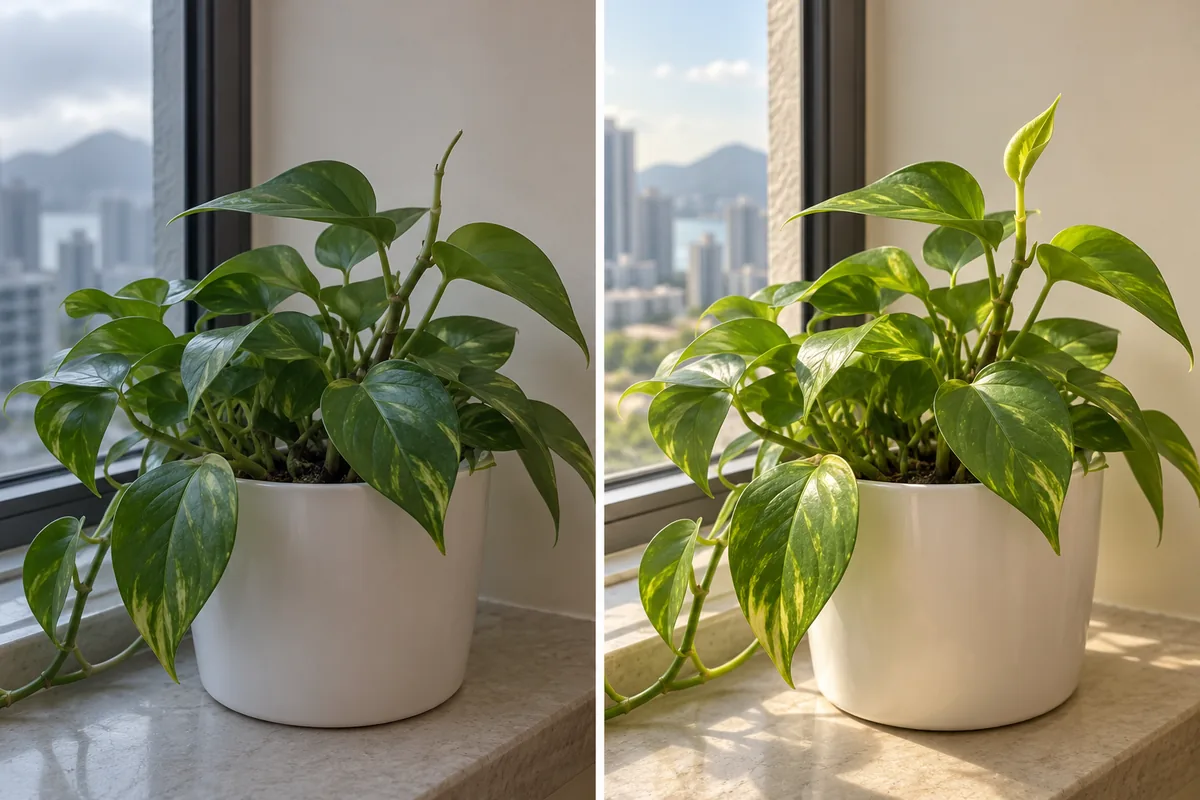
Most houseplants slow down when winter days get shorter, so they usually need less water and a pause in feeding. In Hong Kong the winter is milder, so watch new growth and soil moisture instead of copying overseas calendars.
Key points
- Water less in winter, but decide by how dry the soil is, not by a fixed schedule [1][2].
- If a plant still makes new leaves or buds, treat it as growing; pause feeding only when growth really stops [3].
- Hong Kong is mild in January to March, but days are short and humid, so the mix can stay wet for a long time [8].
- Avoid repotting in winter unless the plant is already showing stress [1][7].
What is dormancy, and how is it different from a problem?
Indoors, most plants slow down in winter rather than stop. University of Vermont Extension explains that shorter, weaker light puts most houseplants into a state it calls quiescence, with much slower growth. Some cacti and succulents may go into a deeper dormancy [1]. Alocasia and caladium can even drop leaves, which the same source calls normal [1].
How do you know a plant is still growing? Nebraska Extension says to look for new leaves, flower buds or flowers. A plant in a bright window, or under a grow light, may keep growing all winter and should be treated as an active plant [3]. So dormancy is a judgement about the plant, not the month.
On a phone, swipe sideways to see every column.
| Clue | Likely cause | Next step |
|---|---|---|
| Winter, firm green leaves, just no new growth | Seasonal slowdown [1] | Water less, pause feeding, keep watching |
| Bright window, still making leaves or buds | Still actively growing [3] | Care for it as a growing plant |
| Yellow lower leaves, soil stays wet, musty smell | Overwatering damaging the roots [4] | Stop watering, unpot and check; see root rot |
| Brown leaf tips and a white crust on the soil | Fertiliser salt build-up [3] | Pause feeding; see fertiliser burn |
| Purple or red leaves, or wilting, after a cold draught | Chilling injury [6] | Move away from vents and cold glass; see cold snaps |
How do you cut back on water safely in winter?
Watering less means leaving longer gaps, not keeping the mix bone dry. Nebraska water extension says needs fall sharply once plants are indoors; a plant watered daily in July may need it weekly or less in winter. It also says overwatering kills more houseplants than any other cause [4]. Vermont advises against a fixed schedule: for most plants, water when the top inch or so is dry, and water thoroughly [2].
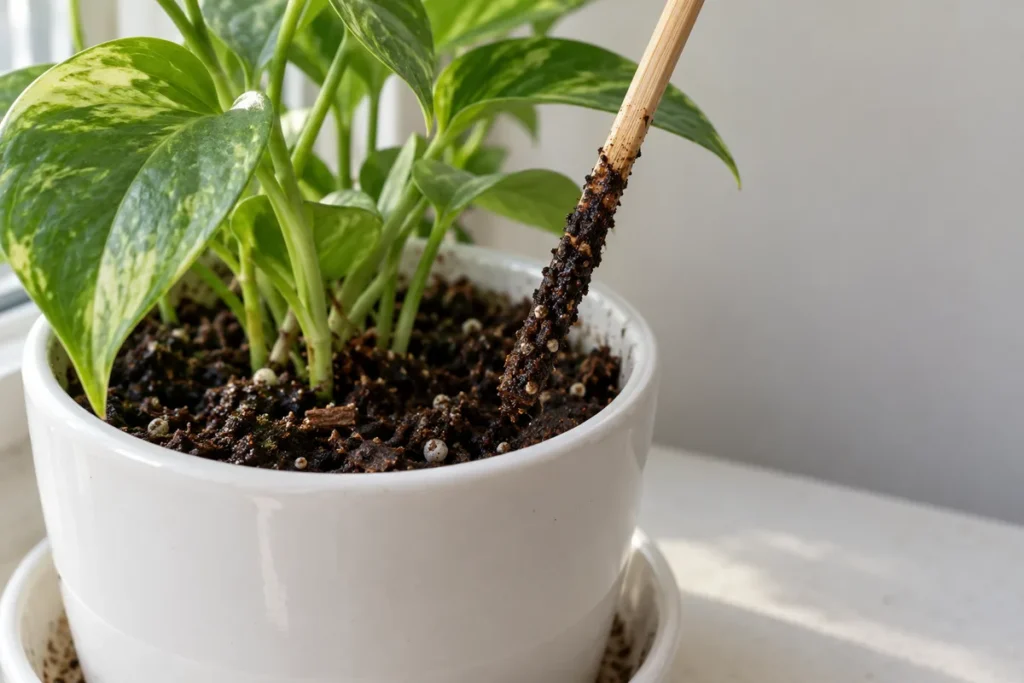
- Push a finger or wooden chopstick into the mix. If damp soil clings to it, wait; if it comes out clean, water [1].
- When you water, wet the whole root ball until water runs out of the base, then empty the saucer [2].
- Plant types differ in what they need; see how to water.
Most of this advice comes from cool-climate winters with indoor heating. Hong Kong winters swing between mild and cold, so use your own light, airflow and soil moisture as the final test.
Should you stop feeding in winter, and when do you restart?
A resting plant usually does not need fertiliser, and feeding it can do harm. Nebraska Extension says not to feed dormant plants because salts build up, and that newly repotted, unrooted or wilted plants should not be fed either [3]. Vermont suggests pausing from October to March in its climate and restarting when new growth appears [2].
Notice the difference: one source goes by plant state, the other by calendar months. We would go by state, because Hong Kong winters are short and mild. In spring, Minnesota Extension suggests a balanced fertiliser at half strength every two to four weeks. The sources do not agree on frequency, so start gently and follow the label [5][3].
For the basics of feeding, see fertiliser basics.
What do Hong Kong figures say about winter growth?
Hong Kong winters are mild but have shorter light. Hong Kong Observatory 1991–2020 normals give a mean temperature of about 16.5°C in January, 17.1°C in February and 19.5°C in March, against about 28.9°C in July [8]. Sunshine is about 145.8 hours in January, 101.7 in February, 100.0 in March and 197.3 in July [8].
So the dimmest months are February and March, and March mean relative humidity is about 82% against 74% in January [8]. Our inference: soil may dry slowly then, so overwatering risk can be higher. Rooms with air conditioning or heating can still dry pots quickly, so check the soil itself.
On cold, UC IPM says tropical and subtropical plants are most susceptible to chilling injury, even above freezing [6]. Nebraska says cacti like cool winters but should not go below about 45°F (about 7°C) [4]. The UC IPM page is about landscape plants, and the Nebraska figure is only for cacti, so do not apply either to every houseplant.
- Beginner: keep plants away from air-conditioner outlets and cold window gaps; see air conditioning.
- Intermediate: photograph the plant from the same angle every two weeks to track new growth.
- Advanced: note light and temperature near the window across a day, and compare them with the Observatory figures to build your own seasonal rule.
What should you do during the slow season?
Mostly, check. Vermont recommends wiping dust from leaves so they catch more light and, at the same time, scouting for pests. Spider mites thrive in dry air and fungus gnats follow overwatering [1].
For repotting, Vermont says to wait for spring unless it is necessary [1]. Montana State says late winter to early spring is the best season, but a plant already showing stress can be repotted at any time [7]. So do not wait if you find rotten roots or standing water.
When light returns, Minnesota Extension advises moving plants closer to the window gradually over one to two weeks to avoid scorch [5].
What should you avoid?
- Feeding to “wake up” a plant with no new growth: a resting plant cannot use it, and salts build up [3].
- Watering on a fixed day: go by the soil, not the calendar [2].
- Repotting or hard pruning for no reason in winter: wait for spring unless roots are rotting [1][7].
- Assuming every yellow leaf is dormancy: rule out wet soil, salts and cold first; see no new growth.
When should you get help or give up?
If winter is over, light has returned and the plant has made no growth for months, and you also see constantly wet soil, a smell from the pot, a soft stem base or heavy leaf loss, it is no longer dormancy. Unpot it and check the roots; see root rot. If most roots are mushy or the stem base has collapsed, recovery is less likely. Consider rooting any healthy stem cuttings, or replacing the plant.
Frequently asked questions
Do plants really go dormant in Hong Kong winters?
They slow down, but how much depends on your home. January mean temperature is about 16.5°C and sunshine is lowest in February and March [8]. Plants in bright windows may keep growing, so watch for new growth [3].
How often should I water in winter?
There is no fixed number of days. Extension sources suggest waiting until the top inch or so is dry, using a finger, chopstick or moisture meter [1][2]. Some plants may go from daily to weekly or less [4], but every home differs.
Can I feed a dormant plant?
Usually not. Nebraska Extension says dormant plants should not be fertilised, though a plant that is still growing should be treated as active [3]. In spring, half-strength feed every two to four weeks is one suggestion; follow the label [5].
Are yellow leaves dormancy or is the plant dying?
It could be either. Leaf drop can be normal for some plants such as alocasia [1], but wet soil, a smell and a soft stem point more to root rot [4]. Unpot and look at the roots; see root rot.
Sources
- University of Vermont Extension: “Houseplant Care During the Winter Months” — Shorter winter days slow houseplants (quiescence); less water, no feeding or repotting, winter pests
- University of Vermont Extension: “Hibernating Houseplants” — Pausing feeding in winter, watering by soil dryness not a schedule, restarting when new growth appears
- Nebraska Extension in Lancaster County: “Success With Houseplants – Fertilization” — How to tell if a plant is still growing, no feeding for dormant plants, signs of salt build-up
- University of Nebraska-Lincoln (Water): “Winter Care of Indoor Plants” — Much lower water needs indoors in winter, overwatering risk, cooler winter temperatures for cacti
- University of Minnesota Extension: “Spring houseplant care” — Gradually raising light, pruning, repotting and restarting feeding as days lengthen
- University of California IPM (UC IPM): “Chilling Injury” — Tropical and subtropical plants can be injured by cold above freezing (landscape plants)
- Montana State University Extension: “Ask Steward: How do I repot a houseplant” — Best repotting season and the exception when a plant already shows stress
- Hong Kong Observatory: “Monthly Meteorological Normals for Hong Kong (1991-2020)” — 1991-2020 monthly mean temperature, relative humidity and sunshine hours
Further reading
- Back to Plant Doctor
- No new growth: dormancy or a problem?
- Overwatered or underwatered? A side-by-side check
- Hong Kong winter plant care
- Soil moisture meters versus the finger test
Sources checked: 31 October 2026. This is general guidance, not an on-site diagnosis. Always follow the product label.
