



Level: Beginner
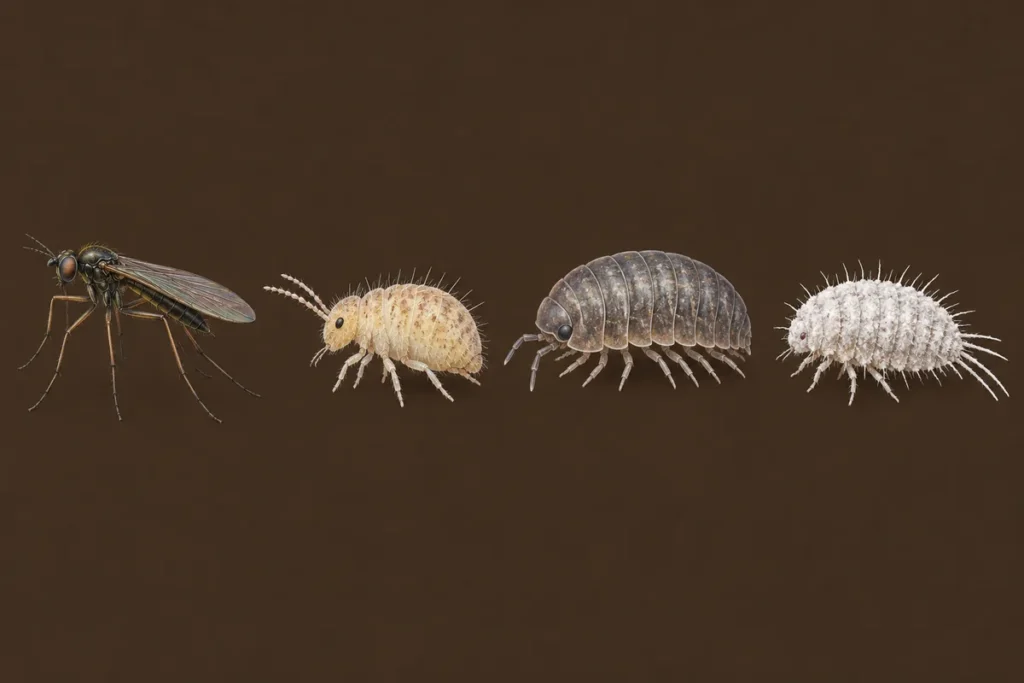
Look at how the bug moves. A small dark fly is most likely a fungus gnat [1][2]. A tiny pale speck that springs away is a springtail, usually harmless and a sign of damp mix [3]. A grey oval creature that rolls into a ball is a pillbug [6]. White powdery specks near the roots could be root mealybugs [4][5].
Key points
- Match movement to type: flying is a fungus gnat, jumping is a springtail, rolling into a ball is a pillbug, white powder near roots needs a root check [1][3][4][6].
- Springtails and pillbugs mostly eat decaying matter, so drying the mix usually comes before any spray [3][6].
- Fungus gnat larvae live in damp mix and can chew roots, so managing wetness is the core fix [1][2].
- University advice makes insecticides a last resort for houseplants. If you use one, choose a product registered in Hong Kong and follow the label [1][2][8].
How can you tell soil bugs apart?
Check three things: size, whether it flies, and whether it jumps. UC IPM describes adult fungus gnats as mosquito-like flies with slender legs and antennae longer than the head [1]. Ohio State Extension gives adult length as about 2 to 5 mm and calls them weak fliers that make short, dancing flights [2]. Springtails are wingless and about 1/16 inch long, and spring into the air using a tail-like structure when disturbed [3].
On a phone, swipe sideways to see every column.
| Clue | Possible creature | Next step |
|---|---|---|
| Dark, mosquito-like, flits over the mix or windows | Adult fungus gnat | Check whether the mix stays wet; see fungus gnats [1][2] |
| Tiny, wingless, springs away when disturbed | Springtail | Dry the surface; sprays are usually unnecessary [3] |
| Grey oval, seven leg pairs, rolls into a ball | Pillbug (a crustacean, not an insect) | Clear damp debris and check how wet the mix is [6] |
| White powder on the outer roots or near the drainage hole | Possibly root mealybugs | Unpot and look; see the next section [4][5] |
| Saucer holds water, mix stays wet on top | Conditions that favour gnats and springtails | Fix watering and drainage first; see how to water [1][3] |
These descriptions come mostly from US universities, and Hong Kong may have different species, so we group by appearance and behaviour rather than naming species. To split gnats from springtails further, see springtails or fungus gnats.
Take a sharp, close photo. A dark bug that flies and a white speck that jumps need very different responses.
Could there be bugs on the roots?
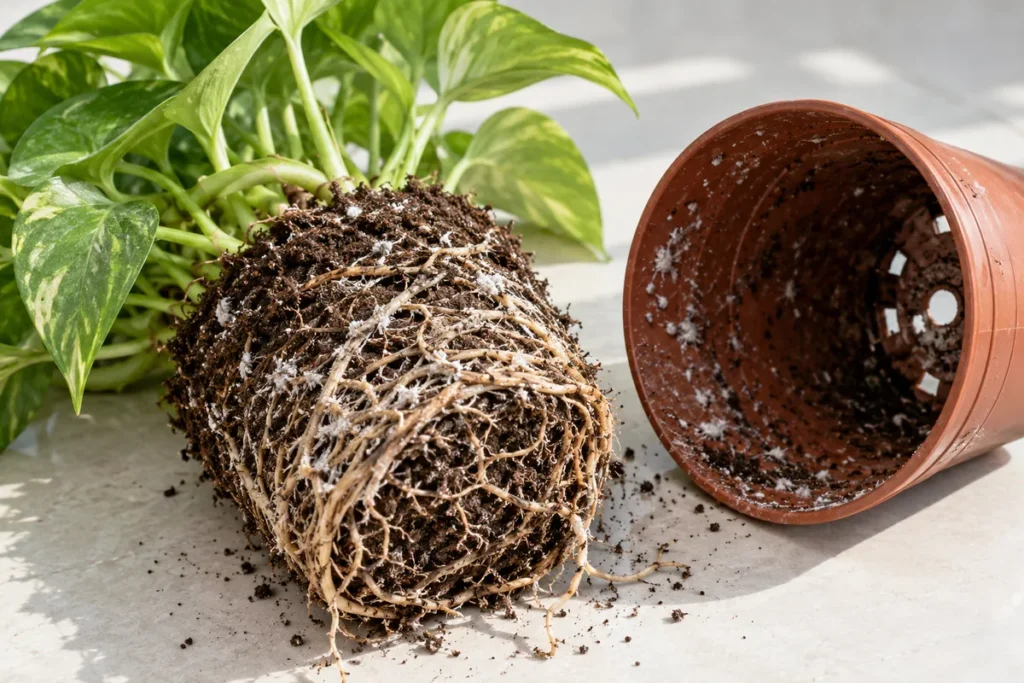
It is possible but less common, and root mealybugs are easily mistaken for springtails. NC State Extension says adults are about 1/16 to 1/8 inch long with a bluish body and a white fluffy bloom, and look like large white springtails that move far more slowly [4]. They can crawl out of drainage holes after watering and are often overlooked because they are small and live on roots [4].
UC IPM notes that white powdery wax on the soil surface near stems or around the root ball can indicate ground mealybugs, and ants near the stem base can hint at sap-feeding pests [5]. That source describes nursery crops, so treat it as a lead for houseplants, not proof. Unpotting the plant is a sensible first check. The same page gives about 2 to 4 months for one generation, so a problem rarely appears overnight [5].
NC State suggests a systemic insecticide labelled for residential use [4]. That involves product choice and strength, so we do not give a recipe. In Hong Kong only registered pesticides may be distributed and used [8]. If you suspect root mealybugs, photograph the roots and ask a plant professional before treating.
What should you do once you know?
- Dry the mix before reaching for a spray. UC IPM advises letting the surface of container soil dry between waterings and improving drainage [1]. Ohio State says moisture management and removing debris are the main approaches [2].
- Stop standing water in saucers. UC IPM says springtails in potted plants can be managed by avoiding overwatering, letting the soil dry out, and not letting drain water stand in saucers [3].
- Monitor with sticky traps and raw potato. UC IPM mentions yellow sticky traps for adults, and raw potato chunks placed cut side down are sometimes used to check for larvae [1].
- Consider biological control for stubborn gnats. UC IPM says Bti products are sold at garden centres, but Bti does not persist indoors, so mix may need repeat treatment at about five-day intervals [1]. Follow the product label for use.
- Repot into clean, free-draining mix. UC IPM advises pasteurised mix and avoiding incompletely composted organic matter [1]. See how to repot.
For adult flies, UC IPM generally does not recommend insecticides around the home [1]. Ohio State says insecticides are usually unnecessary indoors because exclusion, sanitation and potted plant management work [2]. UC IPM also says pesticides should not be necessary for springtails and will not give lasting control alone [3].
If you do use any pesticide, choose a product registered in Hong Kong [8] and follow the label exactly. Do not mix your own strengths, and keep pets and children in mind.
What should you avoid?
- Spraying at the first sight of a bug. Springtails are mainly a sign of moisture, and a spray does not fix that [3].
- Keeping the surface constantly wet. UC IPM says fungus gnats thrive in moist conditions [1], and that continued springtail presence indoors points to moisture [3].
- Using uncomposted or garden material as potting mix. UC IPM says incompletely composted organic matter is often infested with fungus gnats [1].
- Assuming peat is always safe. Ohio State says peat amendments seem more attractive to egg-laying females than commercial compost mixes [2]. That is an observation, not a rule for every setting.
- Cinnamon, coffee grounds and similar home remedies. We have not seen university or botanic garden support for them, so the evidence is weak and we do not recommend them as a step.
For pillbugs, UC IPM says they mainly eat decaying plant matter but also chew seedlings and tender parts close to damp soil [6]. A few at the pot edge usually call for removing damp debris first, not a pesticide.
How do you prevent soil bugs in a Hong Kong home?
Aim for mix that does not stay wet, not ‘water less because Hong Kong is humid’. Hong Kong Observatory 1991-2020 normals give monthly mean relative humidity from about 70% in December to about 83% in April and May, and about 19 rain days in June [7]. Those are outdoor averages, not the conditions inside your flat or pot.
In practice, press a finger into the mix and wait until the top has dried before watering, and empty saucers after watering. During humid spells, improve airflow, and see houseplants and dehumidifiers. Standing water in saucers also attracts mosquitoes; see plant saucers and mosquitoes.
- Check the mix surface and the pot base for small creatures before you buy.
- Keep new plants apart for a while before placing them with others; see quarantine and hygiene.
- For the wider approach to pests, see IPM for houseplants.
When should you ask a specialist or let the plant go?
Ask for help if the plant is also drooping, the roots look rotten, white powder covers the mix, or several plants show the same pattern. UC IPM says large numbers of fungus gnat larvae can damage roots, and plant death has been observed in some houseplants [1]. It also warns that wilting is more often caused by watering problems or root decay than by gnats [1]. Unpot and check; see root rot.
UC IPM notes that in some cases you may wish to discard severely infested plants [1]. Before you do, photograph the mix, the roots and the bugs and ask a local plant professional.
Frequently asked questions
Do soil bugs bite people or pets?
UC IPM says adult fungus gnats do not damage plants or bite people [1], and springtails do not bite people or pets [3]. Pesticides carry their own risks, so follow the label and ask a doctor or vet if you have concerns.
Why do the bugs get worse after I water?
Fungus gnats and springtails both favour damp conditions [1][3]. Overwatering, poor drainage or standing water in saucers can keep the surface wet and support them.
How long does a fungus gnat take to develop?
Ohio State says eggs hatch in four to six days, larvae feed for about 12 to 14 days, and adults live about 7 to 10 days [2]. Catching adults alone is rarely enough, so deal with the damp mix where larvae live.
Are pillbugs harmful to plants?
UC IPM says they mainly eat decaying plant material, but can chew seedlings, tender parts and produce touching damp soil [6]. Established potted plants are usually less affected than seedlings.
Can I just buy a spray to fix it?
Not necessarily. University sources put drying the mix and sanitation first [1][2][3]. If you do use a product, only registered pesticides may be distributed and used in Hong Kong [8]; follow the label and do not mix your own strength.
Sources
- University of California IPM (UC IPM): “Fungus Gnats” — Fungus gnat appearance, larval feeding, potting mix care, yellow sticky traps, Bti and nematodes
- Ohio State University Extension: “Fungus Gnats (ENT-59)” — Fungus gnat size, life cycle, soil moisture and peat effects, insecticides rarely needed indoors
- University of California IPM (UC IPM): “Springtails” — Springtail appearance, jumping, mostly harmless, sign of moisture, pesticides not needed
- NC State Extension: “Root Mealybugs” — Root mealybug size, resemblance to slower white springtails, crawling out of drainage holes
- University of California IPM (UC IPM): “Ground (Root) Mealybugs (Floriculture and Ornamental Nurseries)” — White powdery wax on soil, ants as a clue, 2 to 4 months per generation (nursery setting)
- University of California IPM (UC IPM): “Pillbugs and Sowbugs” — Pillbugs are crustaceans with seven leg pairs, eat decaying plant matter, roll into a ball
- Hong Kong Observatory: “Monthly Meteorological Normals for Hong Kong (1991-2020)” — 1991-2020 monthly mean relative humidity and rain days
- Agriculture, Fisheries and Conservation Department (AFCD): “Pesticide Control and Related Information” — Only registered pesticides may be distributed and used in Hong Kong (Pesticides Ordinance, Cap. 133)
Further reading
- Back to Plant Doctor
- Fungus gnats: identify and manage them
- Springtails or Fungus Gnats? Identify the Soil Visitors First
- Root rot in houseplants: confirm, treat, give up
- IPM for houseplants
- Mealybugs: how to spot and handle them
Sources checked: 31 October 2026. This is general guidance, not an on-site diagnosis. Always follow the product label.
