



Level: Beginner
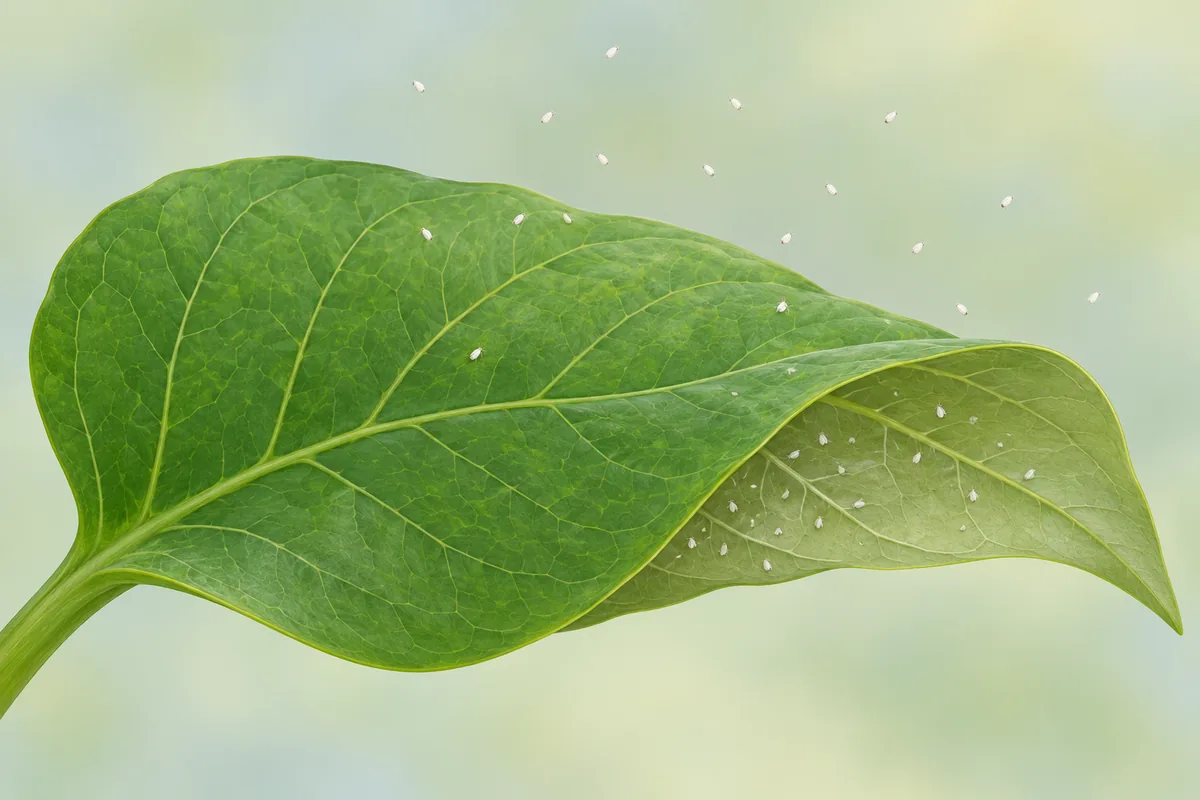
Whiteflies are tiny sap-sucking insects. Adults are white and fly up when disturbed, while the young nymphs sit still under leaves, feed on sap and leave sticky honeydew that black sooty mould can grow on [1][4]. Check under the leaves, then expect to repeat treatments, because eggs and pupae are less affected by sprays [4].

Key points
- White insects flying up when you shake the plant, flat nymphs under the leaf and sticky leaves point towards whiteflies [1][2].
- Whiteflies on houseplants are hard to control, so prevention and early isolation matter most [3].
- Yellow sticky traps mostly catch adults, and soaps or sprays must reach leaf undersides and be repeated [1][4][5].
- For heavy infestations, Illinois Extension and Iowa State both mention discarding the plant [2][3].
How can I tell it is whiteflies and not thrips or something else?
Adult whiteflies are white. Missouri Extension says they look like tiny moths, with wings and body covered in white powdery wax [4]. UC IPM says they fly around when disturbed, while the nymphs are oval, legless and immobile, and cause most of the damage [1]. So two quick checks help: shake the plant gently, then turn leaves over and look for fixed nymphs.
UC IPM lists these signs: tiny nymphs under the leaf, sticky honeydew on leaves or below the plant, black sooty mould, and leaves that turn yellow, silvery or dry [1]. Illinois Extension adds that feeding can cause yellowing, mottling and wilting, and in severe cases plant death [2].
The table gives clues, not a diagnosis.
On a phone, swipe sideways to see every column.
| Clue | Possible cause | Next step |
|---|---|---|
| White insects fly up in a group when shaken; flat nymphs under leaves; sticky leaves | Whiteflies are a common cause [1][4] | Check leaf undersides; isolate; see sticky leaves |
| Slender rice-grain insects, silvery scraping, dark specks, no honeydew | Thrips are more likely; UC IPM describes them as tiny and slender [6] | See thrips |
| Black sooty layer that wipes off | Sooty mould growing on honeydew, which comes from sap-sucking insects [1][4] | Read black sooty mould on leaves and look for the source |
| White cottony bodies in leaf joints | Mealybugs, among others | See mealybugs |
| Fine dots and fine webbing | Spider mites, among others | See spider mites |

Why do whiteflies keep coming back?
Mostly because all life stages overlap and indoors there is no winter to break the cycle. Missouri Extension says that in warmer climates, and indoors and in greenhouses, whiteflies can reproduce all year round with overlapping generations [4]. UC IPM adds that they develop rapidly in warm weather and numbers can build up quickly [1].
A rough timeline from Missouri: a female usually lays 200 to 400 eggs, eggs hatch in about a week, nymphs stay fixed and feed for about four weeks, then adults emerge and live around a month [4]. Illinois gives egg hatching as 7 to 10 days [2]. The sources differ slightly, probably by species and temperature, so treat both as rough guides.
For advanced readers: Missouri says eggs and non-feeding pupae are less susceptible to insecticides, so clearing a population usually takes repeated applications, and it reports four to five applications at five- to seven-day intervals [4]. UC IPM, however, says even the most toxic insecticides are only partially effective [1], and Iowa State calls whiteflies on houseplants extremely difficult to control [3]. Read together: repeating helps, but do not expect a single round to clear them.
Hong Kong context: a warm flat in summer may speed things up, but that is our inference, not something the sources say about Hong Kong. Iowa State also warns that plants brought indoors from the garden or patio in autumn need checking [3]. The same applies when you bring balcony pots in ahead of a typhoon; see typhoon preparation.
How do I deal with whiteflies?
Isolate first, cut numbers by physical means next and use sprays last.
- Move the plant away today. Missouri advises isolating new plants for a few days, inspecting them and treating any that are infested [4]; Iowa State also stresses prevention and isolation [3].
- Remove the worst-affected older leaves. Missouri says heavily infested older leaves with immobile nymphs and pupae can be removed by hand [4], and UC IPM suggests pruning infested leaves when they are first found [1]. Bag and bin them.
- Wash or wipe. UC IPM mentions hosing adults off with a strong stream of water [1]. Iowa State says wiping leaf undersides with a moist cloth or sponge can cut numbers but is only practical for small plants [3].
- Vacuum adults in the early morning. Missouri suggests a small hand-held vacuum when it is cool and the insects are slow [4]. Empty the vacuum carefully afterwards.
- Hang yellow sticky traps. Illinois says they work much better if the foliage is disturbed daily so the adults fly off [2], and Chicago Botanic Garden says bright yellow traps catch adults [5]. Traps catch adults, while nymphs and pupae stay under the leaves, so treat traps as a helper (this last point is our inference).
- If you use a spray, choose one labelled for houseplants and follow its label. UC IPM suggests insecticidal soaps or oils, which are less harmful to natural enemies, with good coverage including leaf undersides and repeats if needed [1]. Chicago Botanic Garden says soap sprays can help [5]. Iowa State says sprays need to be applied uniformly and frequently, at weekly intervals, to the undersides of the foliage [3]. Follow the label for exact timing.
Hong Kong note: pesticides are regulated under the Pesticides Ordinance (Cap. 133) [7]. Choose clearly labelled products meant for houseplants, follow the label and do not mix your own. With pets or young children at home, ask a vet or doctor first. We found no pet-safety data in our sources for specific products.
UC IPM also says ants protect whiteflies from natural enemies, so deal with ants on the pot as well [1]. See snails, slugs and ants.
How well do sticky traps and soap really work?
The sources do not fully agree, and we report that as it is. Illinois says yellow traps can catch adults indoors [2], and Missouri says traps can be very helpful for light infestations in greenhouses [4]. Iowa State is gloomier overall for houseplants, calling control extremely difficult [3].
On sprays, Illinois says soap, oil and chemical insecticides are effective, in a passage mainly about outdoor use [2]. UC IPM says even the most toxic insecticides are only partly effective [1], and Missouri asks for repeated applications because eggs and pupae are less susceptible [4].
A sensible reading is that traps, washing, pruning and soap are tools that add up, not a single fix. The weak spot in the evidence is how many repeats are enough for a home plant. We have no reliable household number, so we do not invent one.
What should I avoid doing?
- Spraying once and stopping. Missouri, UC IPM and Iowa State all point to repeat treatment [1][3][4].
- Spraying only the tops of leaves. UC IPM stresses good coverage including the undersides [1], and Iowa State says to spray the undersides [3].
- Reaching for broad-spectrum insecticides. UC IPM advises avoiding pyrethroids, organophosphates and neonicotinoids because they harm natural enemies [1]. That is outdoor landscape advice; indoors there are fewer natural enemies, but label rules still apply.
- Trying home mixtures. We found no university or botanic garden support for a specific home remedy that clears whiteflies safely, so we do not recommend trying them.
- Keeping the infested plant beside others. Missouri says a slight infestation on one plant can spread quickly to others [4].
If you only wipe off a black sooty layer, it will return as long as honeydew keeps coming; the insects are the source to deal with.
How do I stop whiteflies coming back?
Prevention is more realistic than cure. Iowa State calls prevention the best strategy and advises checking new plants and plants brought in from the garden or patio in autumn, and isolating them from other houseplants [3].
- Isolate new plants for a few days and look under their leaves daily [4].
- Check leaf undersides regularly, because large colonies often develop there [1].
- Prune off a few infested leaves as soon as you see them. UC IPM suggests pruning out isolated infested leaves when first detected [1].
- Keep dust down. UC IPM, in its outdoor advice, says dust can disrupt natural enemies [1].
- Do not keep the mix constantly wet in an attempt to raise humidity; see humidity myths.
The whole routine fits into quarantine and hygiene and integrated pest management.
When should I give up on the plant?
If leaves are crowded with nymphs, yellowing and dropping, and several rounds of treatment have not helped, discarding may be the practical choice. Illinois Extension says infestations can be reduced by discarding heavily infested plants [2], and Iowa State says it is usually best to discard them so whiteflies do not spread to other houseplants [3].
Bag the plant before carrying it out so adults do not fly off. Check neighbouring plants for honeydew or sooty mould as well.
If it is a plant you value, ask an experienced nursery or horticulturist for help. Even so, none of the university sources we read describes a home method that clears every whitefly with certainty.
Frequently asked questions
Do whiteflies bite people?
The sources we read describe damage to plants only and give no information on bites, so we make no claim. If your skin is irritated, speak to a doctor.
How do I tell whiteflies from thrips?
Adult whiteflies are white and fly up in a group when disturbed, and honeydew often makes leaves sticky [1][4]. Thrips are slender, rice-grain shaped insects that leave silvery scars and dark specks [6].
Why do I only see them when I shake the plant?
Whiteflies mostly sit under leaves, and UC IPM says large colonies often develop on the undersides [1]. Adults fly up when disturbed [2], so turn leaves over during routine checks.
Can yellow sticky traps replace spraying?
We do not suggest relying on them alone. Traps mainly catch adults [4], while eggs, nymphs and pupae stay under the leaves. Use them to monitor and support washing, pruning and repeat treatment.
How do I clean sticky honeydew off leaves?
Honeydew is whitefly excrement and black sooty mould can grow on it [1][4]. Wiping is only cosmetic unless you also deal with the insects; see sticky leaves.
Sources
- University of California IPM (UC IPM): “Whiteflies” — Appearance, flying when disturbed, nymphs under leaves, honeydew and sooty mould, fast build-up in warm weather, ants protecting whiteflies, soaps and oils, covering leaf undersides, repeat sprays, even strong insecticides only partly effective
- University of Illinois Extension: “Whitefly” — Yellow sticky traps indoors (better if foliage is disturbed daily), egg hatching time, discarding heavily infested plants
- Iowa State University Extension: “How do I control whiteflies on houseplants?” — Houseplant whiteflies are hard to control, prevention matters most, check and isolate new plants and those brought in for autumn, weekly sprays under leaves, use only houseplant-labelled products, discarding heavy infestations
- University of Missouri Extension: “Managing Whiteflies on Indoor and Outdoor Plants” — Life cycle, moth-like adults, eggs and pupae less susceptible, yellow traps, hand vacuum, isolating new plants, removing infested older leaves
- Chicago Botanic Garden: “Controlling Whitefly” — Insecticidal soap can help; bright yellow sticky traps catch adults
- University of California IPM (UC IPM): “Thrips” — Thrips are slender, used here to separate them from whiteflies
- Agriculture, Fisheries and Conservation Department (Hong Kong): “Pesticide Control and Related Information” — Pesticides in Hong Kong are regulated by the Pesticides Ordinance (Cap. 133)
Further reading
- Back to Plant Doctor
- Thrips: silvery scars and black specks
- Sticky leaves and furniture: tracing the honeydew
- Mealybugs: clearing white fluff and preventing repeats
- New-plant quarantine and hygiene
- Black Sooty Mould on Houseplant Leaves: Why Wiping It Off Is Only Half the Job
Sources checked: 31 October 2026. This is general guidance, not an on-site diagnosis. Always follow the product label.
