



Level: Beginner
Sticky leaves or a tacky surface under a plant are most often honeydew from scale insects, mealybugs or aphids feeding on sap [1]. Wiping it off helps, but the stickiness only stops once you find and manage the insects behind it [1].

Key points
- The stickiness is usually insect waste called honeydew, not the plant sweating; fix the insects to fix the stickiness [1].
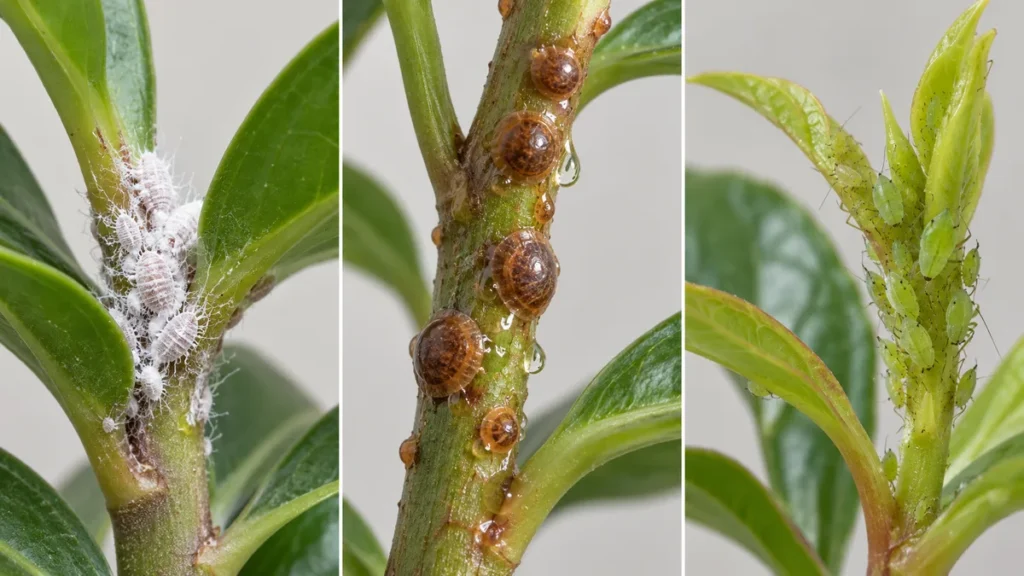
- Check leaf undersides, stem joints and new shoots: white fluff suggests mealybugs, rounded bumps suggest soft scale, and tight clusters suggest aphids [1][2].
- Wiping honeydew and sooty mould is cosmetic; both fade only as the insect numbers fall [6].
- Follow the product label for any treatment, and expect repeat rounds rather than one clean-up [1][3].
How can I confirm the stickiness is honeydew?
Honeydew is a sugary liquid that sap-feeding insects excrete. Iowa State University Extension notes it often coats lower leaves, tables and floors, and can lead to black sooty mould when it is severe [1]. If the sticky patch is on furniture, look at the leaves directly above it.
Touch the sticky spot, then turn the leaf over. Work along the veins, leaf stalks, stem joints and new growth. Use a hand lens or your phone camera zoomed in, because the insects are small.
- Find the stickiest leaf, then check the leaves above it, since honeydew drips downward.
- Look under leaves and in stem joints for white fluff, rounded brown or yellowish bumps, or clusters of small soft-bodied insects.
- Watch for ants. UC IPM notes ants protect mealybugs from their natural enemies [3].
- Take a photo, then photograph the same spot a week later to see whether numbers are growing.
If a black, dusty film sits on the sticky area, it may be sooty mould. UC IPM says it grows on honeydew without infecting the plant, though a heavy coat can reduce photosynthesis [6]. Our guide on black sooty mould on houseplant leaves covers it in more detail.
Which insect is making the honeydew? A quick guide
Several insects leave similar sticky patches, but they look different and hide in different places. Use the table, then confirm with a hand lens. One plant can host more than one pest.
On a phone, swipe sideways to see every column.
| Clue | Likely cause | Next step |
|---|---|---|
| White cottony tufts in stem joints or leaf axils | Mealybugs; UC IPM describes them as wax-covered insects living in colonies in sheltered spots [3] | Dab single insects with a cotton swab and alcohol, then recheck daily; see mealybugs |
| Round or oval raised dots on stems or veins that can be scraped off | Scale insects; soft scales excrete honeydew, armored scales do not [2][7] | Confirm there is honeydew, then see scale insects |
| Clusters of small soft insects on new shoots, buds or leaf undersides | Aphids; UC IPM says they curl leaves and produce sticky honeydew [4] | Wipe or rinse them off; see aphids |
| Tiny white insects that flutter up when you shake the plant | Whiteflies; UC IPM says they excrete honeydew and often gather under leaves [5] | Isolate the plant; see whiteflies |
| Sticky patch but no insect found | Insects may be hidden, may have moved on, or the drip may come from another plant above. Spray residue is possible too (this last point is my own inference, not stated in the university pages) | Widen the search to plants above, window frames and air-conditioning vents; recheck in two or three days |
What should I do in the first week?
Isolate first, remove insects second, wipe the residue last. If you only wipe, the insects stay and the stickiness returns within days.
- Move the plant away from others so leaves do not touch. Iowa State advises isolating infested plants [1].
- Wipe off honeydew, sooty mould and loose insects with a damp cloth [1]. UC IPM suggests a strong water spray for aphids on sturdy plants [4]; test a small area first on delicate foliage.
- For small numbers of scale or mealybugs, scrape them off with a thumbnail or dab them with a cotton swab dipped in rubbing alcohol [1]. Alcohol may mark some leaves, so I would test one leaf underside first. That precaution is my own suggestion; the source only mentions the swab.
- Prune the worst-affected leaves or stems [1] and bag them before binning.
- If you use a product, Iowa State lists insecticidal soap, neem, horticultural oil or pyrethrin, and says to check the label names both the plant and the pest [1]. UC IPM adds that products should be tested for plant damage first, and no product is likely to remove every insect, so keep monitoring and treat again if needed [3].
On timing, Iowa State says thorough weekly applications for four to six weeks may be needed [1]. That is general university advice for houseplant scale, mealybugs and aphids; your product label has the final word on frequency. For help choosing, see pest-control products.
How do I know the insects are gone?
UC IPM says honeydew production lessens once the insect numbers fall, and sooty mould then gradually fades [6]. So the best sign of success is no new stickiness, not simply a clean-looking leaf.
- Wipe one marked leaf every two or three days and see whether it turns tacky again.
- Photograph leaf undersides and stem joints on the same day each week and compare.
- Watch new growth for distortion or small size; if it continues, insects may remain.
- Fewer ants usually suggests less honeydew, but that is an inference, so read it together with what you see on the plant.
If fresh honeydew still appears after two or three weeks, you may have missed a pocket of insects, or another plant nearby may be the source. Widen the search to pot rims, saucers and any plants hanging above.
What should I avoid doing?
- Do not just wipe. Honeydew is the result; the insects are still feeding [1].
- Do not invent home recipes. Dish soap, oils or alcohol mixes with no university or official backing can burn leaves. If you spray, follow a labelled product [1].
- Do not repeat one product without checking results. UC IPM warns that no insecticide is likely to kill every individual, so monitoring matters [3].
- Do not keep an infested plant beside others. Iowa State advises isolating it [1].
- Do not water more to wash the problem away. The stickiness is on the leaves; extra water only adds root-rot risk.
If you have pets or children at home, read the safety directions on the label before treating, and ask a vet or doctor if unsure. We found no university guidance that replaces the label.
How can Hong Kong homes stop honeydew coming back?
Prevention takes less effort than clean-up. UC IPM says mealybugs do well where winters are mild and on indoor plants [3], and whiteflies develop quickly in warm weather [5]. Hong Kong has short winters and most homes stay warm, so make checking a year-round habit rather than a summer one.
- Inspect new plants under the leaves and at stem joints before bringing them in; UC IPM advises checking plants when you buy and discarding infested ones [3].
- Keep new arrivals apart for two to three weeks before grouping them with others (the length of time is my own suggestion; the sources give no number of days).
- Glance under leaves and at new growth each time you water. One minute is enough.
- Under hanging or high plants, use an easy-wipe mat on furniture and windowsills so drips are noticed quickly.
- Watch plants on sills and balconies where ants travel: UC IPM says ants protect mealybugs and aphids [3][4].
For a routine you can follow week to week, see integrated pest management for houseplants and quarantine and hygiene.
When should I call in help or let the plant go?
Consider letting go if most leaves are sticky, new growth is distorted and the plant is yellowing or dropping leaves. UC IPM says severe mealybug cases may justify discarding a houseplant [3], and Iowa State says discarding a heavily infested plant may be better than letting pests reach other plants [1].
- New honeydew keeps appearing after three to four weeks of labelled treatment.
- Pests have spread to three or more plants.
- You find white fluff on the stem base or at soil level; UC IPM notes some mealybugs feed on roots [3].
- The plant is valuable or hard to replace, and a horticulturist or plant clinic could look at clear photos.
If you discard it, bag the plant and its potting mix together, and wash the pot before reuse.
Check it step by step with Plant Doctor →
Frequently asked questions
Could the plant itself be producing the sticky coating?
The university pages I read attribute stickiness to honeydew from sap-sucking insects [1][7], so treat insects as the first suspect. If you cannot find any, check plants above and leaf undersides, then look again in two or three days before spraying. Other causes such as spray residue are only my inference.
Can I rinse sticky leaves with water?
UC IPM says aphids can be knocked off with a strong water spray and that sooty mould can be washed away with water or soapy water [4][6]. Indoor foliage may be delicate, so a gentle shower or a damp cloth is a safer start.
Does black sooty mould harm the plant?
UC IPM says it does not infect the plant but a heavy coat may reduce photosynthesis [6]. University of Minnesota Extension adds that honeydew itself is not directly damaging, and the harm comes from the feeding insects [7]. So clean the mould and still deal with the insects.
Do all scale insects make leaves sticky?
No. Both UC IPM and University of Minnesota Extension say soft scales excrete honeydew while armored scales do not [2][7]. Bumps without stickiness may be armored scale or old shells, so keep checking; see scale insects.
Should I worry about ants on my plant?
Yes, take them as a clue. UC IPM says ants protect mealybugs and aphids from natural enemies, which makes the pests harder to control [3][4]. If you see ants, check leaf undersides and stem joints for insects.
Sources
- Iowa State University Extension: “What is this sticky substance all over the table, floor, and lower leaves of my houseplant?” — Honeydew sources (scale, mealybug, aphid), how to spot each, wiping and repeat treatment
- University of California IPM (UC IPM): “Scales” — Soft scales excrete honeydew, armored scales do not; what scales look like
- University of California IPM (UC IPM): “Mealybugs” — Where mealybugs hide, the ant link, limits of insecticides, discarding when severe
- University of California IPM (UC IPM): “Aphids” — Aphid features (cornicles), honeydew, water-spray control
- University of California IPM (UC IPM): “Whiteflies” — Whiteflies excrete honeydew, cluster under leaves, develop quickly in warm weather
- University of California IPM (UC IPM): “Sooty Mold” — Sooty mould grows on honeydew, can be washed off, fades once insects are reduced
- University of Minnesota Extension: “Scale insects” — Soft versus armored scale; honeydew itself is not directly damaging
Further reading
- Back to Plant Doctor
- Black sooty mould on houseplant leaves: find the cause after wiping
- Mealybugs
- Scale insects
- Integrated pest management for houseplants
Sources checked: 31 October 2026. This is general guidance, not an on-site diagnosis. Always follow the product label.
