



Level: Intermediate
A plant that will not flower is most often too young, short of light, over-fed with nitrogen, or pruned at the wrong time so the flower buds were cut off [3][4]. Some species also need set day lengths and night temperatures [1]. Identify the plant first, then check each cause, changing one thing at a time.
Key points
- Separate species habit, plant age and growing conditions first. A very young plant may simply need to wait [3].
- Flowering houseplants usually need far more light than foliage plants, and low light is a common cause [2][3].
- Too much nitrogen gives leaves at the cost of flowers [3][4], and pruning at the wrong time can remove buds [3].
- Some plants, such as holiday cactus, need particular day lengths and night temperatures [1].
Is the plant not flowering yet, or is something wrong?
Start with species and age. Clemson Extension lists immaturity as a very common reason plants do not flower, with low light another [3]. Iowa State Extension notes that many flowering houseplants have a limited bloom season and often need a rest period before flowering again [2]. A newly bought, just-flowered or young plant may be perfectly healthy.
On a phone, swipe sideways to see every column.
| Clue | Possible cause | Next step |
|---|---|---|
| Dark green, fast leaf growth, no buds at all | Low light or too much nitrogen [3][4] | Check light first, then the fertiliser label |
| Flowered before, not this year | Missed rest period, wrong day length or night temperature, or buds pruned off [2][3] | Check the species’ bloom season and when you last pruned |
| Small, recently rooted or newly bought | Not yet mature [3] | Keep care steady for a season or two |
| Buds appear, then fall | Not a failure to flower: bud drop | See bud drop |
| Street light at the window, or lights on all evening | Short-day plants may be disturbed by night light (our inference) | Give the plant longer real darkness at night |
The last row is our own inference. Purdue Extension only says that some plants, such as chrysanthemums and poinsettias, respond to long nights [4]. It does not discuss household lighting.
Is there enough light? Flowering asks for more than leaf growth
Flowering plants usually need brighter light than foliage plants. Iowa State Extension says most flowering houseplants need direct or bright, indirect light well above what most foliage plants require, and that supplemental light can help when natural light is short [2].
University of Illinois Extension gives rough numbers. Full sun outdoors can reach 10,000 to 12,000 foot-candles and indoors you get only a small share. It puts bright light at about 300 foot-candles and direct sun at about 1,500 [5]. Light falls quickly as you move away from a window, so a few steps can matter.
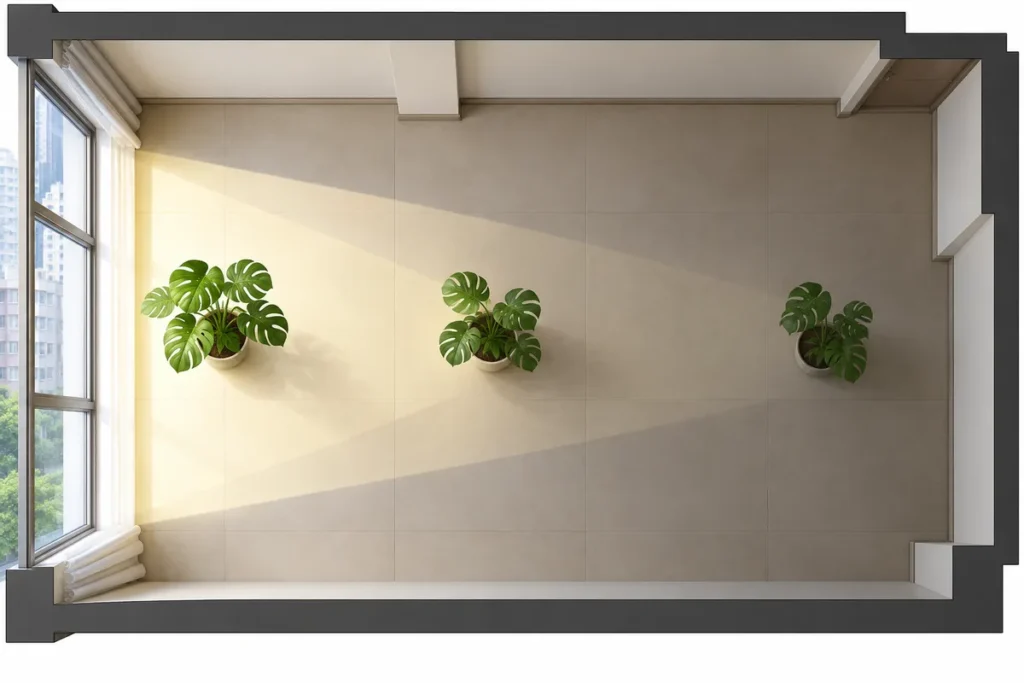
In dense Hong Kong housing, neighbouring blocks, curtains and screens all cut light. Illinois Extension also notes that the sun’s height changes with the season, so room light changes too [5]. Photograph the same spot at the same time over a week rather than trusting a glance. See assessing indoor light in Hong Kong homes and light, PPFD and DLI.
Hong Kong tip: midday summer sun through glass can scorch leaves. Move the plant closer in small steps and watch for sunburn.
Can too much nitrogen stop flowering?
It can. Clemson Extension says too much nitrogen produces mainly leaves and stems, so the plant looks large and healthy but has few or no flowers [3]. Purdue Extension says the same and suggests a balanced, low-analysis fertiliser, giving 12-12-12 and 6-10-4 as examples for garden plants [4].
The opposite also happens: a shortage of nutrients may reduce flowering [3], so the answer is not to stop feeding altogether. University of Minnesota Extension offers a specific schedule for holiday cactus: a balanced houseplant feed at half strength monthly from June to August, then a low-nitrogen, higher phosphorus and potassium formula such as 0-15-10 once buds are forming [1]. That is advice for one plant group, not every species.
Products sold as bloom boosters have not, as far as we can see, been compared by universities or botanic gardens. If you use one, follow the label and do not increase the strength. See fertiliser basics.
How does pruning time affect flower buds?
Some plants flower only on last year’s growth. Clemson Extension warns that pruning at the wrong time can remove next year’s flower buds. It gives azaleas as an example: they start setting next year’s buds in late spring, so summer or autumn pruning may prevent flowers [3]. Purdue Extension says early-spring bloomers in the landscape set buds in autumn on old wood, so late-winter pruning removes many of them [4].
Both sources describe garden plants. A similar plant in a pot may behave the same way, but check your species first. For holiday cactus, University of Minnesota Extension suggests pruning after flowering to encourage branching [1]. The basics are in pruning basics.
Do temperature and day length matter?
For some species, yes. Purdue Extension notes that short-day plants such as poinsettias and chrysanthemums respond to long nights, and that blooming is delayed if they lack a proper dark period [4]. University of Minnesota Extension is specific for holiday cactus. With nights near 55°F (about 13°C), flowering takes roughly 5 to 6 weeks. With nights of 60 to 65°F (about 16 to 18°C), the plant needs at least 12 hours of complete darkness for about 6 weeks. Above 65°F (about 18°C) blooming is unlikely [1].
The Hong Kong Observatory’s 1991 to 2020 normals show mean daily minimums of roughly 15 to 16°C from December to February, about 20°C in November and 26 to 27°C from June to September [6]. These are outdoor readings, and air conditioning or heating changes the picture indoors. Setting them beside the Minnesota figures is our rough inference. Measure night temperature at the plant itself.
What to do, step by step
- Identify the plant, its normal bloom season, and whether it flowers on old or new growth.
- Check light. Move the plant closer to a bright spot one step at a time and wait several weeks. Consider supplemental light if natural light is poor [2][5].
- Stop high-nitrogen feeds. Use a balanced, low-strength product and follow the label [3][4].
- Write down your pruning dates and check the species before the next cut [3].
- For day-length or night-temperature sensitive plants such as holiday cactus, follow the conditions in [1].
- Allow a growing season to see a result. This is practical advice, as the sources give no general waiting time.
What not to do
- Do not change light, feed, pot and position all at once, or you will not know what worked.
- Do not add a lot more fertiliser. Excess nitrogen favours leaves over flowers [3].
- Do not keep moving the plant once buds form. Minnesota Extension says holiday cactus dislikes disturbance at that stage [1].
- Do not prune hard while buds are forming, as this can remove them [3].
- Do not rely on folk tips such as rice water or sugar water. We found no university or botanic garden support, so the evidence is weak.
How to prevent it, and when to let go
Ask for the species and bloom season when you buy, and keep notes on purchase, repotting and pruning dates. That makes any later problem easier to trace. If the species is right, the plant is mature, and light and feeding have been adjusted, yet it still skips several seasons, consider keeping it as a foliage plant or choosing an easier bloomer. That is a practical judgement.
If you also see yellowing, persistently wet mix or insects, deal with roots and pests first rather than chasing flowers. See root rot.
Frequently asked questions
Can a grow light help a plant flower?
Iowa State Extension says supplemental light can be used when natural light is not enough [2]. Illinois Extension says 14 to 16 hours is sufficient, that plants should not get more than 16 hours, and that day length can affect flowering in some plants, so allow for that when adding light [5].
My plant only grows leaves. Is it always too much fertiliser?
No. Excess nitrogen is one possible cause [3][4], but low light and immaturity are equally common [3]. You cannot tell from appearance alone, so check each cause and change one thing at a time.
Why does my Christmas cactus never bloom?
Nights may be too warm or too light. Minnesota Extension says blooming is unlikely above 65°F (about 18°C) [1]. The Observatory’s November mean minimum is about 20°C outdoors [6], though indoor conditions vary, so measure the night temperature at the plant.
Will a plant flower again after its first bloom?
It depends on the species. Iowa State Extension notes that many flowering houseplants have a limited season and often need a rest period first [2].
How long before I know a change has worked?
The sources give no general time. Only holiday cactus has specific figures, around 5 to 12 weeks depending on type and conditions [1]. For other plants, judge over a full growing season.
Sources
- University of Minnesota Extension: “Holiday cacti” — Day length and night temperature for holiday cactus blooming, feeding change, leaving buds undisturbed
- Iowa State University Extension: “How to Care for Flowering Houseplants” — Flowering houseplants need stronger light than foliage plants, have limited bloom seasons and rest periods, supplemental light
- Clemson Home & Garden Information Center: “Why Plants Fail to Flower or Fruit” — Immaturity, low light, excess nitrogen, wrong pruning time, drought drop of buds (landscape plant guidance)
- Purdue University Extension: “Why Plants Fail to Bloom” — Short-day plants, excess nitrogen, balanced low-analysis fertiliser, pruning time for spring bloomers (landscape plant guidance)
- University of Illinois Extension: “Lighting (Houseplants)” — Indoor light is a small fraction of outdoor light, foot-candle bands, daily light limit, day length can affect flowering
- Hong Kong Observatory: “Monthly Meteorological Normals for Hong Kong (1991-2020)” — 1991-2020 monthly mean maximum, mean and minimum temperature
Further reading
- Back to Plant Doctor
- Flower buds dropping: temperature, water and ethylene
- Light, PPFD and DLI
- Fertiliser basics
- Pruning basics
- Assessing Indoor Light in Hong Kong Homes
Sources checked: 31 October 2026. This is general guidance, not an on-site diagnosis. Always follow the product label.
