



Level: Beginner
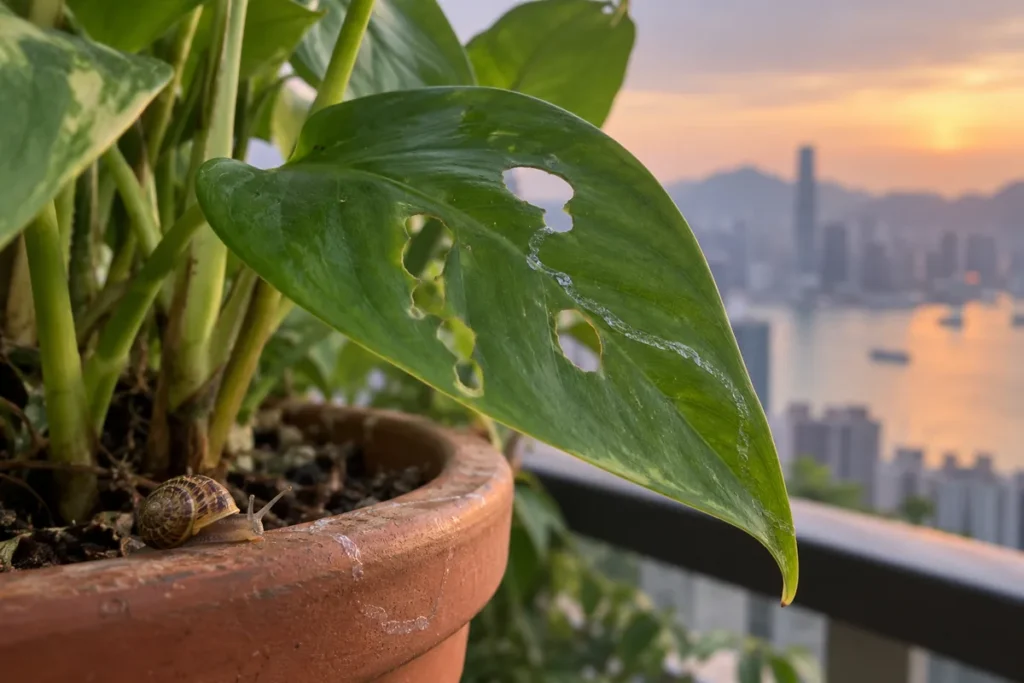
Irregular holes with a silvery trail usually point to snails or slugs feeding at night [1]. Ants rarely harm plants directly, but they can signal honeydew pests or a nest in the pot [4][5]. Start by removing hiding places and damp spots, not by reaching for bait [1][3].
Key points
- Irregular holes plus a silvery slime trail suggest snails or slugs. Check at night or early morning [1].
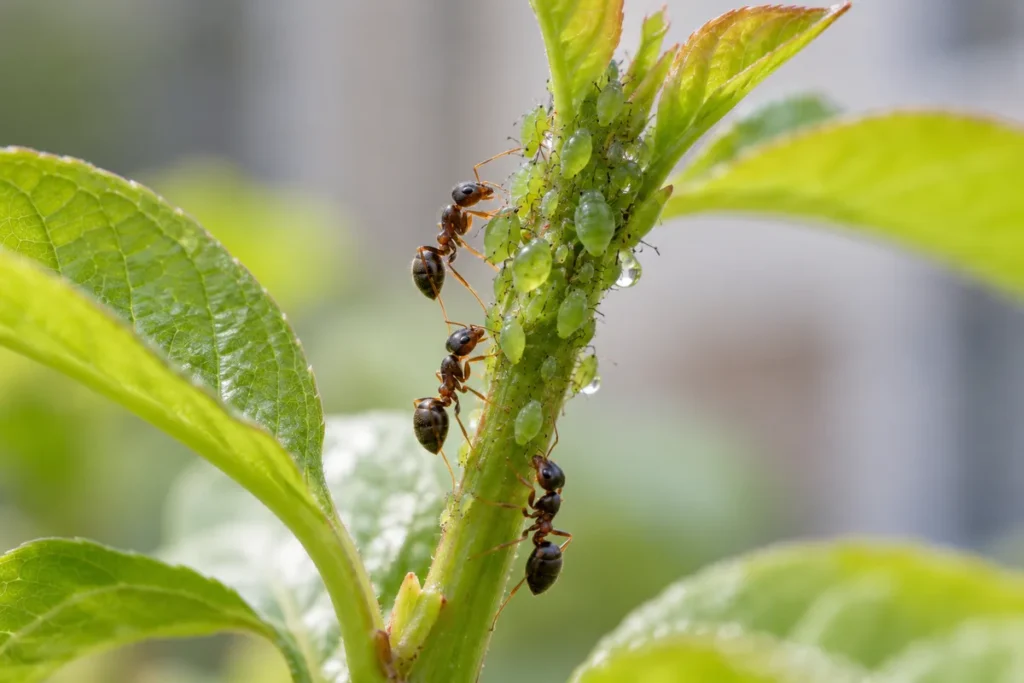
- Ants mostly come for honeydew, so look for aphids, mealybugs, scale insects or whiteflies first [4][5].
- Removing hiding places beats bait. Bait alone does not give lasting control [1][3].
- Hong Kong’s Centre for Food Safety advises against eating wild-caught snails because of a parasite risk [6].
How can you tell snail and slug damage from other pests?
Go out with a torch at night or early in the morning. UC IPM says snails and slugs feed at night and hide by day, and the shiny slime trails they leave are a key clue [1]. RHS says the holes and slime trails are often the only evidence because feeding happens at night [2].
On a phone, swipe sideways to see every column.
| Clue | Possible cause | Next step |
|---|---|---|
| Irregular holes with smooth edges and a silvery trail | Snails or slugs | Check the pot rim and base at night [1] |
| Holes but no slime trail | Possibly caterpillars or other chewing insects | UC IPM says trails help separate them [1]; see holes in leaves |
| Ants climbing stems to tender shoots, sticky leaves | Honeydew pests such as aphids or mealybugs may be nearby | Check leaf undersides and shoots; see sticky leaves [4] |
| Ants going in and out of the drainage hole, loose soil at the rim | An ant nest may be in the pot | Unpot and check; see below [4][5] |
| A couple of ants passing, no holes or trails | Probably foraging only | Watch for a while before acting [4] |
Snails and slugs prefer damp, cool spots. The University of Minnesota says slugs generally do not bother plants in full sun [3], and UC IPM says they are most active on cloudy days [1]. These are US garden sources, so use them as a guide for balcony pots, and expect local species to differ.
Photograph the holes and the trail, and add a night-time photo of the culprit if you can. It helps if you later ask a specialist.
Why are there ants in or around the pot?
Usually they are after sugar, not the plant. UC IPM says ants protect and tend honeydew producers such as aphids, soft scales, whiteflies and mealybugs, which increases their damage [4]. RHS says ants collect honeydew and can protect aphids from predators such as ladybirds [5]. A line of ants up a stem is a cue to check leaf undersides and shoots.
The other possibility is a nest in the pot. RHS says ants do little direct damage but can disturb roots in containers, which can make plants wilt more easily when the roots are dry [5]. UC IPM advises checking potted plants for nests [4]. If you suspect one, unpot and look for ants and eggs in the root ball.
RHS says ants are part of a healthy garden and are best left alone unless a nest is a real nuisance [5], and notes some red ants can sting, usually causing only minor irritation [5]. On a balcony or indoors you may still want to act, as below.
What should you do once you know?
- Remove hiding places first. UC IPM advises removing cool, shady daytime shelter such as boards, stones and flowerpots [1]. The University of Minnesota suggests relocating containers, boards and flat stones [3]. On a balcony, check under pots, saucers and stacked empty pots.
- Hand-pick at night. UC IPM and RHS both list hand-picking in the evening as a practical method [1][2]. Washing your hands afterwards is our own suggestion, not from the sources.
- Cut the damp. UC IPM suggests watering near sunrise to shorten the time surfaces stay wet [1]. The University of Minnesota also advises morning watering at the root zone, not over leaves [3].
- For ants, treat honeydew pests first. Check for aphids, mealybugs, scale insects and whiteflies; see mealybugs and scale insects [4].
- If the nest is in the pot. UC IPM describes taking an infested pot outdoors and submerging it in a soapy insecticidal solution so the soil surface is just covered [4]. Our own caution, not from the source: not every plant may tolerate this, so follow the product label and try one pot first.
Indoor spraying is weak against ants. UC IPM says spraying ants indoors will not prevent more entering and gives only temporary control [4]. For the wider approach, see IPM for houseplants.
If you use any pesticide, choose a product registered in Hong Kong [8] and follow the label exactly. Do not mix your own strengths, and keep pets and children away.
What should you avoid, and what is weakly supported?
- Relying on bait alone. UC IPM says baits will not give long-term control unless you also remove shelter and moisture [1].
- Metaldehyde bait near pets. UC IPM says it can be poisonous to dogs and birds, and describes iron phosphate bait as safer around dogs, children and wildlife [1]. Safer does not mean risk-free, so read the label and ask a vet if unsure.
- Assuming copper always works. The evidence is mixed. The University of Minnesota says copper barriers are most practical for small gardens and containers [3], and RHS notes copper has repelled slugs in some studies, but a recent RHS study in a garden-like setting found no reduction in damage from copper tape and similar barriers [2].
- Diatomaceous earth. The University of Minnesota calls it generally not an effective slug deterrent [3].
- Eating wild snails. The Centre for Food Safety says wild-caught snails carry parasite risk, with overseas cases of Angiostrongylus cantonensis infection that can cause meningitis [6]. Do not eat them.
For coffee grounds, eggshells, salt and similar home remedies, we have not seen university or botanic garden support, so the evidence is weak. RHS also says many barrier ideas lack scientific proof [2].
How do you prevent this on a Hong Kong balcony?
Cut down the shady, damp spots and keep an eye on honeydew pests. Hong Kong Observatory 1991-2020 normals show about 19 rain days in June, about 6 of them with 25 mm or more [7]. In the wet season, pot bases, saucers and wall corners stay damp and give snails and slugs a daytime hide. Those are territory-wide averages, and your balcony’s aspect and airflow may differ.
- Move pots and saucers off wall corners from time to time, and check underneath.
- Do not stack empty pots, boards or tiles in a corner; they are hiding places [1][3].
- Do not let saucers hold water; it also attracts mosquitoes. See plant saucers and mosquitoes.
- If a plant moves from indoors to the balcony, do it gradually; see balcony transition.
- During humid spells, see Hong Kong humid weather care.
When should you ask a specialist or accept the loss?
Ask for help if seedlings are eaten to the ground, large areas of leaf are stripped, or several pots are hit at once. The University of Minnesota says light to moderate slug feeding usually affects looks rather than plant health, and severe feeding can injure plants, especially seedlings [3]. Established plants usually cope, but seedlings need protection quickly.
If ants are nesting in a large pot and the plant keeps wilting, and you cannot unpot it, photograph it and ask a horticulturist. Before using any product, remember that only registered pesticides may be distributed and used in Hong Kong [8].
Frequently asked questions
Where do snails and slugs go in the day?
UC IPM says they hide in cool, shady places such as boards, stones and flowerpots [1]. Check at night or early morning, and look under pots and saucers.
Can I use a beer trap?
UC IPM, the University of Minnesota and RHS all describe beer or fermented-liquid traps, which need checking and emptying daily or regularly [1][2][3]. They are a management aid, not a sure cure, and on a balcony take care that they do not attract other pests.
Do I need to remove ants completely?
Not necessarily. RHS says ants do little direct damage and are best left alone unless a nest is a nuisance [5]. If they are protecting aphids or mealybugs, treat those pests [4].
What if my pet reaches slug bait?
UC IPM says metaldehyde bait can be poisonous to dogs and birds [1]. If you suspect your pet has eaten any, call a vet straight away and bring the packaging.
Why are there more snails after heavy rain?
UC IPM says snails and slugs are most active on cloudy days [1], and the University of Minnesota says feeding risk is higher in cloudy, rainy weather [3]. Hong Kong has many rain days in June [7], so check pot bases more often in the wet season.
Sources
- University of California IPM (UC IPM): “Snails and Slugs” — Night activity, slime trails, removing shelter, hand-picking, traps, bait limits and pet risks
- Royal Horticultural Society (RHS): “Slugs and snails” — Barrier evidence, hand-picking, traps, learning to live with slugs
- University of Minnesota Extension: “Slugs” — Relocating hiding places such as containers, copper barriers for containers, diatomaceous earth weak
- University of California IPM (UC IPM): “Ants” — Ants protect honeydew producers, check pots for nests, indoor sprays give only temporary control
- Royal Horticultural Society (RHS): “Ants” — Ants do little direct damage, can disturb roots in pots, usually tolerated
- Centre for Food Safety, Hong Kong: “Do Not Consume Wild-caught Snails” — Wild snails may carry Angiostrongylus cantonensis and should not be eaten
- Hong Kong Observatory: “Monthly Meteorological Normals for Hong Kong (1991-2020)” — 1991-2020 monthly rain days and heavy-rain days
- Agriculture, Fisheries and Conservation Department (AFCD): “Pesticide Control and Related Information” — Only registered pesticides may be distributed and used in Hong Kong (Pesticides Ordinance, Cap. 133)
Further reading
- Back to Plant Doctor
- Holes in leaves: pests, physical damage or disease?
- Sticky leaves and furniture: tracing the honeydew
- IPM for houseplants
- Helping a Houseplant Settle onto the Balcony
- Plant Saucers and Mosquitoes: A Hong Kong Home Checklist
Sources checked: 31 October 2026. This is general guidance, not an on-site diagnosis. Always follow the product label.
