



Level: Beginner
A houseplant with no new leaves is most often just slowing down in short winter days. If it also stalls in the growing season, fades in colour or dries out fast, check light, roots and feeding in that order.
Key points
- Most houseplants slow down a lot in winter, so a pause in new leaves is common and does not call for extra fertiliser [1][2].
- Firm stems and normal colour suggest a rest; pale leaves, lower-leaf yellowing or very fast-drying soil point elsewhere (our reading, not a formal test).
- Fix light and watering first, then think about repotting, and do not feed for two weeks after repotting [5].
- If most roots are dark and mushy, follow the root rot guide instead.
Is the plant really not growing, or just slower?
First work out how long it has been still. University of Vermont Extension says growth slows considerably in winter, when daylight is shorter and weaker, so you should water less and avoid feeding or repotting [1]. A few weeks without new leaves in winter is therefore a normal pattern, not proof of trouble.
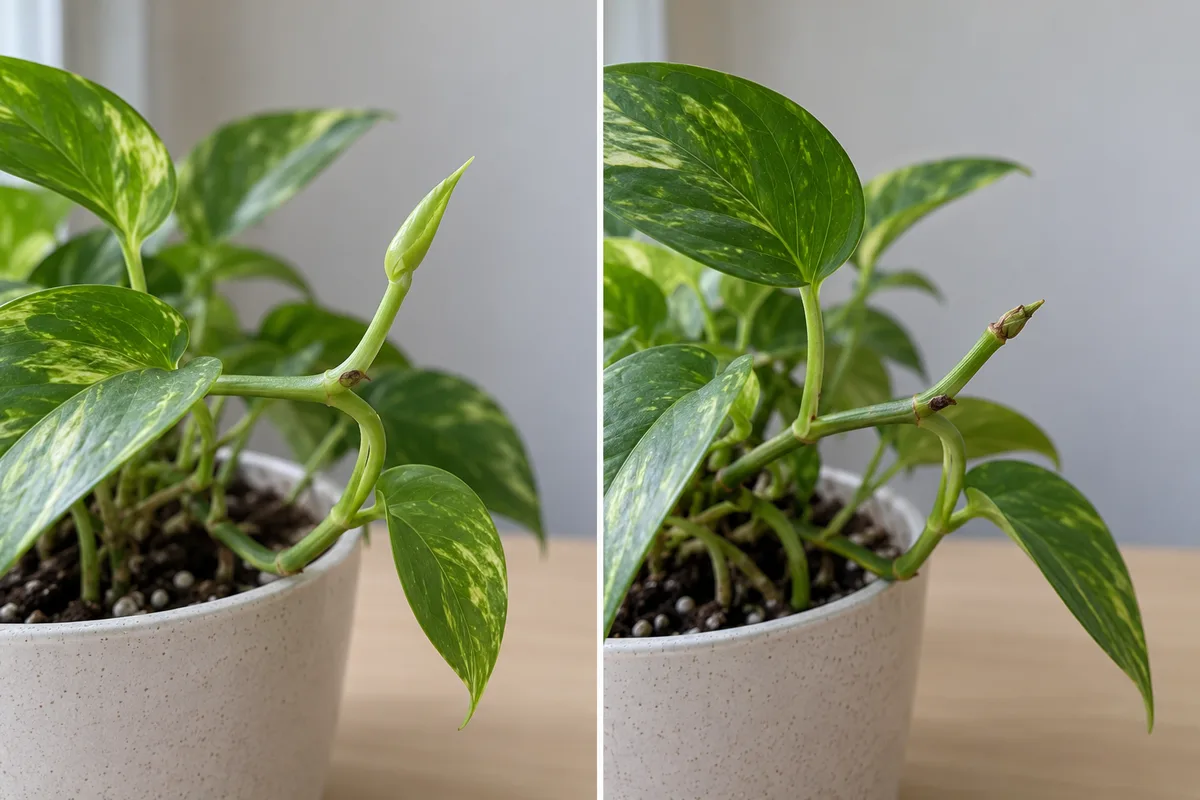
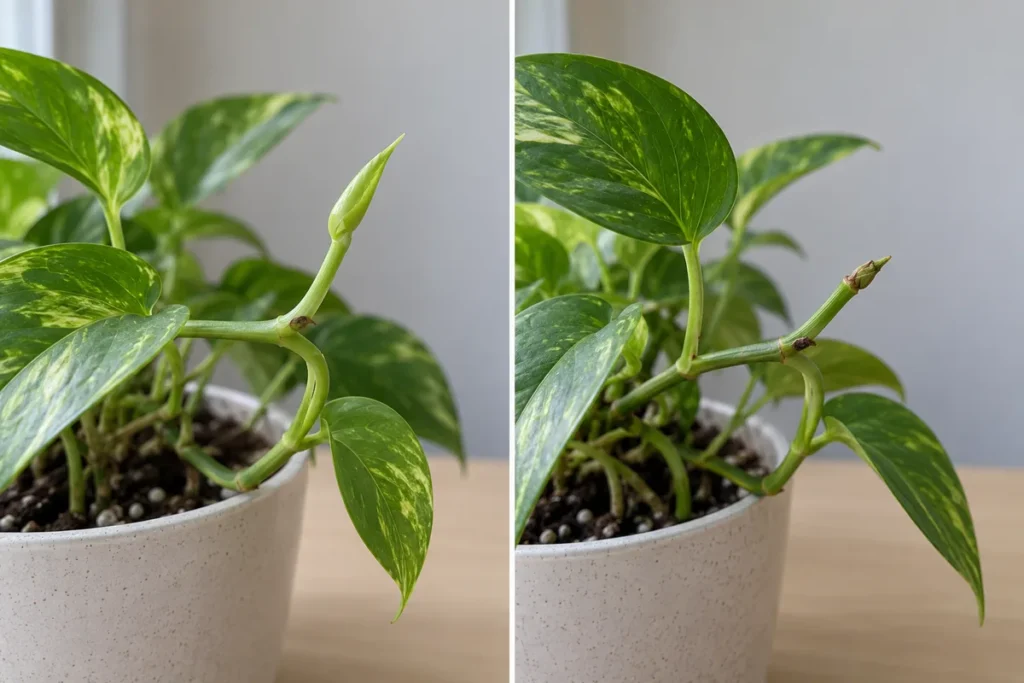
Next, look at the growing tip. Is there a small bud, a sheath or a tightly rolled leaf? If so, the plant is only slow. If nothing moves but leaves stay plump and green, it may simply be resting. Photograph the tip from the same angle every two weeks so you are not relying on memory.
Be careful with dates: much of this advice comes from temperate regions. In Hong Kong the Observatory’s 1991-2020 normals give about 16.5 C in January and 28.9 C in July, with roughly 145.8 hours of bright sunshine in January against 197.3 in July [9]. Winter slows plants here too, but how much depends on your window and how bright the spot really is.
On a phone, swipe sideways to see every column.
| Clue | Likely cause | Next step |
|---|---|---|
| Winter (roughly December to February), normal colour, firm stems | Seasonal slowdown or rest [1] | Do not feed, water less, wait for warmer weather |
| Stalled for months in the growing season, pale leaves, long gaps between leaves | Not enough light [6][8] | Move closer to a window, increasing light gradually |
| Soil dries very fast, roots show at the drainage holes | Root-bound pot [4][5] | Check the roots; go up one pot size if needed |
| Brown leaf tips, white crust on the soil | Fertiliser salts building up [2] | Flush the pot and pause feeding |
| Yellow lower leaves, soil always wet, sour smell | Overwatering damage to roots [7] | Stop watering and inspect the roots |
| Tiny insects on leaf undersides, curled leaves | Pests or other damage [7] | Check with a hand lens and isolate the plant |
Not every plant rests. Some ferns and foliage plants can grow all year, so check the habit of your own species before calling a pause normal.
Is the plant getting enough light?
Weak light is one of the more common causes. Virginia Tech Cooperative Extension explains that light intensity affects food production, stem length and leaf colour; a plant in low light tends to be spindly with pale green leaves, and light falls off quickly as you move away from the source [6]. A spot a few steps from the window can be far darker than the sill.
UF/IFAS Extension notes that a desk by a window may be about ten times brighter than space across the room, and that even midday light in a north window may never reach 400 foot-candles [8]. Clemson puts the preferred range for low-light plants at roughly 75 to 200 foot-candles and for medium-light plants at about 200 to 500 [3]. A phone light-meter app gives a rough idea, but treat the numbers as indicative only.
- Beginner: Move the plant within an arm’s length of the window, and watch for direct sun on the leaves.
- Intermediate: Turn the pot weekly so all sides get light, and wipe dust off the leaves.
- Advanced: Log readings at the window, 1 m and 2 m away across the day, and place plants by their stated needs.
Could a root-bound pot be holding it back?
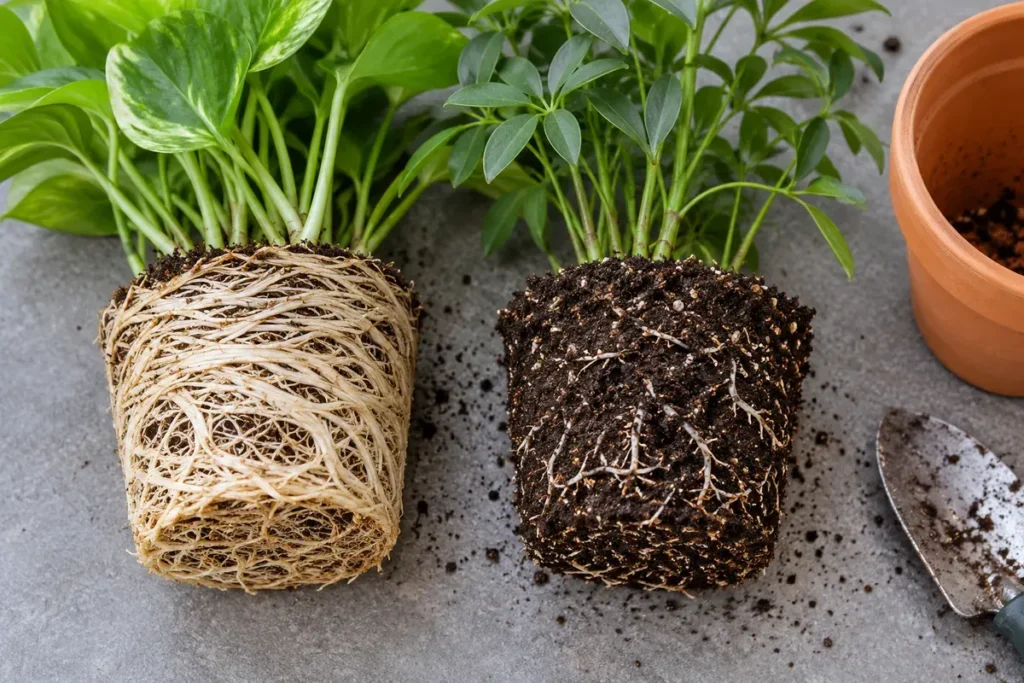
It can, though it is rarely the only cause. University of Minnesota Extension lists roots circling tightly inside the pot, roots pushing out of drainage holes and soil that dries unusually fast [4]. Montana State Extension adds dense tangled roots, a top-heavy plant, more frequent watering and poor growth [5]. Several signs together make the case stronger.
To check, ease the plant out when the soil is moist but not soaking. Are the outer roots wrapped in a pale mat with very little soil left? If so, repotting may help. If the roots are still loose, there is no rush.
On timing, Montana State suggests late winter or early spring, when plants are naturally less active, but says to repot at any time if the plant is clearly stressed [5]. Go up only one pot size [4], roughly a third wider and deeper [5]; an oversized pot keeps extra soil wet for longer.
Some plants prefer snug roots, so circling roots alone are not a reason to repot. Look at the species and at other signs too.
Is it underfed, or overfed?
A resting plant usually needs no feeding. University of Nebraska-Lincoln Extension says some plants make little new growth while resting and need little or no fertiliser, and advises against feeding dormant plants [2]. Clemson also says not to feed a plant that rests in winter [3].
There is an exception: a plant in a bright south or west window, or under a grow light, may keep growing and should be treated as active. With a quick-release soluble product, growing plants are fed about every two months [2]. Fertiliser cannot replace light (this is my inference from the sources), so feeding a plant in dim light mainly builds up salts.
Too much feeding also slows growth. Nebraska lists reduced growth, brown leaf tips, dead root tips and wilting as possible signs of excess salts [2], and the Connecticut Agricultural Experiment Station lists excess fertiliser among the causes of stunted plants, alongside drought and overwatering damage [7]. That overlap is why you should rule things out one by one rather than simply adding fertiliser.
If you suspect salt build-up, flush the pot thoroughly so water runs out of the drainage holes, and empty the saucer. Nebraska suggests leaching every four to six months [2], and dilute soluble fertiliser lowers the risk of burn [3].
What should I do, step by step?
- Record the starting point: photograph the tip and the newest leaf, then again two weeks later.
- Check light: move the plant to a brighter spot, increasing light gradually rather than all at once.
- Check water: push a finger or skewer a few centimetres into the soil; water only when it is dry, and tip out standing water.
- Check roots: if the soil dries very fast or roots escape the base, unpot the plant when the soil is moderately moist.
- Pause feeding: in winter, and for two weeks after repotting [5].
- Wait: it may take several weeks to a couple of months after a change to see new growth, so avoid switching tactics every few days.
As days lengthen, houseplants usually move into active growth, and some put out new leaves within a few weeks of a light prune [4]. Hong Kong has no clear spring line, so let the plant tell you: new buds, quicker-drying soil and deeper leaf colour mean you can ease back to normal care.
What should I avoid?
- Adding fertiliser the moment growth stops: a resting plant does not need it, and salts can injure roots [2][7].
- Heavy winter watering: slower growth means slower water use, so wet soil lingers [1].
- Moving straight into strong sun: change light gradually [6]; a sudden jump is more likely to stress the leaves (my inference).
- Repotting into a much larger pot in winter: extra wet soil, and the plant may not be ready to root out [1][5].
- Parking beside an air-conditioner outlet or a heat source: extreme temperatures can stall growth or damage foliage [6].
Popular tricks such as adding vitamins or hydrogen peroxide to wake a plant are, so far as I could see, not supported by university or botanic-garden advice. The evidence is weak, so this guide does not recommend them.
How can I prevent it and set realistic expectations?
Consistency matters most. Virginia Tech says indoor foliage plants generally grow best at about 70 to 80 F by day and 60 to 68 F at night (roughly 21 to 27 C and 16 to 20 C; the conversion is mine), and that extreme heat or cold can stop growth [6]. In Hong Kong, air-conditioning in summer and cold fronts in winter both cause swings, so keep plants away from vents.
- Check the roots once a year, in spring or when the plant becomes active.
- Water less in autumn and winter while keeping the light as good as possible.
- Feed only in active growth, follow the product label, and use dilute soluble fertiliser [3].
- Expect a settling-in period of a few weeks after buying a new plant.
When should I get help, or accept the loss?
If light, water and roots have been corrected and there is still nothing after two to three months in the growing season, and stems are soft or black or leaves drop in numbers, look seriously for root or stem rot. If most roots are dark, mushy and smelly when unpotted, follow the root rot guide.
If you find insects, cottony fluff or sticky residue on leaf undersides, see the houseplant pest management guide and isolate the plant. If you are unsure, take clear photos (see how to photograph a plant problem) and ask a local nursery or horticulturist.
If the stem has gone soft throughout or all the roots have rotted, recovery is less likely. You may be able to save healthy stem pieces as cuttings; see the propagation guide.
Check it step by step with Plant Doctor →
Frequently asked questions
Should I use a grow light on a plant with no winter growth?
If the spot is clearly dim, extra light may help. Clemson puts the preferred range for low-light plants at roughly 75 to 200 foot-candles [3]. If new buds appear afterwards, light was probably one cause, though a winter slowdown is also normal.
How long does a rest last?
The sources only say growth returns as days lengthen in spring [4]; none gives a fixed number of days. In Hong Kong, many plants show change within a few weeks of warmer weather, but species and light matter.
Is no growth normal after repotting?
It can be. Montana State notes some yellowing or leaf drop after repotting is common, and advises no feeding for two weeks and bright indirect light at first [5]. The plant needs time to rebuild its roots.
How can I tell if I am overwatering?
The Connecticut Agricultural Experiment Station lists overwatering among the causes of stunted and wilting plants [7]. Check the soil: if it stays wet for a long time or the base smells sour, stop watering and inspect the roots.
Sources
- University of Vermont Extension: “Houseplant care during winter months” — Shorter winter days slow most houseplants; water less, avoid feeding and repotting (temperate-climate advice)
- University of Nebraska-Lincoln Extension (Lancaster County): “Success With Houseplants – Fertilization” — Resting plants need little or no fertiliser; brightly lit plants may keep growing; excess salts can also slow growth
- Clemson University Home & Garden Information Center: “Indoor Plants – Cleaning, Fertilizing, Containers & Light Requirements” — Light-need classes in foot-candles, no feeding for resting plants, dilute soluble fertiliser lowers burn risk
- University of Minnesota Extension: “Spring houseplant care” — Houseplants return to active growth as days lengthen; signs of a root-bound plant; move up one pot size only
- Montana State University Extension: “Ask Steward: How do I repot a houseplant?” — Signs a plant needs repotting, best timing, new pot size, no feeding for two weeks after repotting
- Virginia Tech Cooperative Extension: “Chapter 12: Indoor Plants (Virginia Gardener Handbook)” — Light intensity affects leaf colour and stem length; light drops fast with distance; extreme temperatures can stop growth; root-bound soil check
- Connecticut Agricultural Experiment Station: “Diagnosis of Common Houseplant Problems” — Common causes of stunted plants: excess fertiliser, drought or overwatering damage; one symptom has several causes
- University of Florida IFAS Extension: “Light for Houseplants” — Window desk space can be ten times brighter than a room’s interior; north windows may never reach 400 foot-candles
- Hong Kong Observatory: “Monthly Meteorological Normals for Hong Kong (1991-2020)” — 1991-2020 monthly mean temperature and total bright sunshine (January 16.5 C, 145.8 h; July 28.9 C, 197.3 h)
Further reading
- Back to Plant Doctor
- Leggy plants: why they stretch and how to fix them
- New leaves getting smaller: light, roots or nutrients?
- Houseplant dormancy explained
- Transplant shock after repotting
- Repotting guide
Sources checked: 31 October 2026. This is general guidance, not an on-site diagnosis. Always follow the product label.
