


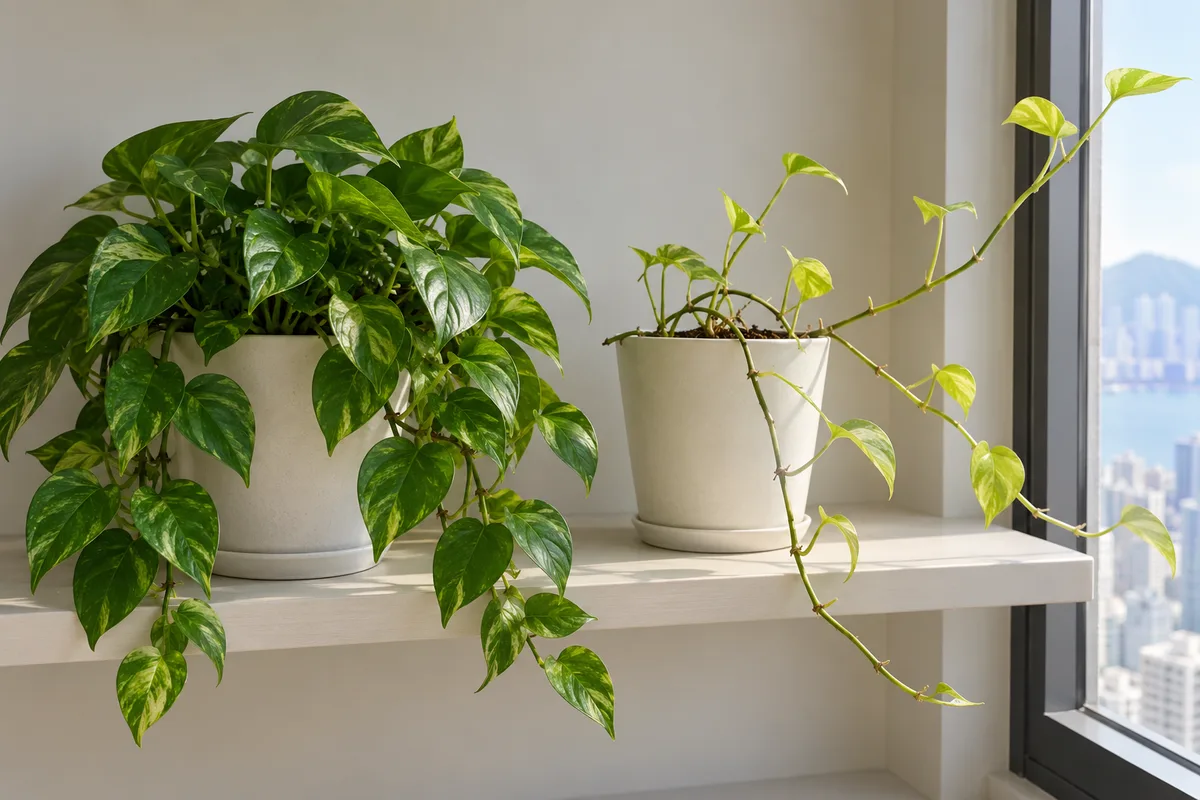

Level: Beginner
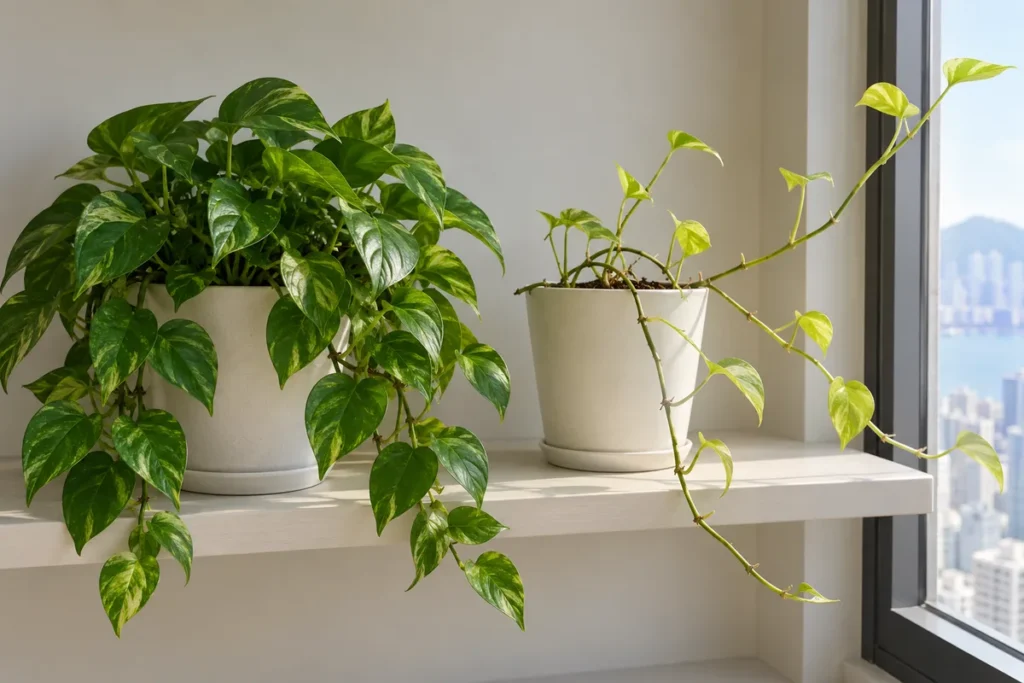
A leggy plant has long stems, wide gaps between leaves and small pale foliage, and low light is the most common cause [1][2][3]. Fix the light first, then prune lightly just above a leaf node in a growing season so buds below can branch [5][6]. Stems that have already stretched will not shorten again.
Key points
- Typical clues: long gaps between nodes, small pale leaves and a lean toward the window [1][2].
- Add light first, then prune; pruning without more light may only give you new stretched shoots (our inference).
- Cut lightly just above a leaf node, ideally in early spring [5][6].
- Not every plant recovers: the thin growth of barrel cacti stays even when light improves [4].
How do I confirm it is legginess and not normal growth?
The key sign is long stems with wide gaps between leaf nodes. The University of Minnesota Extension lists long, thin stems and long spaces between nodes, plus dropped older leaves and variegation reverting to green, among the signs of too little light [1]. The RHS describes weak, pale, spindly growth when light is too low [2].
University of Illinois Extension says a plant that stretches or looks spindly is one indicator of inadequate light, though leaf drop and poor colour can also point to watering problems [3]. So keep other explanations in mind.
On a phone, swipe sideways to see every column.
| Clue | Possible cause | Next step |
|---|---|---|
| Long stems, wide gaps, small pale leaves, leaning toward the window | Too little light | Add light or move closer to the window [1][2] |
| Variegated plant produces plain green shoots | Low light reduces variegation | Add light and trim plain green shoots [1][2] |
| Succulent grows tall, thin, pale new growth | Etiolation from low light | Add light; prune lanky parts if needed [4] |
| New leaves get smaller each time | Light, roots or nutrients | See small new leaves |
| Frequent feeding, soft long shoots | Excess fertiliser can cause weak stretched growth | Cut back feeding and check light [5] |
| No new growth at all | Dormancy or another problem | See no new growth |
Hong Kong note: tower blocks across the road, balcony overhangs and trees outside can all cut the light a window gives. Illinois notes that overhangs and nearby buildings reduce light [3].
Why do plants get leggy, and is light the only cause?
Low light is the main cause. The RHS says plants that do not get enough light cannot make the food they need, and weak, pale, spindly growth follows [2]. The sources we used do not go into the hormone mechanism, so we do not either.
Minnesota says excess fertiliser can cause weak, stretched growth, and that low-light plants need less feeding [5]. Extra feed in dim conditions is therefore unlikely to help.
Minnesota also notes that incandescent bulbs give off a lot of far-red light, which causes stretching [1]. Bear that in mind if you add supplemental light.
How do I add light so it actually helps?
Move the plant closer to a bright window first, then consider a grow light. Illinois explains that north-facing windows give low light, east or west medium, and south bright [3]. The RHS says a north-facing windowsill is usually too dark in winter and suggests south- or west-facing sills then [2]. That advice is from the UK; Hong Kong is also in the northern hemisphere, so the aspect logic should carry over, but actual light levels still need checking by eye or with a light meter.
For grow lights, Minnesota suggests 12 to 24 inches from foliage houseplants for about 12 to 14 hours a day on a timer [1]. Iowa State suggests lights within 12 inches for succulents, 12 to 16 hours a day [4]. Both are university figures, but for different plant types, so adjust for yours.
- Rotate pots regularly so all sides get light [3].
- Light drops in winter, so supplemental lighting may be needed [3].
- Moving a plant suddenly from dim to full sun can scorch some succulents, so make the change gradually [4].
Balconies in Hong Kong get plenty of light, but western summer sun and typhoons are extreme. Move a plant from long-term low indoor light to a balcony gradually, or legginess can turn into sunburn.
Should I prune, when, and how?
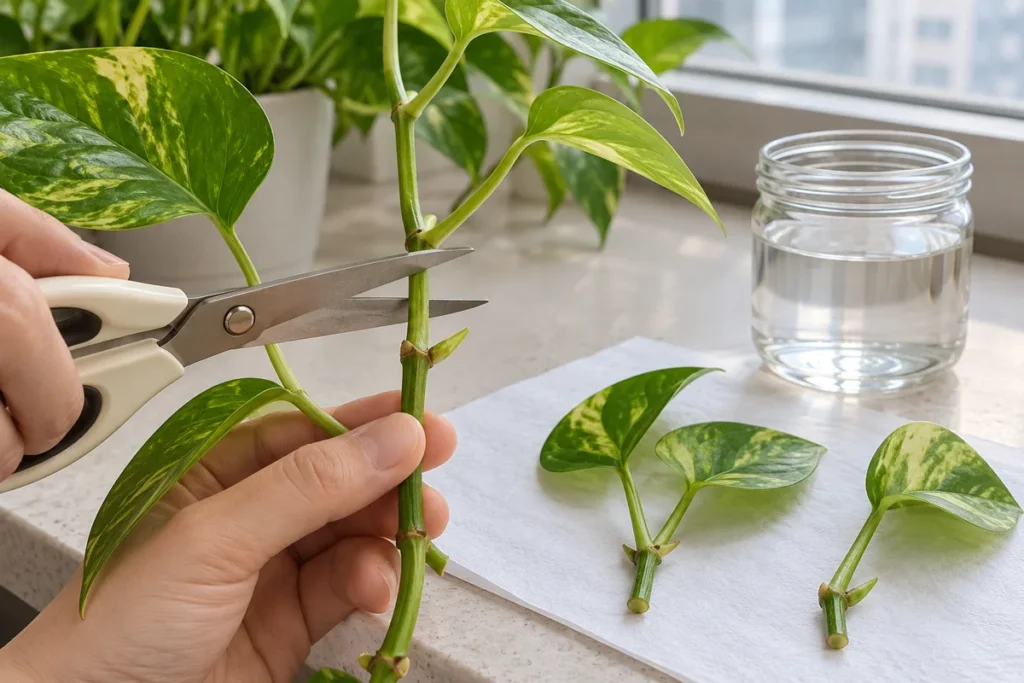
Pruning reshapes a leggy plant, but without more light it treats the symptom only. Minnesota says early spring is ideal for light pruning, trimming leggy stems just above a leaf node to encourage fuller growth [5].
NC State Extension describes pinching as nipping out the tip of a shoot, and says to cut about a quarter inch above a bud, not too close and without leaving a stub, with new growth coming from buds below the cut [6]. That page is about woody landscape plants, so applying it to houseplants is our inference; the principle is similar.
- Improve light for a few weeks first so the plant can produce new buds (our inference).
- Prune in early spring or a growing period with clean, sharp shears [5].
- Cut about a quarter inch above a node, leaving a few leaves [6].
- If the cut piece has a node, try propagating it; see the propagation guide.
- After pruning, keep the light up and avoid heavy feeding or big watering changes.
Which plants will not recover fully?
Iowa State says some succulents recover over time in better light, others need lanky growth pruned so new growth forms under enough light, and many barrel-type cacti keep their misshapen narrow growth even after light improves [4].
So not every leggy plant can be rescued. Stems that have stretched usually stay as they are, and better light mainly changes what grows next (our inference; the sources do not say this for every species).
If a plant is down to bare stems with no leaves or buds, or the stems turn soft and black, it may no longer be simple legginess. Consider stem or root problems and see root rot.
What should I avoid?
- Do not prune without adding light; new shoots will probably stretch again (our inference).
- Do not move a plant suddenly from dim light to strong western sun; Iowa State notes sun scald after such a change on succulents [4].
- Do not feed to compensate for low light; excess fertiliser can add to weak growth [5].
- Do not strip all the leaves; keep some so the plant can recover.
How do I prevent it, and when should I switch plants?
Prevention starts with matching plant to light. Minnesota groups light into low, medium and high: north windows or dim corners suit low-light plants, east or west windows suit medium, south windows suit high-light plants [1].
Rotating pots and adding winter light [3], plus light pruning each early spring [5], help keep growth compact. If a plant keeps stretching after a month or two of better light, or your home simply has little natural light, consider a shade-tolerant species or a grow light.
Check it step by step with Plant Doctor →
Frequently asked questions
Will a leggy stem shorten by itself?
Generally not. Stems that have stretched usually stay as they are, and better light mainly affects new growth (our inference). To make the plant bushier, cut lightly above a node so buds below can branch [5][6].
Is a variegated plant turning plain green related?
It can be. Minnesota and the RHS both list variegated plants reverting to green as a sign of low light [1][2]. Add light first, then trim the plain green shoots.
Can I use ordinary white bulbs as a grow light?
It depends on the bulb. Minnesota says LED and fluorescent are common options, while incandescent is inefficient and its far-red light causes stretching [1].
When is the best time to prune?
Minnesota recommends early spring for light pruning [5]. Our sources do not say how to adjust this for Hong Kong’s warmer climate, so we suggest pruning when the plant is actively putting out new growth (our inference).
What about leggy succulents?
Iowa State says some succulents recover with better light and others need the lanky growth pruned off [4]. Thin growth on barrel cacti stays even with more light [4].
Sources
- University of Minnesota Extension: “Lighting for indoor plants and starting seeds” — Signs of too little light (leggy stems, long gaps between nodes, dropped older leaves, variegation reverting); grow-light distance, hours, incandescent far-red
- Royal Horticultural Society (RHS): “How plants use light to grow” — Signs of low light (weak, pale, spindly growth); variegated plants reverting; windowsill aspect by season
- University of Illinois Extension: “Houseplants and Indoor Lighting” — Stretching or spindly growth as an indicator of low light; window aspect; obstructions; winter supplemental light; rotating plants
- Iowa State University Extension: “Common Problems and Issues of Succulents” — Succulent etiolation in low light, grow lights within 12 inches for 12 to 16 hours, pruning lanky growth, barrel cactus growth not reversing, sun scald after sudden move
- University of Minnesota Extension: “Spring houseplant care” — Early-spring light pruning just above a leaf node; excess fertiliser can cause weak stretched growth; feed low-light plants less
- NC State Extension: “General Pruning Techniques” — Pinching, cutting about a quarter inch above a bud, regrowth from buds below the cut (woody-plant guidance)
Further reading
- Back to Plant Doctor
- Light, PPFD and DLI explained
- Pruning basics
- Propagation guide
- No new growth: dormancy or a problem?
- New leaves getting smaller
Sources checked: 31 October 2026. This is general guidance, not an on-site diagnosis. Always follow the product label.
