



Level: Intermediate
Shrinking new leaves most often point to weak light, a cramped root ball, too little fertiliser or soil that is too dry. The leaf alone cannot name the cause, so compare leaf colour, gaps between leaves and soil moisture, starting with light.
Key points
- The Connecticut Agricultural Experiment Station lists too little light, lack of fertiliser or dry soil for small, pale, spindly new foliage, so causes overlap [7].
- Low-light plants tend to be spindly with pale leaves, and light drops quickly away from a window [6][8].
- A root-bound pot, excess fertiliser salts and overwatering damage can also stunt a plant, so do not simply add feed [2][7].
- After a change, wait several weeks to a couple of months and judge by the next batch of leaves.
How can I confirm the new leaves really are shrinking?
Compare leaves along one stem, oldest to newest. Is each leaf smaller than the last? Are the gaps between leaves (internodes) getting longer? Is the colour fading? All three together suggest the plant is short of resources; one odd small leaf may be a one-off.
The Connecticut Agricultural Experiment Station gives a handy cross-check: small, light green, spindly new foliage is commonly linked to too little light, lack of fertiliser or soil that is too dry. It also stresses that one symptom can have several causes, so you need to do some detective work [7]. This guide therefore ranks the checks rather than telling you to feed or move the plant at once.
Some plants naturally change leaf shape between juvenile and mature stages, or grow smaller leaves when a cutting is settling in. The sources do not cover this, so treat it as my own reminder and compare against what your species normally looks like.
On a phone, swipe sideways to see every column.
| Clue | Likely cause | Next step |
|---|---|---|
| Long gaps between leaves, pale colour, plant far from the window | Not enough light [6][7] | Move nearer a window, increasing light gradually |
| Soil dries very fast, roots at the drainage holes | Root-bound pot [4][5] | Check the roots; go up one pot size if needed |
| No feeding for a long time, pale lower leaves | Lack of fertiliser [7] | Use dilute soluble fertiliser in the growing season, following the label |
| Brown tips, crust on soil, heavy recent feeding | Fertiliser salts [2] | Flush the pot and pause feeding |
| Soil bone dry, limp leaves | Too little water [7] | Water thoroughly, then empty the saucer |
| Curled new leaves, many tiny leaves at the tip, insects on leaf undersides | Aphids, mites, or fume damage [7] | Inspect leaf undersides with a hand lens and isolate the plant |
If the new leaves are small and also twisted or crinkled, read distorted new leaves alongside this guide.
Is weak light the most likely cause?
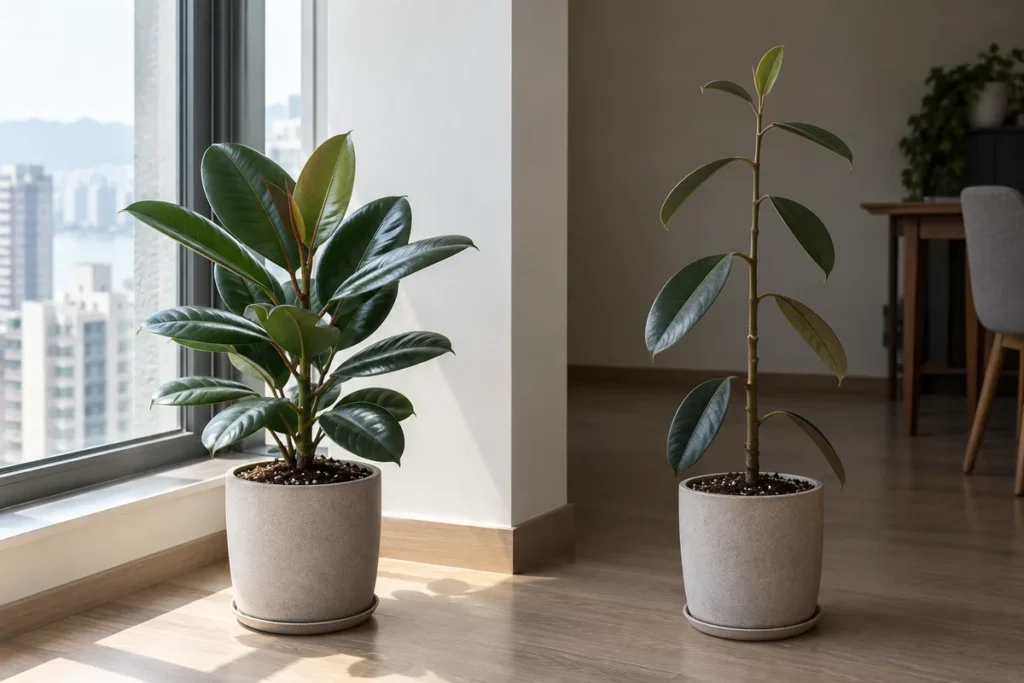
Light is the first thing to check. Virginia Tech Cooperative Extension says light intensity affects food production, stem length and leaf colour: a plant in low light tends to be spindly with light green leaves, while one in very bright light is shorter, better branched and has larger, dark green leaves. Light also falls off rapidly with distance from the source [6].
UF/IFAS Extension notes a desk by a window may be about ten times brighter than space across the room, and that midday light in a north window may never reach 400 foot-candles [8]. Clemson lists low-light plants at roughly 75 to 200 foot-candles and medium-light plants at about 200 to 500 [3]. These are general classes, so check your own species.
In Hong Kong high-rises, neighbouring blocks, glare and half-drawn curtains often cut window light. The Observatory’s 1991-2020 normals show about 145.8 hours of bright sunshine in January and 197.3 in July [9]. It is plausible that leaves formed in winter come out smaller than summer ones, though that is my inference from the light data rather than a conclusion in the sources.
- Beginner: Move the plant within an arm’s length of the window, avoid harsh midday sun, and wipe dust off leaves.
- Intermediate: Rotate the pot weekly and compare new-leaf size at the window and 1 to 2 m away.
- Advanced: Log light readings through the day and match them to the plant’s stated needs.
Can a root-bound pot make new leaves smaller?
It can. University of Minnesota Extension lists roots circling tightly inside the pot, roots through the drainage holes and soil that dries unusually fast [4]. Montana State Extension adds dense tangled roots, a top-heavy plant, more frequent watering and poor growth [5]. One sign alone is weak evidence; look for several.
To check, ease the plant out when the soil is moist, not soaking. A pale mat of roots around the outside with very little soil points to a root-bound plant; loose roots mean no repot is needed. Montana State suggests late winter or early spring, though a stressed plant can be repotted at any time [5].
Go up one pot size only [4], roughly a third wider and deeper [5], and do not feed for two weeks afterwards [5]. See our repotting guide for the full routine.
A pot that is too big keeps extra soil wet, and the plant may take a long time to fill it [4].
Is it underfed, or overfed?
Lack of fertiliser can give small, pale new foliage [7], but excess fertiliser can also stunt a plant; the Connecticut station lists excess fertiliser alongside drought and overwatering damage as causes [7]. University of Nebraska-Lincoln Extension says too many salts can bring reduced growth, brown tips, dead root tips and wilting [2].
So first note whether you feed at all, how often, and whether there is crust on the soil. Clemson advises feeding more often in the growing season, not feeding plants that rest in winter, and using dilute soluble fertiliser to lower burn risk; a balanced 20-20-20 is an example for foliage plants [3]. With a quick-release soluble product, growing plants are fed about every two months [2]. Follow the product label for strength.
Fertiliser cannot make up for poor light (my inference from the sources), so feeding a plant in a dim spot may just build up salts. If you suspect salt build-up, flush the pot so water runs out of the drainage holes and empty the saucer; Nebraska suggests doing this every four to six months [2].
How much do water and temperature matter?
Soil that is too dry is on the Connecticut station’s list of causes [7], and overwatering damage to roots can stunt a plant too [7]. Water thoroughly, empty the saucer, and wait until the soil is dry to a sensible depth rather than watering on a fixed schedule.
On temperature, Virginia Tech says indoor foliage plants generally grow best at 70 to 80 F by day and 60 to 68 F at night (about 21 to 27 C and 16 to 20 C; the conversion is mine), and that extremes can stop growth or cause spindly, damaged plants [6]. In Hong Kong, cold air from an air-conditioner and winter cold fronts both add stress.
Move plants out of direct air-conditioner airflow, which dries leaves and may affect new growth.
What should I do, step by step?
- Set a baseline: photograph the newest three leaves and measure the largest one, then repeat every two weeks.
- Improve light first: move nearer the window or add a grow light, changing gradually [6].
- Check watering: the soil should neither stay bone dry nor stay wet; empty the saucer.
- Check the roots: if the soil dries very fast or roots escape the base, unpot and look.
- Feeding: only in the growing season, dilute and following the label [3]; flush first if there is crust.
- Judge the next batch of leaves: a new leaf takes weeks to unfurl, so wait for the next set.
What should I avoid?
- Heavy feeding as soon as leaves look small: underfeeding is only one possibility, and over-feeding can also stunt a plant [2][7].
- Moving straight into strong direct sun: change light gradually [6].
- Repotting into a much bigger pot in winter: extra wet soil, and roots that may not fill it [1][4].
- Spraying pesticide on a guess: if there really are insects, follow the product label.
Tips online about vitamin B1 or hydrogen peroxide to enlarge leaves are, so far as I could find, not supported by university or botanic-garden advice. The evidence is weak, so this guide does not recommend them.
How do I prevent it and set realistic expectations?
Aim for steady light, steady watering and a yearly root check. University of Vermont Extension says growth slows considerably in winter [1], so slightly smaller winter leaves may be seasonal; it is worth acting only if leaves keep shrinking in the growing season.
- Check the root ball each spring to see if it needs a bigger pot [4].
- Feed only in active growth, diluted [3].
- Allow a few weeks of settling in after buying a new plant.
- Wipe leaves regularly so they capture more light.
When should I get help, or accept the loss?
If light, water, roots and feeding have been put right and leaves keep shrinking after two to three months in the growing season, or stems turn soft or black or leaves drop in numbers, suspect root or stem rot and see our root rot guide.
If new leaves are curled with many tiny leaves at the tip, or you find insects or sticky residue, isolate the plant and read the pest management guide. The Connecticut station notes such symptoms can come from aphids, mites or air pollutants [7]. If you are still unsure, take clear photos and ask a nursery or horticulturist.
Check it step by step with Plant Doctor →
Frequently asked questions
Are smaller winter leaves normal?
They can be. University of Vermont Extension says growth slows considerably in winter [1], and low light makes plants spindly with paler leaves [6]. If new leaves grow back to size as it warms up, the cause was probably seasonal.
Will a grow light make new leaves bigger?
If weak light is the main cause, it may help. Clemson puts low-light plants at roughly 75 to 200 foot-candles [3]. Roots and feeding still matter, and you need to judge by the next batch of leaves.
Do I need to repot to get bigger leaves?
Not as soon as leaves look small. Check first for signs such as circling roots, roots at the drainage holes or soil drying unusually fast [4]. If it is root-bound, go up one pot size [4].
Can fertiliser make the new leaves larger?
Underfeeding can give small, pale new foliage [7], but over-feeding can also stunt a plant [2][7]. Check light and roots first, then use a dilute feed according to the label.
Can the plant recover?
Usually the next batch of leaves improves once conditions are better. Leaves already formed rarely enlarge, so judge by new growth. If the stem or roots are rotting, recovery is harder.
Sources
- University of Vermont Extension: “Houseplant care during winter months” — Shorter winter days slow most houseplants; water less, avoid feeding and repotting (temperate-climate advice)
- University of Nebraska-Lincoln Extension (Lancaster County): “Success With Houseplants – Fertilization” — Resting plants need little or no fertiliser; brightly lit plants may keep growing; excess salts can also slow growth
- Clemson University Home & Garden Information Center: “Indoor Plants – Cleaning, Fertilizing, Containers & Light Requirements” — Light-need classes in foot-candles, no feeding for resting plants, dilute soluble fertiliser lowers burn risk
- University of Minnesota Extension: “Spring houseplant care” — Houseplants return to active growth as days lengthen; signs of a root-bound plant; move up one pot size only
- Montana State University Extension: “Ask Steward: How do I repot a houseplant?” — Signs a plant needs repotting, best timing, new pot size, no feeding for two weeks after repotting
- Virginia Tech Cooperative Extension: “Chapter 12: Indoor Plants (Virginia Gardener Handbook)” — Light intensity affects leaf colour and stem length; light drops fast with distance; extreme temperatures can stop growth; root-bound soil check
- Connecticut Agricultural Experiment Station: “Diagnosis of Common Houseplant Problems” — Common causes of small, light green, spindly new foliage; one symptom has several causes
- University of Florida IFAS Extension: “Light for Houseplants” — Window desk space can be ten times brighter than a room’s interior; north windows may never reach 400 foot-candles
- Hong Kong Observatory: “Monthly Meteorological Normals for Hong Kong (1991-2020)” — 1991-2020 monthly mean temperature and total bright sunshine (January 16.5 C, 145.8 h; July 28.9 C, 197.3 h)
Further reading
- Back to Plant Doctor
- No new growth: dormancy or a problem?
- Leggy plants: why they stretch and how to fix them
- Distorted new leaves: pests, nutrients or chemical damage?
- Repotting guide
- Fertiliser burn
Sources checked: 31 October 2026. This is general guidance, not an on-site diagnosis. Always follow the product label.
