



Level: Intermediate
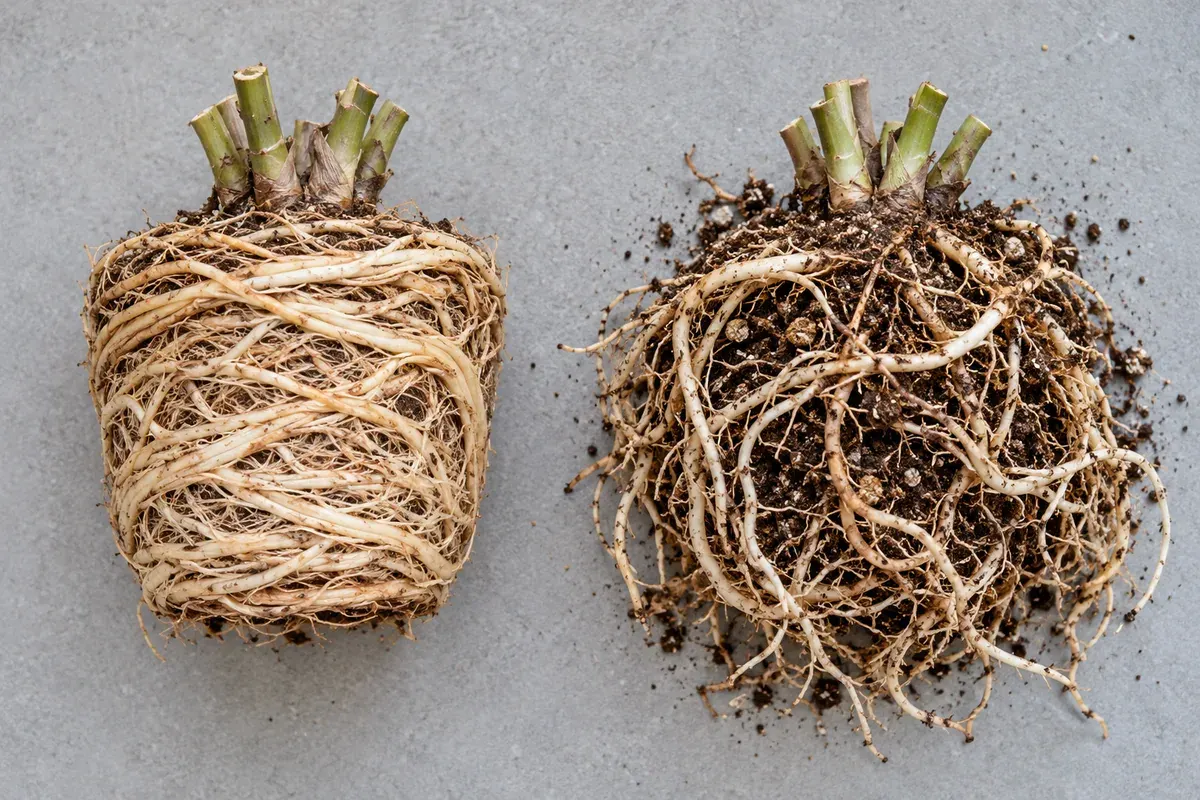
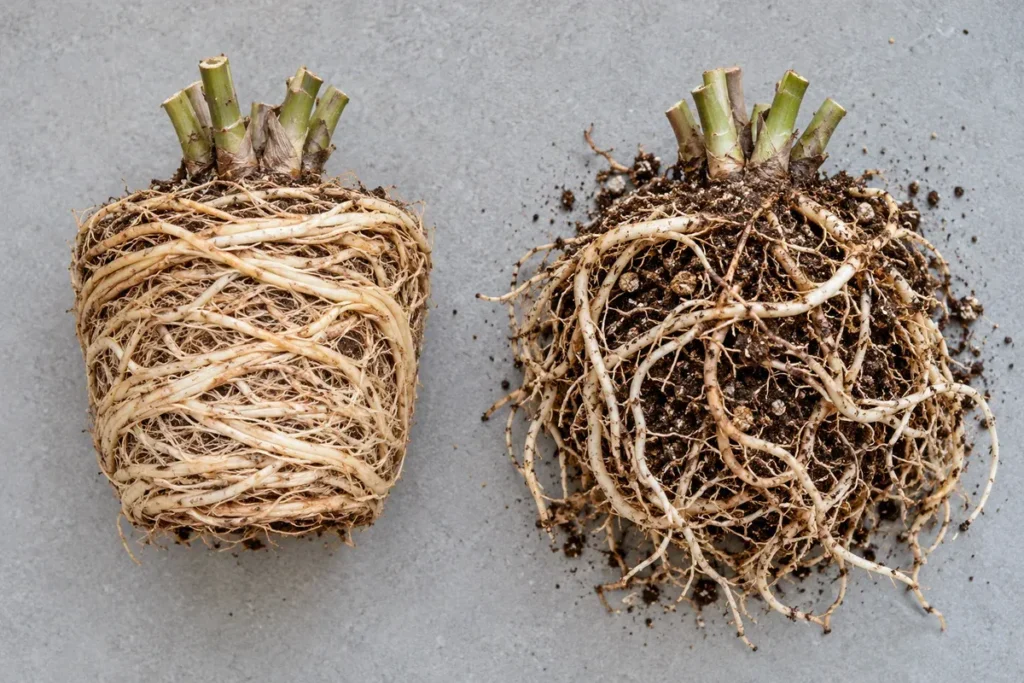
A root-bound plant has filled its pot with roots that circle the inside or push out of the drainage holes, leaving little room for soil. Slide the plant out and look: dense circling roots and very little mix point to a repot, but one sign on its own can mislead [1][5].
Key points
- The most reliable check is to slide the plant out and look for circling roots and how much soil is left [1][4].
- Go up only one pot size: about a third wider and deeper per Montana State, or 2.5–5 cm for smaller pots per the RHS [2][4].
- Some plants tolerate tight roots, so a few roots at the drainage hole is not an emergency [1].
- After repotting, hold off fertiliser and avoid an oversized pot [2][3].
How can you tell a plant is root-bound?
Slide the plant out and look. Clemson describes a pot-bound plant as one that has filled its pot with roots [5]. The RHS notes that roots spiralling at the bottom of a container, or growing out of the holes, can stop water draining properly [4]. Roots at the hole are a hint, not proof.
University of Illinois Extension lists several signs: roots growing through drainage holes, roots on the soil surface, a pot full of roots, smaller new leaves and wilting between normal waterings [1]. That last sign looks like thirst, so check the roots before deciding.
On a phone, swipe sideways to see every column.
| Clue | Possible cause | Next step |
|---|---|---|
| Circling outer roots, little soil left | Commonly root-bound [4][5] | Consider repotting and loosening roots |
| A few roots at the hole, but plenty of soil inside | May be a stray root rather than a full pot [1] | Wait and watch growth |
| Pot dries fast, leaves go limp quickly | Could be root-bound or under-watering [1][5] | Check the roots first |
| Brown-black, soft roots; mix stays wet | Looks more like root rot | See root rot |
| Water rushes down the pot edge | Mix may have shrunk away from the pot | See water runs straight through |
Do not yank the plant. Squeeze the pot sides, or hold the base of the stems and tip it gently. The RHS says dry, shrunken mix often comes out more easily [4].
When is the best time to repot, and what changes in Hong Kong?
Several universities say to repot when the plant is starting to grow. Illinois recommends active growth, usually spring or early summer [1]. Minnesota and the RHS both say spring [3][4]. Montana State suggests late winter to early spring [2]. These are temperate-climate sources, so Hong Kong needs adjusting.
Hong Kong Observatory 1991–2020 normals give a March mean of about 19.5°C, April about 23.0°C and July about 28.9°C [7]. Our own reading, not stated in the sources: late March to May is closest to the spring-growth window, while peak summer heat and the days around a typhoon are poor moments to disturb roots.
The same normals show mean relative humidity of about 82–83% from March to May [7]. High humidity does not mean you should water less, but fresh mix may stay damp longer, so check the soil before each watering after a repot.
How do you repot and loosen the roots?
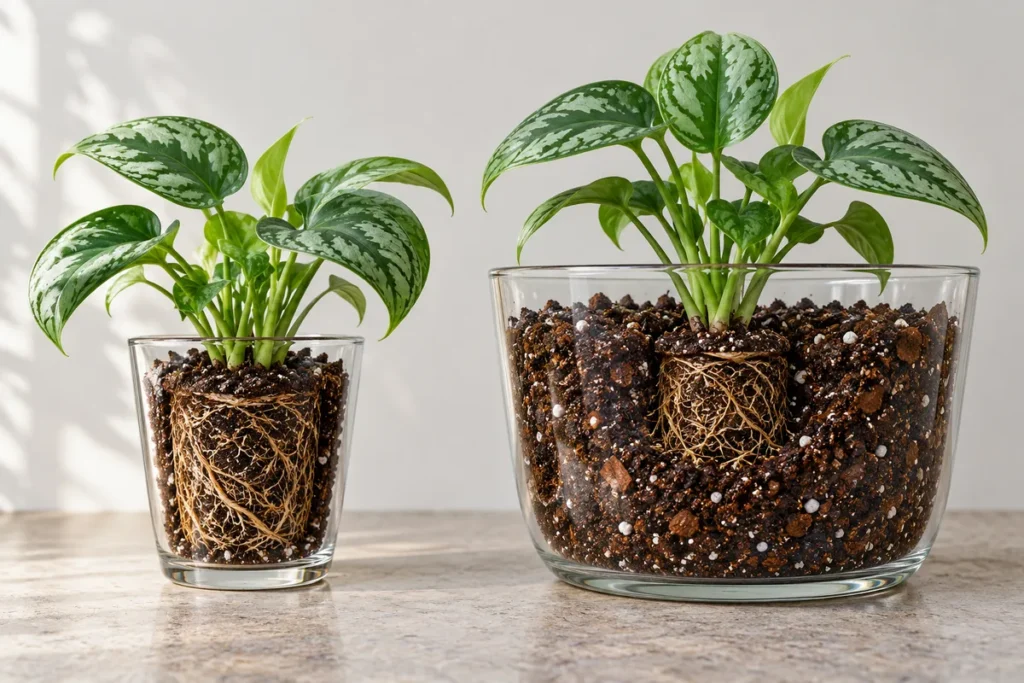
- Pick a pot one size up, with drainage holes [3][6]. Montana State suggests about a third wider and deeper [2]. For pots under 25 cm, the RHS suggests 2.5–5 cm more in width and depth [4].
- Slide the plant out and check the outer roots. Illinois says to cut or unwind circling roots [1]; Montana State says to pull them gently apart [2].
- If the mass is very tight, the RHS says a light trim of up to 15% of the root system every few years can be enough [4]. That is guidance for container plants in general, not for every houseplant.
- Fill with fresh, well-drained potting mix and keep the original planting depth [1][6].
- Water until it runs out of the holes. Montana State advises no fertiliser for at least two weeks so the roots can recover [2].
Beginners can stop at steps 1, 2 and 4. Intermediate growers can handle circling roots. Trimming roots is for confident growers only.
What should you avoid?
- Do not jump several sizes. Minnesota warns that extra soil can hold too much water and cause root problems [3]; Iowa State also says the container should not be too big [6].
- Do not plant straight into a pot without holes. Iowa State recommends a drainage hole and no standing water in saucers [6]. See planters without drainage holes.
- Do not repot at the first sight of a root. Illinois notes that some plants do well pot-bound and others do not [1].
- Do not fertilise straight away. Montana State suggests waiting at least two weeks [2].
- Do not hack away most of the root ball. We found no university or botanic garden support for heavy root cutting here. The RHS describes a light trim [4].
How do you prevent it and choose the pot and mix?
The RHS says many container plants stay healthy for years in the same pot size if the roots are pruned [4]. So repotting is not an automatic yearly upgrade. Clemson also advises repotting periodically in new potting soil [5].
- Beginner: slide the plant out once each spring. If the roots are not circling, leave it.
- Intermediate: note the last repot date and how fast the pot dries after watering [1].
- Advanced: decide between going up a size, a light root trim, or refreshing the mix in the same pot. Old mix can also compact, which is covered in potting mix science.
If the plant sulks afterwards, see droop and leaf drop after repotting.
When should you get help, or let go?
If most roots are brown-black and soft, treat that first rather than just moving up a size; see root rot. If leaves keep dropping or the stem base turns soft two to three weeks after repotting, take clear photos and your care details to a nursery or a qualified horticulturist.
Large plants, heavy pots and windy balconies carry a risk of injury or toppling, so ask for help. For bigger plants, see the spring repotting guide.
Check it step by step with Plant Doctor →
Frequently asked questions
Roots are poking out of the holes. Must I repot?
Not necessarily. Illinois lists roots through the drainage holes as one sign [1], but also says some plants cope with being pot-bound [1]. Slide the plant out and check the outer roots and how much soil remains.
How much bigger should the new pot be?
One size is the safer choice. Minnesota says one size larger [3]. Montana State suggests about a third wider and deeper [2]. The RHS suggests 2.5–5 cm more for smaller pots [4].
How much root can I remove?
The RHS describes removing up to 15% of the root system every few years as sufficient [4]. That is for container plants generally, so treat it as a ceiling, not a target.
When can I fertilise after repotting?
Montana State advises waiting at least two weeks so the roots can regenerate [2]. Use that time to watch watering and light.
Why is an oversized pot a problem?
Minnesota says extra soil can hold too much water and cause root problems [3], and Iowa State also advises against a pot that is too big [6].
Sources
- University of Illinois Extension: “Repotting” — Signs of repotting, cutting or unwinding circling roots, timing, some plants tolerate being pot-bound
- Montana State University Extension: “Ask Steward: How do I repot a houseplant?” — Dense tangled roots, new pot size, gently pulling circling roots apart, no fertiliser after repotting
- University of Minnesota Extension: “Spring houseplant care” — Roots circling, going up one pot size, spring timing, oversized pots hold too much water
- Royal Horticultural Society (RHS): “How to repot a plant: Expert Guide” — Roots blocking drainage, 2.5–5 cm pot step, light root trim, spring repotting
- Clemson University Home & Garden Information Center: “Houseplant Diseases & Disorders” — Definition of a pot-bound plant, repotting into a larger pot with fresh soil
- Iowa State University Extension: “Diagnosing houseplant problems related to poor culture” — Container not too big, drainage hole, avoid standing water in saucers, repot with fresh well-drained mix
- Hong Kong Observatory: “Monthly Meteorological Normals for Hong Kong (1991-2020)” — 1991–2020 monthly mean temperature and relative humidity
Further reading
- Back to Plant Doctor
- Root rot: how to read the roots and recover
- How to repot: timing, steps and aftercare
- Droop and leaf drop after repotting
- Why water runs straight through a plant pot
Sources checked: 31 October 2026. This is general guidance, not an on-site diagnosis. Always follow the product label.
