



Level: Beginner
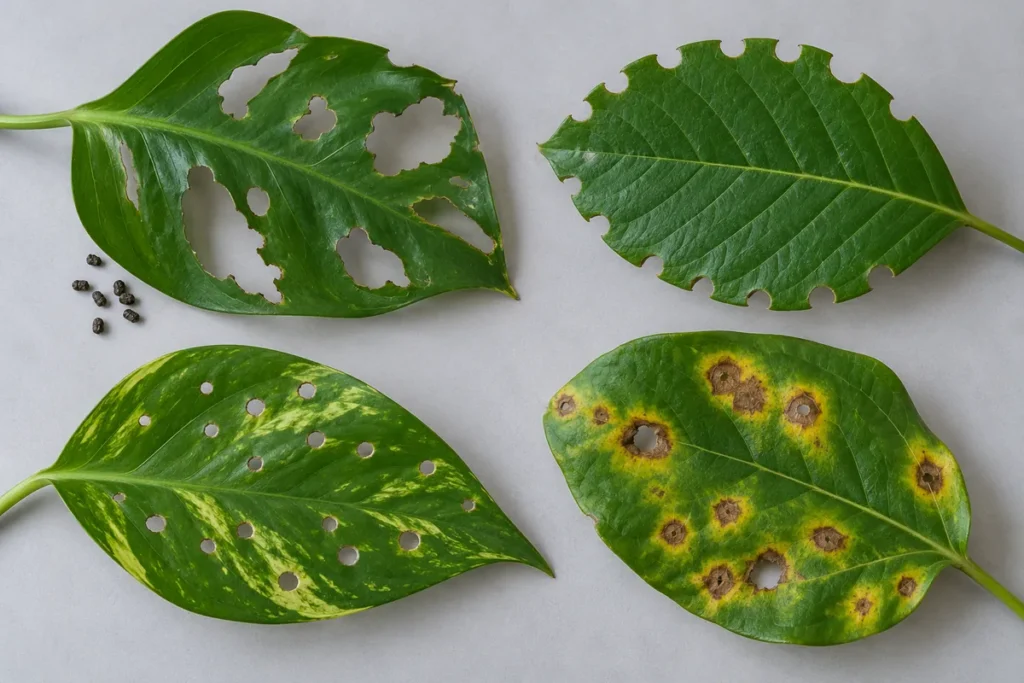
Holes in leaves are most often chewed by something such as a slug, snail or caterpillar, but leaf spots whose centres dry out and drop away can leave similar holes [1][5]. The quickest way to tell is to look at the hole shape, check for slime trails or droppings, and inspect the plant at night with a torch [1][2].
Key points
- Read the hole first: ragged holes with a silvery trail point to slugs or snails [2]; large holes with droppings point to caterpillars or leaf beetles [1][3].
- Holes with yellow rims or brown spots around them may be disease, not a bug [5][6].
- Old holes never close, so check for new ones before deciding whether the problem is still active.
- Follow the product label for any pesticide, and try hand-picking and isolation first for small cases.
How can you tell what made the hole?
Look at the hole, then at what it left beside it. UC IPM’s symptom table lists chewed foliage under beetles, caterpillars, slugs and snails, large droppings under caterpillars and leaf beetles, and slime trails under fungus gnat larvae, slugs and snails [1]. It is a nursery guide, so use it for sorting clues rather than as a diagnosis.
On a phone, swipe sideways to see every column.
| Clue | Possible cause | Next step |
|---|---|---|
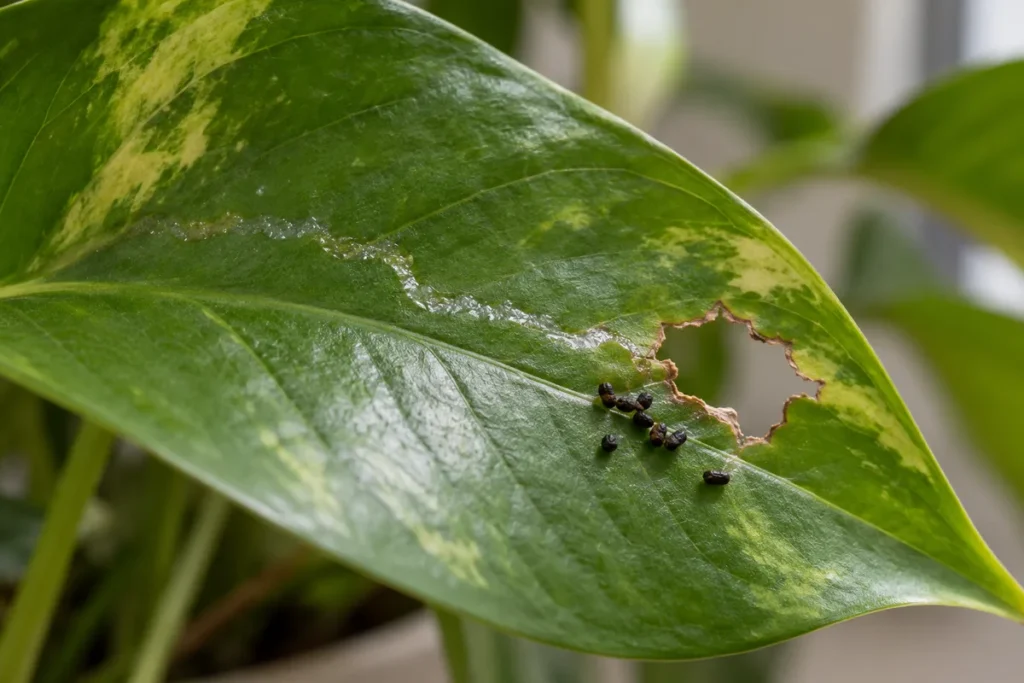
| Ragged, irregular holes with a silvery trail | Slugs or snails commonly leave irregular holes and a silvery trail [2] | Check at night with a torch, around the pot rim, base and saucer [2] |
| Large holes, big veins left, dark pellets nearby | Possibly caterpillars (source is vegetable crops) [3][1] | Check both sides of leaves and pick them off [3] |
| Repeated notches along the leaf edge | Possibly adult vine weevils [4] | Check at night, and look for white C-shaped grubs in the mix [4] |
| Yellow rim or brown spot with the hole where the spot was | Possibly a leaf spot whose centre fell out (tree and shrub sources) [5][6] | Remove affected leaves, improve airflow, keep leaves dry [5] |
| Small holes close to unfurling new leaves | Our own inference: the leaf may have been damaged while still folded; sources do not cover houseplants directly | Read about new leaves that struggle to unfurl |
A simple first step: photograph the top and underside of the leaf, then again two days later. New holes mean something is still active; no new holes usually means old damage.
Which holes come from pests?
Penn State Extension says slugs and snails chew irregular holes and leave a silvery trail; they feed at night and rest in cool, damp places by day [2]. That is why you may see nothing in daylight. The source is about gardens, so balcony pots may be closer to it than a high indoor shelf, and we found no source on how often they reach indoor plants.
University of Minnesota Extension describes small caterpillars making little holes that do not break through the upper surface, and larger ones chewing big ragged holes while leaving the main veins; it also advises checking both sides of leaves [3]. Droppings help: UC IPM links large droppings to caterpillars and leaf beetles, and lists tiny dark specks under a separate group that includes thrips [1].
The RHS says adult vine weevils notch leaf margins, while the grubs eat roots and pot-grown plants suffer most [4]. If notched leaves come with unexplained wilting, unpot the plant and check the roots.
Fungus gnat larvae appear next to slime trails in UC IPM’s table, but they live in the potting mix, and we found no source saying they chew leaf holes [1]. Do not blame gnats for leaf holes without other evidence.
Could the hole be disease or physical damage?
Yes. University of Minnesota Extension notes that the centre of some bacterial leaf spots can dry and fall out, leaving a shot-hole look [5], and UC IPM describes the same for shot hole on Prunus plants [6]. Both are tree sources, so apply them to houseplants with care; the order of events (spot first, hole later) is the useful part.
For physical damage, no source we read covers houseplants directly, so this is our own inference: a leaf that stuck or was squeezed while unfurling, was scraped during a move or was nibbled by a pet can leave holes or tears. Look for spots around the edge and for new holes; damage usually stops spreading.
If you see yellow halos or brown spots, compare with fungal and bacterial leaf spots. If the new leaf itself looks misshapen, see distorted new leaves.
What should you do first?
- Isolate the plant so neighbours are not affected; new arrivals benefit from a separate period too, see quarantine and hygiene.
- At night, use a torch on the leaf tops, undersides, pot rim and saucer for slugs, snails, caterpillars and droppings [2][3].
- Hand-pick what you find into soapy water; Penn State Extension says hand-picking can work for small numbers [2].
- If there are no pests but spots surround the holes, remove affected leaves and keep foliage dry with good airflow [5].
- Check for new holes every two or three days. Old holes do not heal, so do not use chemicals just for looks.
If you do use a pesticide, follow the product label for plants, dose and safety interval, and do not mix your own. Penn State Extension treats slug bait as a last resort [2]. For choices, see pest control products.
What should you avoid?
- Do not spray at the first sight of a hole. Without confirming the cause you may treat the wrong target; UC IPM stresses confirming thrips are present before acting, and the same logic fits here [1].
- Do not salt slugs or snails. Penn State Extension says salt is not recommended because it can injure plants [2].
- Do not prune heavily over old holes; they will not heal and the leaf still works.
- Do not assume every hole is a bug and ignore the roots, especially if the plant also wilts [4].
How can you stop it coming back?
Prevention is mostly about removing hiding places and entry routes. Penn State Extension suggests clearing boards, stones and heavy mulch where slugs shelter, and watering at the base in the morning [2]. In Hong Kong, check saucers, pot bases and damp corners of balcony and windowsill pots, especially after rain.
- Quarantine new plants before placing them with others (our own advice; the sources do not cover it).
- Spend two minutes a week looking at leaf undersides and new growth, so pests are still small [3].
- Avoid leaves staying wet for long and keep air moving to lower the chance of spots [5].
- Clear fallen leaves regularly so pathogens do not linger [5].
Hong Kong tip: after a typhoon or several wet days, check saucers and pot edges of balcony plants for slugs and snails.
When should you get help or give up?
If holes keep appearing, most leaves are affected within weeks, or the plant also wilts, ask a nursery or plant-protection professional to look at the real plant. Vine weevil grubs eat roots and can make plants wilt for no obvious reason, and pots are especially at risk [4].
If only a few leaves are holed and new growth is clean, you can usually keep the plant and just deal with the cause. If disease spots keep spreading after you remove affected leaves, consider replacing the plant so it does not affect others [5].
Frequently asked questions
Why are there holes but no bugs?
Slugs and snails feed at night and hide by day [2]. Check with a torch after dark. It may also be old damage or a spot that fell out, so look for new holes [5].
Do leaf holes heal?
The sources we read do not say that holes fill in. UC IPM says pesticides will not restore injured plant tissue, in its thrips page [1]; treat that as a loose guide for holes. The leaf stays marked until it is removed or drops.
Do fungus gnats chew leaf holes?
UC IPM links slime trails to fungus gnat larvae, slugs and snails [1], but we found no source saying gnats chew leaves. Rule out slugs, snails and caterpillars first.
Is soapy water spray good for leaf holes?
Penn State Extension mentions dropping hand-picked pests into soapy water [2]. We found no source backing a homemade soap spray over the whole plant, so follow product labels.
Could disease cause holes?
Yes. Some bacterial and fungal leaf spots have centres that dry up and fall out [5][6]. Yellow rims and brown spots around the holes point that way; see leaf spots.
Sources
- UC IPM (University of California): “Common Signs and Symptoms on Plants Damaged by Pest Insects, Mites, Slugs, and Snails (Arthropods) and the Probable Causes” — Which pests link to leaf holes, frass and slime trails (nursery setting)
- Penn State Extension: “What is Causing Those Holes in Your Plants?” — Slug and snail holes, silvery trails, night feeding, hand-picking (garden setting)
- University of Minnesota Extension: “Caterpillars on cole crops” — Caterpillar hole patterns, frass, checking both leaf sides (vegetable setting)
- Royal Horticultural Society (RHS): “Vine weevil” — Vine weevil adult leaf-edge notches, root-feeding grubs, pots most vulnerable
- University of Minnesota Extension: “Leaf spot diseases of trees and shrubs” — Bacterial spot centres can fall out leaving holes; sanitation and airflow (tree and shrub setting)
- UC IPM (University of California): “Shot Hole, or Coryneum Blight” — Shot hole starts as small spots whose centres brown and drop out (Prunus setting)
Further reading
- Back to Plant Doctor
- Leaf spots: fungal or bacterial brown and black marks
- Snails, slugs and ants on potted plants
- Quarantine and hygiene for new plants
- New leaves that struggle to unfurl
- Large plant pest and disease control
Sources checked: 31 October 2026. This is general guidance, not an on-site diagnosis. Always follow the product label.
