



Level: Beginner
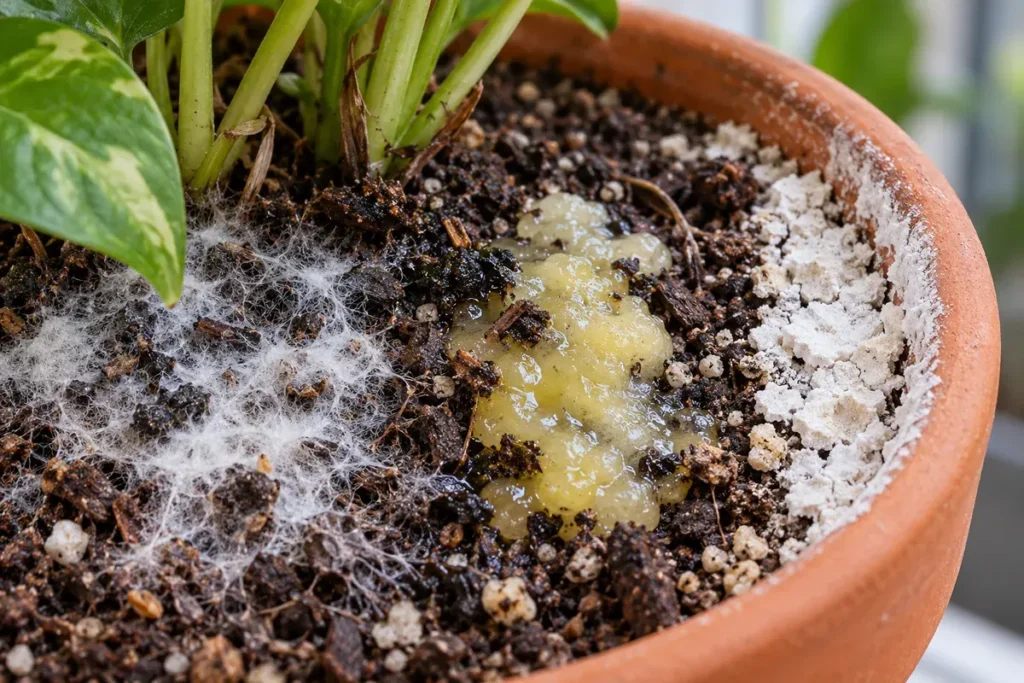
White cotton-like growth on potting mix is usually a saprophytic fungus feeding on dead organic matter. It rarely harms the plant directly, but it often shows that the mix stays wet for too long [1]. Scrape off the top layer, let the surface dry and check drainage and watering gaps.
Key points
- White surface mould is usually a saprophytic fungus, not a plant disease, but it points to mix that stays wet [1].
- Tell the look-alikes apart: white fluff, yellow slime, hard mineral crust and grey mould on leaves each call for a different response [1][2][4].
- Scraping the top layer and drying the mix between waterings has support; cinnamon and hydrogen peroxide have no support from universities or botanic gardens that we could find.
- If the plant also droops, smells or has a soft stem base, treat it as a root problem first [5].
How can I tell it is mould and not something else?
Not every white patch on soil is mould. Look at the texture and where it sits, then prod it gently with a clean toothpick. The table below separates the usual suspects. Appearance is only a guide, so compare with photos when unsure.
On a phone, swipe sideways to see every column.
| Clue | Likely cause | Next step |
|---|---|---|
| Fine white threads or cotton wool, lying on the surface or on bark chips | A saprophytic fungus, common on mix that stays moist [1] | Scrape off the top layer, let the surface dry, improve airflow |
| Yellow or cream slimy or foamy patch that turns powdery when dry | A slime mould, which is not a true fungus and does not attack plants [2] | Remove it or leave it to dry out; check the mix is not too wet |
| Hard, crystalline white crust near the rim or drainage holes | Probably fertiliser or water minerals (our own inference, not mould) | It will not spread like mould; compare with the signs of fertiliser burn |
| Grey powdery coating on leaves or flowers | Grey mould (Botrytis) [4] | Remove the affected parts, lower humidity, improve air movement |
| Small mushrooms in the mix | A different fungal fruiting body | See mushrooms in houseplant compost |
If the specks jump, it is not mould at all. See springtails or fungus gnats.
Does white mould on soil harm the plant?
An Ask Extension expert described this type of saprophytic fungus as common on soil surfaces, especially after overwatering when the mix stays moist. It is unlikely to affect plant health directly, but it can signal a management problem such as poor drainage or frequent watering [1]. The mould is a symptom, not the cause.
Penn State Extension writes about outdoor mulch, where such fungi are not harmful to landscape plants and can be left to decompose [3]. The RHS says slime moulds do not attack plants, and that a jet of water will disperse them if they look unsightly [2]. Both sources describe outdoor settings. Indoors, pots are small and have no rain to rinse them, so the same dampness tends to last longer.
The real concern is the wet conditions behind it. Iowa State Extension notes that root-rot organisms thrive in wet, poorly drained soil and potting mix [5]. Mould plus drooping leaves, a sour smell or a soft stem base should be treated as a possible root problem. See root rot.
If anyone at home has asthma or a mould allergy, or a pet chews the soil, ask a doctor or vet. The sources we read give no safety data for mould on indoor potting mix, so we make no safety promise here.
What are the steps when I find white mould?
The aim is to remove the surface layer and cut the moisture, not to kill the mould. Because the mould is mainly a marker, treating the surface alone often means it returns.
- Push a finger 2-3 cm into the mix. If it still feels wet, do not water (a practical depth; the sources give no figure).
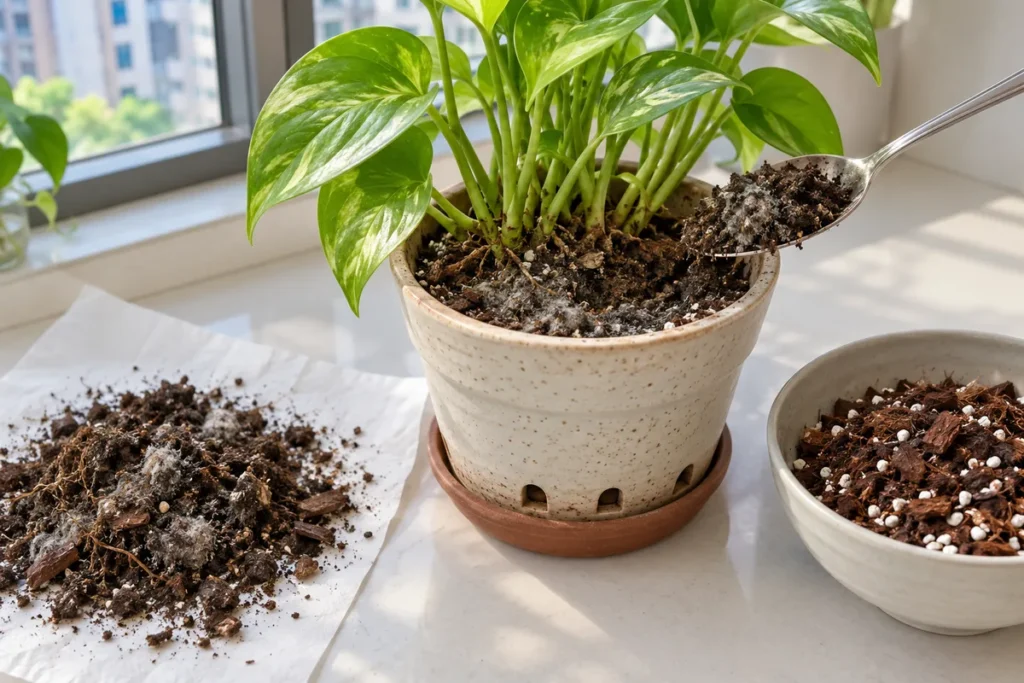
- Scrape off a thin top layer with a clean spoon and seal it in a bag. Avoid vacuuming it (our own suggestion, to avoid spreading it).
- Top up with a little fresh, dry, loose potting mix. If the whole mix has become compacted, consider repotting; see how to repot.
- Check the pot has drainage holes and tip out saucer water after watering.
- Then let the surface dry for longer. The expert advice is to allow more time between waterings [1]; for judging when, see how to water.
- Move the plant to a bright spot with moving air and check again after one to two weeks.
Grey mould on leaves is handled differently. University of Maryland Extension says any measure that lowers humidity, reduces leaf wetness or increases air circulation helps, and at home removing infected parts and drying the environment is usually enough, with fungicides optional [4]. Follow the product label for any fungicide.
What should I not do?
- Water more to wash it away. The mix gets wetter, which feeds the problem.
- Spray hydrogen peroxide, vinegar, cinnamon or home-made mixtures on the soil. We found no university or botanic garden support, so the evidence is weak. Cinnamon is often suggested, but we found no reliable trial.
- Scrape the surface but keep the same watering habit. The mould may well return within weeks [1].
- Cover the plant with a plastic bag to keep it humid. This raises humidity, the opposite of what helps [4].
- Jump to a much bigger pot with lots of fresh mix. A large volume of mix dries slowly; repot when the plant needs it, see how to repot.
Do not rely on a layer of gravel in the pot base alone to stop mould.
How do I prevent mould in Hong Kong’s humid weather?
Hong Kong is humid all year: Hong Kong Observatory 1991-2020 normals give a mean relative humidity of about 78% for the year and 81-83% in each month from March to August [6]. But humid air does not mean every plant needs less water. What matters is how fast the mix dries and whether the air moves.
- During humid spring spells: open windows or run a dehumidifier. Avoid crowding pots into a corner, since still, damp air slows drying (our own inference).
- Air-conditioned rooms: cool air can dry the surface while the base of the pot stays wet. Check with a finger, not by the surface alone.
- Watering: water thoroughly until it drains, tip out saucer water, then wait for the upper mix to dry before watering again [1].
- Mix: use a loose, airy mix and replace old compacted mix.
- Debris: pick up fallen leaves, since they give the fungus something to feed on.
After a typhoon, windows stay shut for long periods and indoor humidity can rise. If the surface stays damp for days, water less and give the plant the airiest spot you have.
When should I repot or ask a specialist?
Scraping the surface is not enough in these cases:
- White mould keeps returning and the mix stays wet for over a week between waterings.
- The plant also droops, yellows, has a soft stem base or smells from the pot. Roots may be affected [5].
- The mould is on stems, leaves or flowers rather than the soil. It may be grey mould or another disease [4].
- Someone at home has an allergy or asthma, or a pet eats the soil. Ask a doctor or vet first.
For root problems see root rot and smelly potting mix. If two to three weeks of these steps change nothing, take photos and your watering notes to a local garden centre or plant clinic.
Frequently asked questions
Does cinnamon get rid of mould on soil?
We found no reliable university or botanic garden evidence that cinnamon treats surface mould on potting mix, so we do not recommend it as a fix. The expert advice we did find is to let the mix dry more between waterings [1].
Can the mould harm people or pets?
Penn State Extension says outdoor mulch fungi have no known health hazards unless eaten [3], but that is an outdoor setting and does not directly cover houseplants. If anyone at home has asthma or allergy, or a pet chews the soil, ask a doctor or vet.
How soon will it come back after I scrape it off?
It depends on whether the mix dries out. If watering and airflow stay the same, mould can return quickly [1]. If it keeps coming back after you improve things, check drainage and the condition of the mix.
What is the yellow slimy stuff?
It may be a slime mould. The RHS says slime moulds do not attack plants and can be dispersed with a jet of water [2]. A mix that is this wet is still worth fixing.
Should I replace all the soil?
Only if mould keeps returning, the mix has compacted, or there are signs of root rot. A one-off patch usually needs only a scrape and some drying time. See how to repot.
Sources
- Ask Extension (US Cooperative Extension Ask an Expert service): “Ask Extension: mold on houseplant soil” — Surface mould is usually a saprophytic fungus, common on constantly moist mix; advice is to let it dry more between waterings
- Royal Horticultural Society (RHS): “Slime Moulds in Gardens” — Slime moulds are not true fungi and do not attack plants; no control needed (garden setting)
- Penn State Extension: “What Is Growing in My Landscape Mulch? Mushrooms, Slime Molds, and Fungus” — Fungi and slime moulds on mulch are mostly harmless and can be left to decompose (outdoor mulch setting)
- University of Maryland Extension: “Gray Mold or Botrytis Blight on Indoor Plants” — Grey mould affects leaves and flowers; favoured by humidity, wet leaves and still air; at home, remove infected parts and lower humidity
- Iowa State University Extension: “Root Rots of Houseplants” — Root-rot organisms favour wet, poorly drained soil and potting mix
- Hong Kong Observatory: “Monthly Meteorological Normals for Hong Kong (1991-2020)” — 1991-2020 monthly mean relative humidity: 78% for the year, 81-83% from March to August
Further reading
- Back to Plant Doctor
- How to repot a houseplant
- Smelly potting mix
- Root rot
- Mushrooms in houseplant compost
- Springtails or fungus gnats?
Sources checked: 31 October 2026. This is general guidance, not an on-site diagnosis. Always follow the product label.
