



Level: Beginner
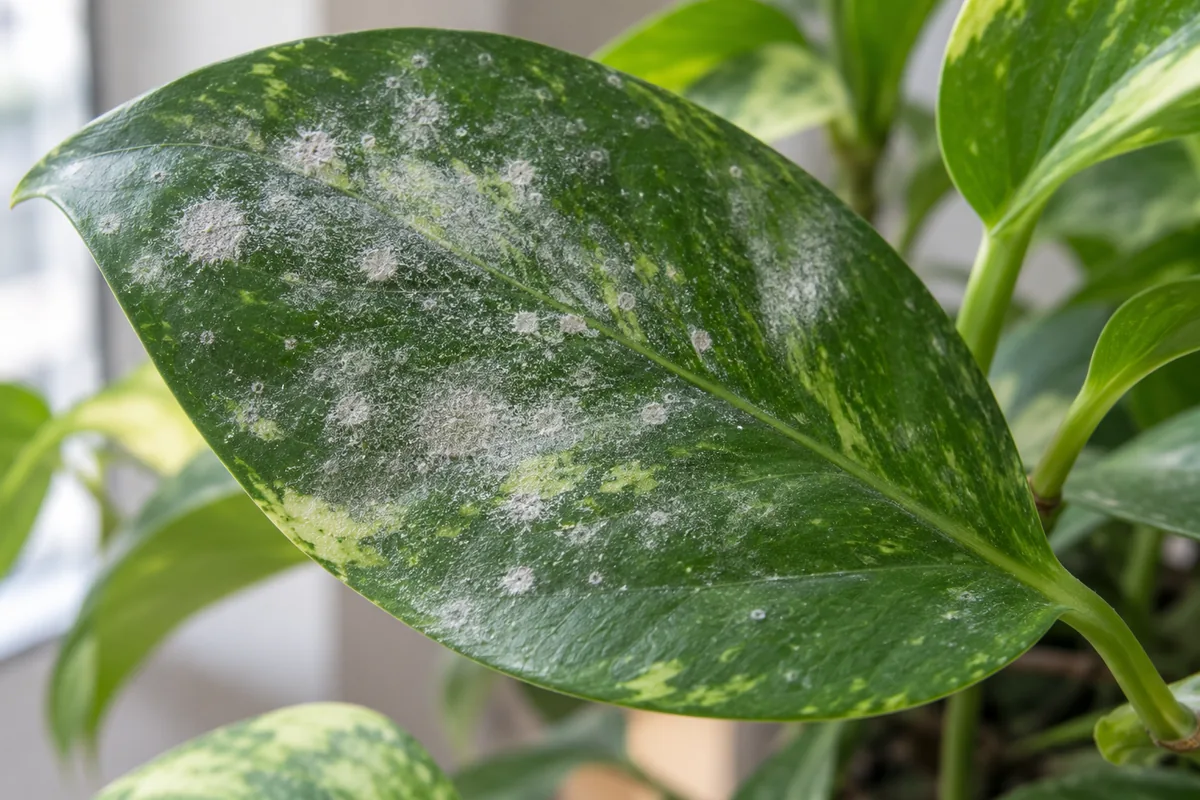
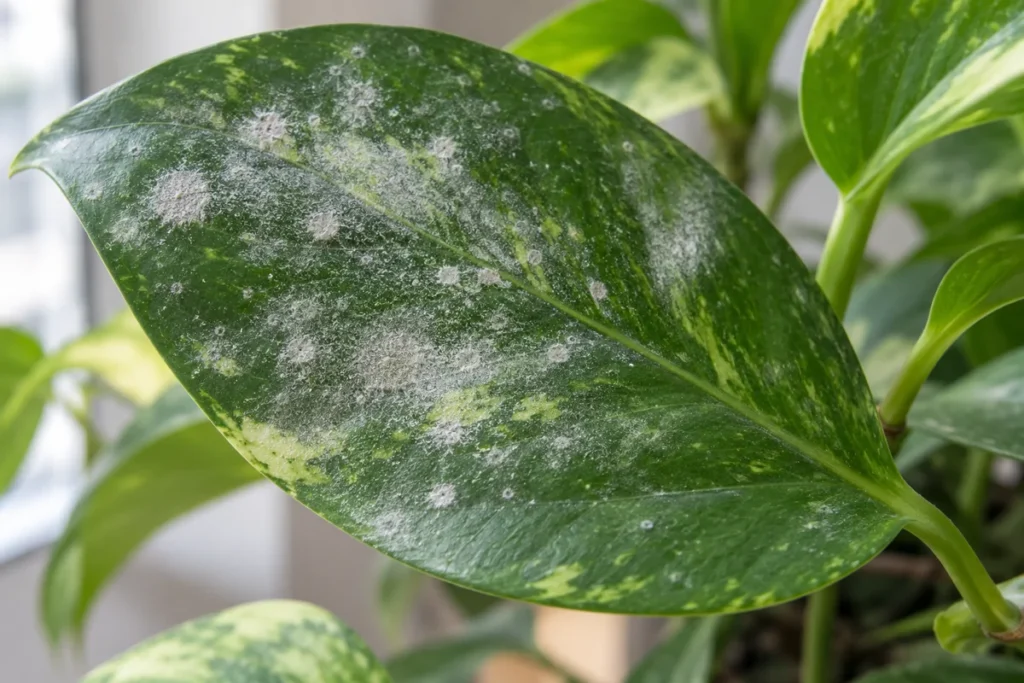
Powdery mildew is a fungal disease. It usually shows as a white powdery coating on leaves or stems, starting as small spots that merge [2]. For indoor plants, University of Maryland Extension advises picking off infected leaves, lowering humidity and improving airflow, and says that should help in most home conditions [2].
Key points
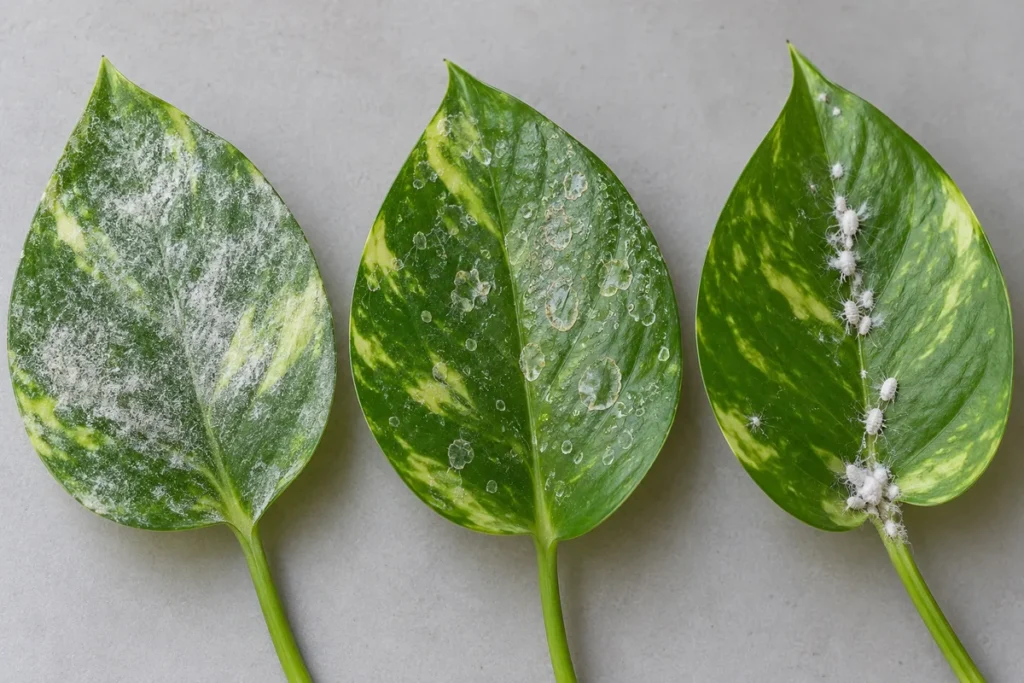
- A white powder that wipes off may be powdery mildew. First rule out mineral marks and mealybugs [2].
- Isolate the plant, remove the worst leaves, then improve airflow and lower humidity [2].
- Baking soda and milk sprays have no university or botanic garden support for indoor plants that we found. The RHS advises against homemade products [4][5].
- For heavy or repeated infection, ask a specialist. Always follow the label of any product [3][4].
How do I confirm it is powdery mildew?
Look for a white, dusty coating on leaves and stems. It often starts as small spots that join up [2]. Penn State Extension says the white growth is usually on the upper surface of lower leaves, and leaves may twist, wilt and die [1]. Our own practical test, not from a source: if the coating wipes off in a dry layer, mildew is more likely.
Some plants hide it. The RHS notes that growth can be sparse and hard to see, and on succulents such as Crassula the infection can scar the leaf with variable white growth [4]. Penn State adds that on kalanchoe the leaves may show dry, corky, scab-like spots with little visible fungus [1]. So do not rely only on white powder.
On a phone, swipe sideways to see every column.
| Clue | Possible cause | Next step |
|---|---|---|
| Dry, flour-like white film that spreads from small spots | Powdery mildew is more likely | Isolate and remove the worst leaves [2] |
| Cottony tufts in leaf joints or on stems, sticky to touch | Possibly mealybugs, not a fungus | See mealybugs |
| Hard, crusty white dots or rings where water dried | Possibly mineral residue | See white spots on leaves |
| Scarring or distortion but very little powder | Some plants show hidden mildew | Check leaf undersides and new growth, then ask a specialist [1][4] |
| Grey fuzzy mould on dying flowers or leaves | Possibly grey mould | See grey mould |
Why does it appear, and what matters in Hong Kong homes?
Penn State lists humid nights, drier days and temperatures of 22-27 C as favourable. Spores travel on air, and new spores can form within 48 hours of germination [1]. Iowa State Extension adds that mildew likes humid but not wet conditions, and is worse in shade with little airflow [3]. Both sources describe greenhouses and gardens, not flats.
Hong Kong Observatory 1991-2020 normals give a yearly mean relative humidity of 78 per cent. March to June average 82-83 per cent, with 86-87 per cent at 0200 and 75-76 per cent at 1400 [7]. Nights are more humid than afternoons, which resembles the pattern Penn State describes. That link is our inference, not a source conclusion.
In a home, risky spots include crowded corners, plants pressed against walls, and rooms where windows stay shut. The RHS says plants near walls meet still, humid air that mildews like, though it writes about garden plants [4]. The RHS also warns that too much nitrogen makes soft growth especially susceptible, and UC IPM advises avoiding excess fertiliser [4][6]. See humid season care for the wider picture.
What should I do first?
University of Maryland Extension suggests picking off and destroying infected leaves, lowering humidity and increasing air circulation, and spacing plants apart [2]. UC IPM says to prune out limited infection as soon as it appears [6]. The order below is our own arrangement of that advice.
- Isolate the plant so spores do not drift to others [1].
- Remove the worst leaves. Bag them and bin them. Do not compost them, as home compost rarely gets hot enough to kill the fungus [3].
- Clean your tools between plants. This is general hygiene; the sources give no strength, so none is stated here.
- Improve airflow. Space plants out and open a window or use a small fan gently [2].
- Water only when needed. See how to water houseplants.
- Re-check new leaves and undersides every few days, because spores can re-form within 48 hours [1].
Do misting, baking soda, milk or fungicides help?
We found no university or botanic garden support for baking soda or milk sprays on indoor plants. A University of Maryland Extension reply, about cucurbit crops, says research shows bicarbonate fungicides are not very effective against powdery mildew and does not recommend a milk and baking soda mix [5]. The RHS advises against homemade products because they are unregulated and usually untested [4]. The evidence is weak, so we give no recipe.
Water is where sources differ. Penn State says liquid water inhibits germination in most powdery mildews, so greenhouses may syringe leaves on dry days, but only if no other leaf disease needs wet leaves [1]. The RHS says mid-morning overhead watering in dry weather can reduce mildew [4]. Yet our leaf spot guide explains that wet leaves favour other diseases. Our inference: in a poorly ventilated flat, routine misting is not worth recommending.
On fungicides, Iowa State says they are mostly protective, not curative [3]. The RHS recommends not using fungicides [4]. Maryland says registered products can be used, but at home removal and airflow should help [2]. UC IPM and an Extension reply mention sulfur, with a warning not to spray in hot weather [5][6]. These come from garden or crop settings, so apply them to indoor pots with great care.
Follow the product label and check it lists your plant. Pesticides in Hong Kong are regulated under the Pesticides Ordinance (Cap. 133) [8]. See choosing pest-control products.
How do I stop it coming back?
Make the setting less welcoming. The RHS recommends avoiding still-air spots, giving plants space and not over-fertilising [4]. Iowa State says good plant vigour helps resistance [3].
- Give plants room so air can move [2].
- Check wall-side and corner spots, which tend to have still air [4].
- Go easy on nitrogen, since soft new growth is more susceptible [4][6]. See fertiliser basics.
- Isolate new plants for a week or two. This is general hygiene; sources give no set period. See quarantine and hygiene.
- Rethink the position of repeat offenders. Iowa State says matching plant to site is the best strategy [3].
When should I ask a specialist or give up on the plant?
If most leaves are coated, new leaves keep twisting, or it returns after you have cleaned up, photograph it and ask a specialist with the plant name. Iowa State’s clinic says it can help confirm the disease, but it serves US samples, so Hong Kong readers should ask a local horticulture professional first [3].
Mildew harm varies. On some deciduous trees it does little damage, especially late in the season [1][3]. A potted plant has few leaves to spare, and the RHS notes that heavy infection can reduce vigour and distort young leaves [4]. If only a few leaves are affected, removal and airflow are usually enough. If the whole plant is badly distorted and other plants are at risk, discarding it is reasonable. That last part is our own judgement.
If you also see soft, smelly or spotted tissue, do not assume it is only mildew. See brown or black spots on leaves.
Check it step by step with Plant Doctor →
Frequently asked questions
Can powdery mildew spread to my other plants?
Spores travel on air, so spread is possible [1]. Iowa State says each plant type usually gets its own mildew fungus, for example the lilac one does not infect roses [3]. Same-species plants close together are at higher risk, but isolating is still sensible.
Can I wash it off with water?
Not reliably. Penn State says liquid water inhibits germination in most powdery mildews, but some are favoured by wet leaves [1]. At home, leaves that stay damp may invite other leaf diseases. We do not recommend it as the main treatment.
Will powdery mildew kill my plant?
It depends on the plant and how bad it is. The RHS notes it can reduce vigour and distort young leaves [4], while Penn State says it does little damage on most deciduous trees [1]. A potted plant has limited leaves, so treat early.
Are baking soda or milk sprays worth trying?
We found no university or botanic garden support for indoor plants. A Maryland Extension reply on cucurbits says bicarbonate products are not very effective and does not recommend a milk mix [5]. The evidence is weak, so we do not advise it.
What do I do with the removed leaves?
Bag and bin them. Iowa State says home compost piles usually do not get hot enough to destroy the fungi [3]. Cleaning your scissors afterwards also helps.
Sources
- Penn State Extension: “Powdery Mildew” — Favouring conditions (humid nights, drier days, 22-27 C), 48-hour spore cycle, liquid water inhibiting germination, greenhouse syringing and its limits
- University of Maryland Extension: “Powdery Mildew on Indoor Plants” — Indoor symptoms, picking off leaves, lowering humidity and improving airflow, environment-first approach at home
- Iowa State University Extension: “Powdery Mildew- Ornamental Plants” — Humid-but-not-wet conditions, shade and still air, fungicides mainly protective, no composting of diseased material (garden ornamentals)
- Royal Horticultural Society (RHS): “Powdery mildews: Symptoms & Control” — Sparse or hidden symptoms, soft growth from excess nitrogen, homemade sprays not recommended, spacing and airflow (garden plants)
- Ask Extension (University of Maryland Home and Garden Information Center reply): “Milk, water, baking soda mixture for powdery mildew” — Bicarbonate products of limited value, sulfur possibly the most effective organic option, avoid spraying in heat (cucurbit context)
- University of California IPM (UC IPM): “Powdery Mildew” — Pruning out limited infection, avoiding excess fertiliser, sulfur only when extensive (home garden context)
- Hong Kong Observatory: “Monthly Meteorological Normals for Hong Kong (1991-2020)” — 1991-2020 monthly mean relative humidity, including 0200 and 1400 hours
- Agriculture, Fisheries and Conservation Department (Hong Kong): “Pesticide Control and Related Information” — Pesticides, including fungicides, are regulated under the Pesticides Ordinance (Cap. 133)
Further reading
- Back to Plant Doctor
- White spots on leaves: mineral marks, mildew or insects
- Brown or black spots on leaves
- Quarantine and hygiene
Sources checked: 31 October 2026. This is general guidance, not an on-site diagnosis. Always follow the product label.
