



Level: Intermediate
Leaf spot disease is a fungal or bacterial infection that causes brown to black spots. Fungal spots are usually roughly round, while bacterial spots are often watery, soft or angular [1][2]. Telling them apart by eye is hard, but home care is similar: remove infected leaves, keep leaves dry and improve airflow [1][2][4].
Key points
- Round tan to black spots lean fungal. Watery, angular or smelly soft spots lean bacterial. Looks alone are not reliable [1][2][4].
- Isolate the plant, remove spotted leaves, water in the morning and give plants room [1].
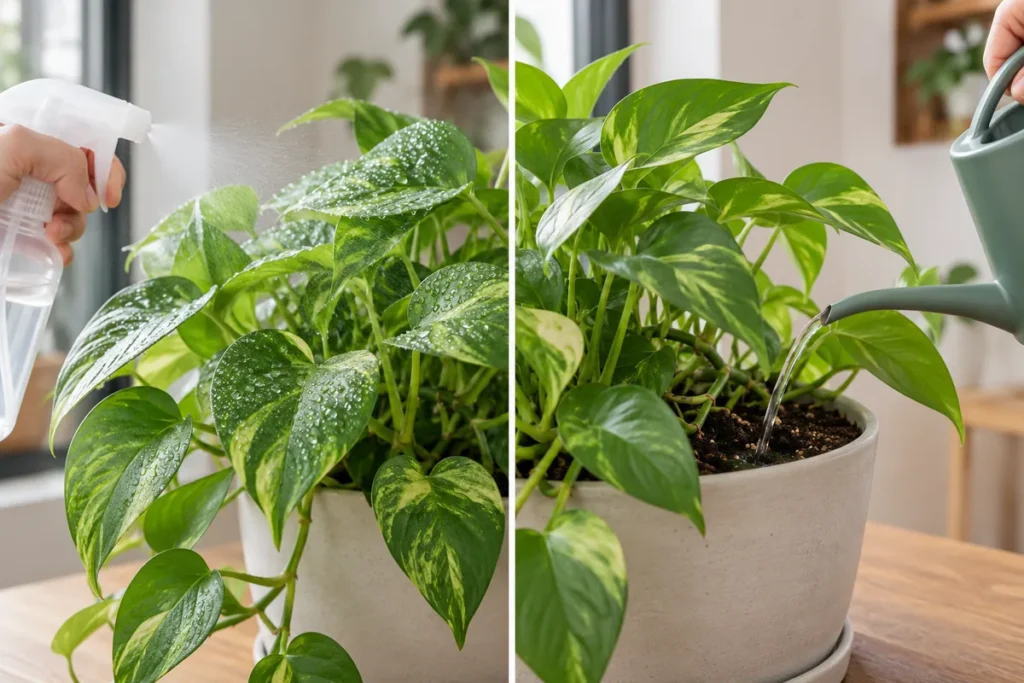
- Misting to raise humidity can keep leaves wet. A Maryland Extension reply suggests a room humidifier instead [4].
- A bacterial disease through the whole plant has no cure, so discarding may be needed. Follow product labels [2][6].
How do I tell fungal, bacterial and non-disease spots apart?
University of Maryland Extension describes fungal leaf spots on houseplants as many tan to reddish-brown to black, roughly round spots. They can run together into large patches, and if they hit the newest leaves the growing point may be killed [1]. Bacterial spots are black to brown and often watery. Collapsed tissue is soft and smells rotten. Spots may be angular or V-shaped between veins, may start at leaf margins, and may have yellow edges [2].
Even so, an Extension reply on a houseplant says spots may look bacterial or fungal but are hard to confirm by eye. It adds that environmental stress, such as lower humidity or salts in old potting mix, can mimic leaf spot [4]. Treat the table as clues, not a diagnosis.
On a phone, swipe sideways to see every column.
| Clue | Possible cause | Next step |
|---|---|---|
| Roughly round tan to black spots that merge | Fungal leaf spot is more likely | Remove leaves, reduce leaf wetness [1] |
| Watery, angular or V-shaped spots with yellow edges | Possibly bacterial leaf spot | Isolate and keep leaves dry [2] |
| Soft, collapsed tissue with a rotten smell | Bacterial more likely; other rot may be present | Isolate quickly; discard if widespread [2] |
| Pale or brown dry patches after a move to brighter light | Possibly sunburn, not infection | See leaf sunburn |
| Dry, crisp marks at tips and edges, no watery look | Possibly dry air or salts | See brown leaf tips and review water and feeding [4] |
| Spots with holes or tiny insects | Possibly pest damage | See holes in leaves |
A hypothetical example: a plant has round spots on old and new leaves and is misted every day. That fits fungal spot with constantly damp leaves, but an on-site check is still needed.
Why does it appear, and what matters in Hong Kong flats?
Both Maryland pages say lowering humidity, reducing leaf wetness and improving airflow cut the chance of infection [1][2]. Missouri Botanical Garden says fungal leaf spots are mostly active in wet periods, and that control starts with watering without wetting above-ground parts [3]. That page covers garden plants, not houseplants.
Hong Kong Observatory 1991-2020 normals show mean relative humidity of 82-83 per cent from March to June [5]. That link to leaf wetness is our inference. The sources do not connect Hong Kong figures to leaf spot.
An Extension reply says misting to raise humidity leaves leaves damp, and damp leaves can be easier for spores to infect. It suggests stopping misting and using a room humidifier, which does not wet leaves [4]. Many people mist during the humid season or in air-conditioned rooms, so this is worth noting. See humidity myths.
What should I do first?
Both Maryland pages advise picking off and destroying spotted leaves [1][2]. The order below is our own arrangement of that advice.
- Isolate the plant and keep infected leaves away from healthy ones.
- Remove spotted leaves. Bag and bin them; do not leave them on the soil or compost them [1].
- Stop misting. Water near the soil. Maryland advises watering early in the day so leaves dry quickly [1].
- Space plants out and improve airflow [1].
- Review your watering. See how to water houseplants.
- Re-check every few days for new spots, especially on the newest growth [1].
Many fungal leaf spots are only cosmetic. Missouri Botanical Garden says most fungal leaf spots cause only cosmetic damage, though that is about garden plants. A houseplant has few leaves, so early action is still worthwhile [3].
Do misting, fungicides and home sprays help?
We found no university or botanic garden support for cinnamon, baking soda, bleach or disinfectant sprays on indoor leaf spot. The evidence is weak, so we do not give recipes. What the sources repeat is less leaf wetness, better airflow and removing infected leaves [1][2][3].
On fungicides, Maryland says registered products labelled for houseplants can be used, but in most homes removing infected parts and drier conditions should help [1]. An Extension reply says few fungicides are labelled for indoor use [4]. Missouri says most garden fungal leaf spots do not need fungicide, and when used, they go on before infection [3].
Follow the product label and check it covers your plant and indoor use. Pesticides in Hong Kong are regulated under the Pesticides Ordinance (Cap. 133) [6]. See choosing pest-control products.
How do I prevent it coming back?
- Water early in the day so leaves dry [1].
- Give plants room so water does not linger between leaves [1].
- Use a humidifier instead of misting to avoid wet leaves [4].
- Isolate new plants for a while. This is general hygiene; sources give no set period. See quarantine and hygiene.
- Keep watering steady. Stress can produce marks that resemble disease [4].
If walls and floors turn damp in humid weather, see humid season care.
When should I ask a specialist or discard the plant?
Maryland says a bacterial disease that has spread through the whole plant cannot be fixed, and such plants should be discarded [2]. For fungal spots on the newest top leaves, the growing point may be killed, and severe infection can cause heavy leaf drop and dieback [1]. If new leaves keep getting infected, the plant turns soft and smelly, or spots return after cleaning, photograph it and ask a specialist. An Extension reply notes that diagnosis from looks alone is hard [4].
If only a few leaves are affected, removal and drier conditions are usually enough. If the whole pot is soft and smelly and other plants are nearby, discarding it protects them. That is our judgement, not a rule from the sources.
Frequently asked questions
Can I just cut off the spotted part of a leaf?
The sources advise removing spotted leaves [1][2]. If the spot is small you may watch it first, but if spots merge or spread, remove the whole leaf. How much to cut is our practical judgement; the sources do not say.
Can leaf spot spread to other plants?
It can. Maryland says reducing leaf wetness and improving airflow lowers the chance of infection, so isolating a spotted plant is sensible [1][2].
Does misting make leaf spot worse?
It may. An Extension reply says misting leaves them damp, which can make infection easier, and suggests a room humidifier [4]. It is one reply, so it may not apply to every plant.
How can I know if it is fungal or bacterial?
By eye, it is hard to be sure [4]. Fungal spots are usually roughly round; bacterial spots are often watery, angular and may rot with a smell [1][2]. For certainty, ask a specialist or send a sample for testing.
Sources
- University of Maryland Extension: “Fungal Leaf Spots on Indoor Plants” — Fungal leaf spot symptoms on houseplants, picking off leaves, lowering humidity and leaf wetness, morning watering, spacing, role of fungicides at home
- University of Maryland Extension: “Bacterial Leaf Spots on Indoor Plants” — Bacterial leaf spot symptoms on houseplants (watery, angular, marginal, soft and smelly), discarding systemically infected plants
- Missouri Botanical Garden: “Fungal spots, blights, and blotches” — Fungal leaf spots mostly cosmetic, cultural measures first, avoid wetting foliage (garden plant context)
- Ask Extension (University of Maryland Home and Garden Information Center reply): “Brown spots on houseplant leaves” — Hard to tell bacterial from fungal by looks, environmental stress can mimic leaf spot, misting wets leaves, few fungicides labelled for indoor use
- Hong Kong Observatory: “Monthly Meteorological Normals for Hong Kong (1991-2020)” — 1991-2020 monthly mean relative humidity
- Agriculture, Fisheries and Conservation Department (Hong Kong): “Pesticide Control and Related Information” — Pesticides, including fungicides, are regulated under the Pesticides Ordinance (Cap. 133)
Further reading
- Back to Plant Doctor
- Brown or black spots on leaves: disease, scorch or water damage
- White spots on leaves: mineral marks, mildew or insects
- Quarantine and hygiene
Sources checked: 31 October 2026. This is general guidance, not an on-site diagnosis. Always follow the product label.
