



Level: Intermediate
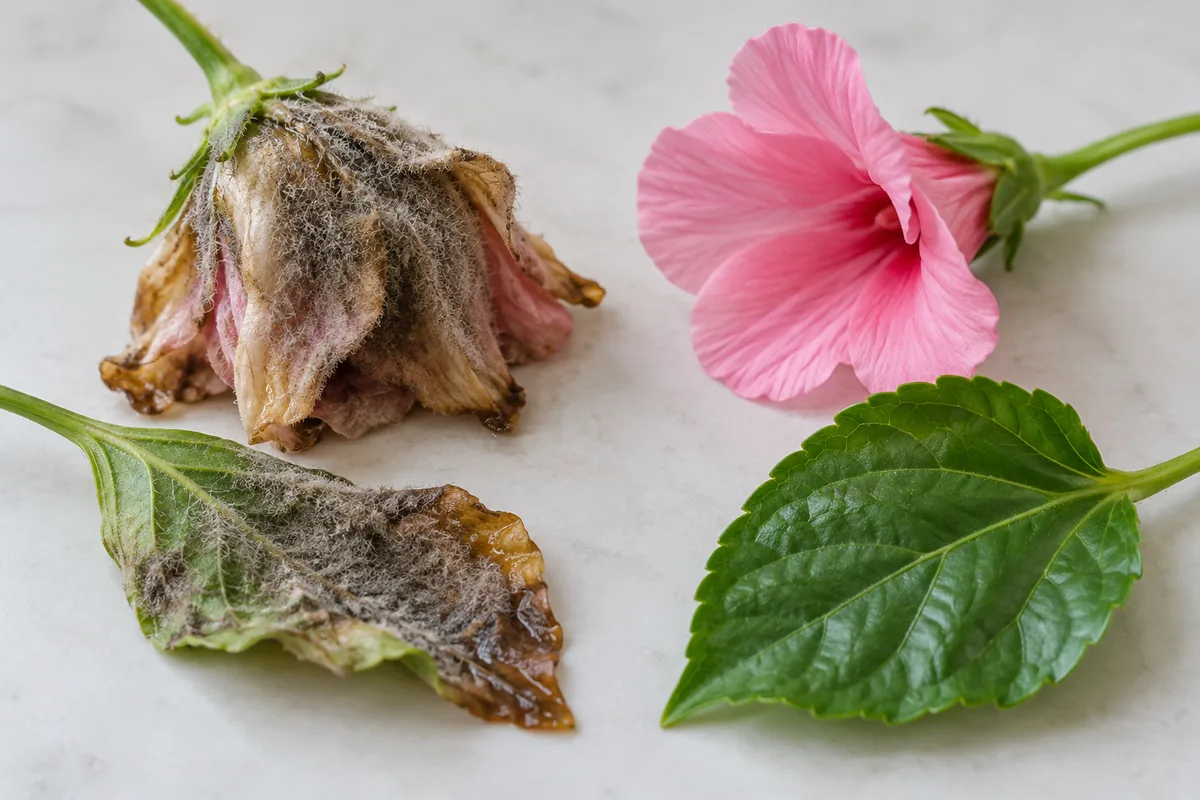
Grey mould is caused by the fungus Botrytis cinerea. It shows as soft, rotting flowers, buds and young leaves covered in fuzzy grey-brown mould, most clearly in humid conditions [2]. The key steps are removing infected tissue, keeping leaves dry and improving airflow, not spraying [1][3].

Key points
- Fuzzy grey-brown mould on flowers, buds or soft dying tissue points to grey mould. Do not brush it off roughly, because disturbed mould can release a cloud of spores [2][3].
- Removing infected tissue, keeping foliage dry and improving airflow are the main steps recommended by university and horticultural sources [1][3][4].
- Fungicides add little at home. The RHS says none are approved for gardeners against grey mould, and UC IPM notes many strains resist some fungicides [1][2].
- Hong Kong’s spring and early summer are humid, but conditions inside your home depend on airflow and dehumidifier use, so outdoor averages are only a guide [5].
How can you tell grey mould from other moulds and diseases?
Look for fuzzy grey-brown mould on soft, rotting tissue. The RHS says that in humid conditions it grows on decaying buds, leaves, flowers or fruit [2]. UC IPM adds that early signs can be tiny, almost see-through spots that turn brown and water-soaked [1].
Infection usually starts at a wound or on stressed tissue, though healthy plants can be hit too when it is humid [2]. Ohio State Extension says dead tissue is an excellent base for spore production, so fallen blooms and leaves on the mix surface matter [4]. Most of these sources describe gardens or greenhouses. Applying them to potted houseplants is a reasonable extension, not something each source tested indoors.
On a phone, swipe sideways to see every column.
| Clue | Possible cause | Next step |
|---|---|---|
| Flowers, buds or young leaves go soft with grey-brown fuzz | Grey mould is likely | Isolate, remove infected tissue, follow the steps below [1][2] |
| White powdery film on leaves that wipes off | Possibly powdery mildew rather than grey mould | See powdery mildew |
| Black sooty layer that scrapes off | Possibly sooty mould, often linked to honeydew | See black sooty mould |
| White mould or small mushrooms on the mix only | Likely harmless surface moulds in the mix | See mould on soil |
| Round brown or black spots, no fuzzy layer | Fungal, bacterial or water-related spots | See brown and black leaf spots |
| Stem base turns soft and black | Stem or root rot, not only grey mould | See soft black stem base |
Hong Kong note: during wet, humid spells walls and glass sweat and plants can stay damp too. Check where the mould is growing: fuzz on flowers and soft leaves is a different problem from white mould on the mix surface.
Why does grey mould love damp, still air?
Its spores need enough moisture to germinate. UC IPM says spores infect only after the plant surface has stayed wet for six hours or more, or relative humidity has stayed above about 90% for six hours or more [1]. Ohio State Extension uses 85% relative humidity as its greenhouse control line and says fuzzy grey mould appears on dead tissue at or above that level [4]. The two figures differ, which shows the sources do not agree on one exact danger point, so treat neither as a fixed rule.
Temperature plays a part. Ohio State gives about 22-25°C as the best range for spore germination [4]. Illinois Extension says infection takes about 20 hours at roughly 20-24°C (68-76°F) with high humidity, and that warm to hot dry weather slows or stops the disease [3].
When does Hong Kong come close? Hong Kong Observatory 1991-2020 normals show monthly mean relative humidity of about 82-83% from March to June, with the 0200 mean reaching 86-87% in those months. April’s mean temperature is about 23.0°C and November’s about 22.2°C [5]. Our own inference, not stated by these sources, is that spring and early summer, plus poorly ventilated corners indoors, are more likely to overlap with these conditions. These are outdoor averages. Air-conditioned rooms and spots beside dehumidifiers can differ a lot, so judge by what you see [5].
What should you do when you see grey mould?
Isolate the plant, remove infected tissue and then fix the conditions. Illinois Extension calls sanitation the main control [3], and UC IPM advises clearing old blooms, declining tissue, fallen leaves and debris [1].
- Move the plant away from others. Spores spread easily through the air to nearby plants [1].
- Bag the affected part as you cut. The RHS advises enclosing affected parts in a bag when removing them [2], and Illinois Extension notes disturbed mould can release spores in clouds [3].
- Cut back to healthy tissue and clear the mix surface. Dead tissue feeds spore production [4], and UC IPM lists old blooms and fallen leaves as common spore sources [1].
- Bin the waste. Tie the bag and put it in the rubbish rather than compost. This is our cautious suggestion; the sources we used do not address home composting.
- Keep leaves from staying wet. UC IPM advises avoiding wetting foliage [1], and Ohio State discourages overhead watering [4]. Water the mix, not the flowers or young leaves.
- Move air. The RHS and UC IPM both advise better ventilation and avoiding crowding [1][2].
Keep watching for one to two weeks to see whether new buds and young leaves stay firm. None of the sources give a recovery timetable for houseplants, so do not expect a quick all-clear.
Do fungicides, peroxide or sun-drying help?
The evidence is weak. The RHS states that no fungicides are approved for use against grey mould by gardeners [2]. Illinois Extension says fungicides are seldom suggested because the fungus often attacks flower petals [3]. UC IPM describes fungicides as mainly preventive and notes many grey mould populations resist certain products [1]. Sanitation and environment come first.
Hydrogen peroxide, baking soda and cinnamon are widely shared online, but we found no university or botanic garden support for them, so we do not teach them here. If you still choose a pesticide product, use only a locally registered one that lists your plant on the label, follow the label exactly and never mix your own strengths. In Hong Kong pesticides are regulated under the Pesticides Ordinance (Cap. 133); check the Agriculture, Fisheries and Conservation Department for details.
Safety: wear a mask and gloves when clearing heavy mould, and ask someone else to do it if anyone at home has asthma or allergies, then speak to a doctor if concerned. This is general caution; the sources we used give no household medical guidance.
What should you avoid when grey mould appears?
- Brushing mould off by hand: disturbed mould can release spores in clouds [3].
- Showering the plant to clean it: wet foliage raises infection risk [1][4].
- Leaving the sick plant among others: spores travel on air currents [1].
- Leaving dead flowers and leaves on the mix: dead tissue is a spore source [4].
- Re-using dirty shears on other plants: wounds are an entry route [2]. Wiping tools with alcohol is sensible, but the grey mould sources give no strength, so we give no number here.
- Misting soft buds to rescue them: there is no evidence misting helps, and it keeps surfaces wet.

How do you prevent grey mould in a Hong Kong home?
Prevention comes down to dry leaves, space between plants and prompt removal of dead tissue. That matches advice from UC IPM, the RHS and Ohio State [1][2][4].
- Leave gaps between plants rather than packing a windowsill leaf to leaf [2][4].
- In humid months keep air moving, for example by opening a window or using a small fan on low [4][5]. Do not point it at tender leaves beside an air-conditioning vent, since cold or dry blasts also harm leaves.
- Water the mix and not the foliage. Morning watering lets leaves dry before night; this is our general reasoning, not a timing given by the sources.
- Clear dead flowers, leaves and debris regularly [1][4].
- Keep new flowering plants apart for one to two weeks; see your first 30 days with a new plant.
If you run a dehumidifier, see plants near dehumidifiers. For long damp spells see humid-season plant care.
When should you get help or let the plant go?
Consider discarding the worst plant if mould spreads fast across many parts, the main stem or stem base has gone soft, or several plants are affected in turn. UC IPM says grey mould can cause blossom blights, bud rots and stem cankers [1], and Ohio State notes that in extreme cases it can kill the plant [4].
If the plant matters to you, photograph the damage clearly and ask a plant disease clinic or a trusted expert rather than escalating treatments yourself. Wash your hands afterwards and clean shears and the work surface.
Letting go is not failure. If the spot stays damp and stuffy, the next plant there may get the same problem.
Frequently asked questions
Can grey mould spread to other plants?
It can. UC IPM says the fungus makes huge numbers of spores that spread easily in air to nearby plants [1]. Isolate the plant and bag the affected part as you cut it [2].
How do I tell grey mould from powdery mildew?
Grey mould is fuzzy and grey-brown, usually on soft, dying or damaged tissue [2]. Powdery mildew is a white powdery film on leaf surfaces; see powdery mildew. If unsure, take clear photos and ask for a second opinion.
Is grey mould a problem all year?
UC IPM says it can be a problem almost any time of year in greenhouses or coastal areas [1]. Indoors in Hong Kong it may appear in any season depending on humidity and airflow, but the sources we read give no local seasonal data.
Should I replace the mix after removing infected parts?
The sources do not cover houseplant mix specifically. Clearing fallen debris from the surface is sensible [4]. If you suspect rot at the roots or stem base too, see root rot.
Why do some buds turn grey and mushy before opening?
Grey mould often attacks flowers and buds [2][3]. Damaged or overly damp buds can be easier targets [2]. If buds simply fall, see bud drop.
Sources
- University of California IPM (UC IPM): “Botrytis Blight, or Gray Mold” — Wetness needed for infection, spore spread, removing dead tissue, air circulation, keeping foliage dry, fungicide resistance (landscape and greenhouse context)
- Royal Horticultural Society (RHS): “Grey mould: Symptoms, Causes & Control | RHS Advice” — Symptoms, wounds and stress, humid conditions, ventilation, bagging affected parts, no fungicides approved for gardeners
- University of Illinois Extension: “Gray Mold (Botrytis) | Plant Problems | Illinois Extension | Illinois” — Sanitation as main control, spores released when disturbed, faster infection at about 20-24 C with high humidity, fungicides seldom suggested
- Ohio State University Extension: “Botrytis Gray Mold in Greenhouse Floral Crops” — Dead tissue feeds sporulation, 85 percent humidity threshold, optimum spore germination temperature, avoiding overhead watering (greenhouse floral crops)
- Hong Kong Observatory: “Monthly Meteorological Normals for Hong Kong (1991-2020)” — 1991-2020 monthly mean relative humidity (daily and 0200 hours) and mean temperature
Further reading
- Back to Plant Doctor
- Powdery mildew: how to spot and treat it
- Brown and black leaf spots: disease, sunburn or water marks?
- White mould on potting mix: should you clean it?
- Plant care in Hong Kong’s humid season
- Can you keep plants near a dehumidifier?
Sources checked: 31 October 2026. This is general guidance, not an on-site diagnosis. Always follow the product label.
